Comments
  Print
Print  Mail
Mail  Large Medium Small
|
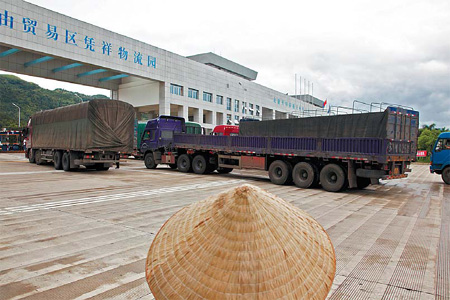
Trucks wait to gain access to a China-ASEAN Free Trade Zone logistics center near the city of Pingxiang, Guangxi Zhuang autonomous region. China has expanded yuan settlement initiatives from border zones to its largest financial centers, including Shanghai, Guangzhou and Hong Kong. The program will then roll out across Malaysia, Indonesia, Brazil and Russia - all nations that are seeking to reduce the dollar's role as the linchpin of world finance and trade since 1945. Bloomberg News |
China's yuan is expected to play a bigger role in regional trade with the China-ASEAN Free Trade Area (CAFTA) becoming effective on Jan 1, 2010.
"The upcoming CAFTA, which boasts the largest population among all the world's FTAs (free trade areas) and allows zero tariff on 90 percent of products traded between China and ASEAN (Association of Southeast Asian Nations), will quicken the process of renminbi regionalization," said Xu Ningning, executive secretary general of the China-ASEAN Business Council.
Free trade demands a free flow of currency, making possible the regional use of renminbi, he said.
Alongkorn Ponlaboot, Thailand's deputy minister of commerce, said he believes the renminbi will play a more important role in bilateral trade between China and ASEAN in the future.
The messages of Xu and Ponlaboot came from the annual China-ASEAN Expo in Guangxi Zhuang autonomous region late last month.
Ponlaboot said the yuan was a very stable currency and expanding its use could help reduce risks faced by the ASEAN countries in using the US dollar, which has become highly volatile as a result of the global financial crisis.
Pung Kheav Se, general manager of Canadia Bank Plc of Cambodia, echoed Thailand's deputy minister, saying trade between China and ASEAN was growing and the use of renminbi would benefit both sides.
Data from China's General Administration of Customs showed trade between China and ASEAN totaled $105.88 billion in 2004, and rose to $231.07 billion in 2008. China and ASEAN are currently each other's fourth-largest trade partner.
Challenges
However, the use of yuan in ASEAN countries fell far short of the trade growth between China and ASEAN members. Currently, renminbi settlement is mainly adopted in border trade, which accounted for only 10 percent of China-ASEAN bilateral trades, said Teng Chong, board chairman of Guangxi Beibu Gulf Bank.
Pung Kheav Se said renminbi, US dollars, Thai Baht and Vietnamese Dong currently are in circulation in Cambodia, but that the amount of yuan is small, mainly used for tourism and small commodity business. He did not give specific figures.
The main reason was that Cambodia is not a developed economy, and some people have inadequate knowledge about the yuan, he said.
He suggested that China should gradually establish a credit system and settlement mechanism for yuan in ASEAN, and then expand its use globally.
Su Ning, vice governor of China's central bank, said financial cooperation between China and ASEAN members was still at the initial phase, and added that financial markets were not open enough. But the potential for cooperation is huge, as finance in China and ASEAN is seeing fast development, he said.
China has launched pilot renminbi programs over the years, but the pace has obviously quickened since the onset of the global financial crisis as the US dollar has been getting weaker, arousing concerns that an unstable dollar would lead to increased costs and risks for traders.
Last December, China announced pilot programs to settle trade deals in yuan between the country's two economic powerhouses, Guangdong province and the Yangtze River Delta (which includes Shanghai) and the two special administrative regions of Hong Kong and Macao.
A similar arrangement was proposed for exporters in Guangxi and Yunnan province in southwestern China to settle trade in yuan with ASEAN.
In April, China announced a pilot program to settle cross-border trade deals in yuan in five cities - Shanghai, Guangzhou, Shenzhen, Zhuhai and Dongguan.
Currently, China has signed cooperation agreements for bilateral trade settlement with the central banks of Laos and Vietnam in ASEAN.
Wider use of the yuan
Representatives of the Vietnamese trading company Vietnam Charity Trading Company Ltd has attended the expo for five years. It began trading with China 22 years ago and has been exporting 70 percent of its products to China.
The company buys materials from Laos and sells products to China and other countries, in which dollars, yuan and Vietnamese Dong are adopted.
"That makes the process very complex and always results in losses because of the fluctuation of exchange rates," said Huang Yifan, executive director of the company.
"I really hope there is a single currency like the euro to cut off the cost of exchanging currency and to make the whole process easier," she said.
"I hope the yuan could be the one, as it has been stable and welcomed by the ASEAN people," she said, adding that the yuan is very popular in Vietnam, Cambodia and Laos.
Grace See Choo, managing director of Grace Cosmetics, a Malaysian cosmetics company, said her company has been importing packing materials from China since 2000. "We have always traded in yuan, which operates well," she said.
"China is a huge market for us. Guangxi's market alone is larger than that in our whole country. We prefer yuan as the trading currency if the Chinese partner wants the same," Choo said.
The company now is looking for a Chinese agent to explore Chinese markets, she added.
Although yuan has gained a reputation among ASEAN people, efforts of the 10 nations' central banks still are necessary to commit to a consensus of popularizing renminbi, said Teng Chong of Guangxi Beibu Gulf Bank.
Xu Ningning said the three FTAs between ASEAN and China, Japan and the Republic of Korea, respectively, will build a wider platform for renminbi exchanges.
"Although it needs time to build a new trade market or a new currency market, the CAFTA is believed to create new space for the regionalization of renminbi," Xu said.
Xinhua
(China Daily 11/23/2009 page3)

 Night views of Harbin through the lens
 Tibetans take train home after pilgrimage or travelling
 World's largest shaftless Ferris wheel built in China
 Ancient cities to be connected by Xi'an-Chengdu high-speed railway
 Snow turns Harbin into winter wonderland
 Reed Catkin Festival held in Wuhan
 Is it a building or a bookshelf?
 First flight
 Polar icebreaker Snow Dragon arrives in Antarctic
 Xi's vision on shared future for humanity
 UN's top environmental honors go to three in China
 German trains collide near Duesseldorf, several people injured
 China beats Germany 7-4 in men's curling Olympic qualification
 Bayern beat Paris Saint-Germain 3-1 in UEFA Champions League


Copyright 1995 - . All rights reserved. The content (including but not limited to text, photo, multimedia information, etc) published in this site belongs to China Daily Information Co (CDIC). Without written authorization from CDIC, such content shall not be republished or used in any form. Note: Browsers with 1024*768 or higher resolution are suggested for this site.
License for publishing multimedia online 0108263 Registration Number: 20100000002731