Comments
  Print
Print  Mail
Mail  Large Medium Small
|
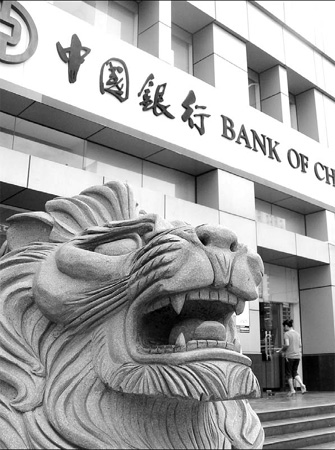
Chinese banks that have branch or representative offices in the Big Apple include Bank of China, Bank of Communications, China Construction Bank, Industrial and Commercial Bank of China, China Merchants Bank and Agricultural Bank of China. Asianewsphoto |
NEW YORK: Home to the financial capital of the world, the northeastern United States is the country's main draw for foreign capital - and Chinese firms are no exception.
Of course, the region has a strong presence in a number of other sectors such as construction, metals, oil and broadcasting.
Some of the biggest include China Construction America, China Magnetism Corp, Sinopec USA, The People's Insurance Co of China and TV channel SinoVision.
But it is the banking industry that draws many Chinese companies to the region.
According to the Federal Reserve Bank of New York, foreign banking institutions hold about one-fourth of all commercial banking assets in the US.
Among the Chinese banks that have branch or representative offices in the Big Apple are Bank of China, Bank of Communications, China Construction Bank, Industrial and Commercial Bank of China, China Merchants Bank and Agricultural Bank of China.
Under the Foreign Bank Supervision Enhancement Act of 1991, the US Federal Reserve must inspect foreign bank branches annually.
Branches are assessed based on risk management, operational controls, and compliance and asset quality.
Branch status
The coveted branch status allows foreign banks to operate wholesale banking operations, engaging in activities such as extending letters of credit, taking commercial deposits and trade financing.
Without it, banks are simply "representative offices" with the ability to market the bank and do research, but not to close transactions, according to Dave Fredsall, deputy superintendent of foreign and wholesale banking with the New York State Banking Department.
With the conversion to branch status, banks can conduct wholesale banking business, but can not take consumer deposits, he said.
Any deposits from commercial customers must be more than $100,000, he added.
"Once you open a branch, you need a bigger real estate footprint, more employees to handle wire transfers, internal controls and more record-keeping requirements," Fredsall said.
Foreign banks are a big part of the New York economy.
According to a 2008 report from the Institute of International Bankers, foreign-based banks employed 62,500 people in New York, approximately 25 percent of all persons employed by foreign-based financial institutions in the United States.
New Jersey accounts for 12,800 of those employees, while Connecticut has more than 8,600.
The report estimated that the activities of foreign-based banks in New York led to the creation of 162,000 jobs in New York alone, and about 300,000 jobs in the tri-state area of New York, New Jersey and Connecticut.
Boost to the US
Although the report does not break out the number of people employed by Chinese-owned banks in the US, the activities of foreign-based banks in general have a major effect on the community where they operate, according to the report.
"Operations conducted by international banks in New York during 2006 generated in excess of $15 billion in payroll expenditures," the report's authors wrote.
"We estimate that these operations resulted in an increase in New York household earnings in all industries of at least $30.6 billion," the authors reported.
The US Federal Reserve has authorized three Chinese banks to open branches in the US in the last several years.
The first to convert to branch status under the 1991 law was China Merchants Bank in 2008.
Andrew Mao, chief marketing officer at China Merchants Bank's New York branch, told the US edition of China Daily in a past interview that the branch status authorization had "opened the gate for others" in China.
Indeed, after China Merchants Bank successfully won over the Fed, China Construction Bank and the Industrial and Commercial Bank of China soon followed.
Given that the Chinese banks have opened branches in the US so recently, they have yet to make a significant impact on the local economy.
Bank of China and Bank of Communications already had branch offices in the US prior to the Federal Reserve's 1991 law. But the Chinese banks are expected to grow.
"Bank of China has had a longstanding presence here, and during the last two years a number of other major Chinese banks have opened branches in New York and are expected to substantially expand their operations over the years," said Institute of International Bankers CEO Lawrence Uhlick.
The Fed's approval of the branch openings is a reflection of the US government's growing confidence in the financial regulatory system in China.
Bank acquisitions
The next step in China's banking expansion in the US could be the acquisition of US banks, which would be a way to expand even further in the US financial sector, Fields said.
"After the balance sheet positions of the US banks become clearer and after China begins once again to export capital," he said, "you are likely to see some bank acquisitions by Chinese banks in New York and California."
As more Chinese banks establish themselves in the US, other companies in China's financial sector have also begun to follow.
China Unionpay (CUP), a bankcard association similar to MasterCard or Visa with more than 200 member banks, set up shop in New York in 2005.
Since its arrival, the firm has been working to get its cards accepted in the States. "Right now, roughly 90 percent of ATMs in the US accept China Unionpay cards," said Jia Hang, chief representative of CUP's US representative office in the company's international division.
Experts say most Chinese financial enterprises share the same optimism.
(China Daily 09/21/2009 page4)

 Night views of Harbin through the lens
 Tibetans take train home after pilgrimage or travelling
 World's largest shaftless Ferris wheel built in China
 Ancient cities to be connected by Xi'an-Chengdu high-speed railway
 Snow turns Harbin into winter wonderland
 Reed Catkin Festival held in Wuhan
 Is it a building or a bookshelf?
 First flight
 Polar icebreaker Snow Dragon arrives in Antarctic
 Xi's vision on shared future for humanity
 UN's top environmental honors go to three in China
 German trains collide near Duesseldorf, several people injured
 China beats Germany 7-4 in men's curling Olympic qualification
 Bayern beat Paris Saint-Germain 3-1 in UEFA Champions League


Copyright 1995 - . All rights reserved. The content (including but not limited to text, photo, multimedia information, etc) published in this site belongs to China Daily Information Co (CDIC). Without written authorization from CDIC, such content shall not be republished or used in any form. Note: Browsers with 1024*768 or higher resolution are suggested for this site.
License for publishing multimedia online 0108263 Registration Number: 20100000002731