Comments
  Print
Print  Mail
Mail  Large Medium Small
|
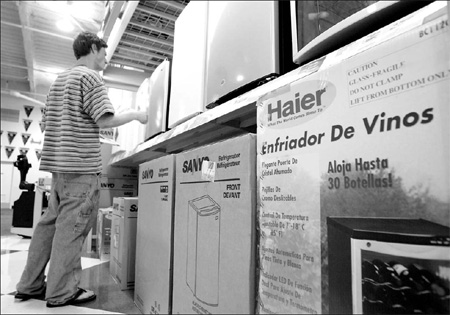
Corey Swinborne of Seattle looks at refrigerators made by the Chinese company Haier at a Best Buy store in Seattle, Washington. Haier America built a $40-million industrial park in South Carolina, and other Chinese enterprises are eyeing the United States, too. Bloomberg News |
NEW YORK: When the cargo ship Liu Lin Hai docked in Seattle in 1979 to pick up 37,000 tons of corn, it marked the first time in 30 years that a Chinese vessel had entered a US port.
Thirty years later, one company collecting $5 million worth of corn has turned into an estimated 1,200 Chinese companies operating in the United States with a total investment of $3.67 billion, according to the China General Chamber of Commerce-USA.
"There were no business relations 30 years ago and few structures on which business could be based," said Robert Kapp, former president of the US-China Business Council.
"Since then, the two countries have developed the biggest or second-biggest bilateral trade partnership, which relies increasingly on a set of shared practices," Kapp said.
Despite the rapid transformation from strangers into perhaps the world's most financially interdependent duo, trade relations have not been the smoothest over the past three decades.
In recent years, however, the two countries have shown a willingness to work together that hints at a promising future.
In the 30 years since reconnecting with the United States, China has managed the delicate balancing act of mastering global business practices while still adhering to its Communist principles.
"Although China remains limited by a number of inherited patterns it has proved quite adept at learning the ways of the outside world," Kapp said.
But it wouldn't have been able to function this way if not for a major change in the attitude of Chinese society toward the accumulation of private wealth.
This change in attitude also led to the most significant turning point in the trade relationship between the United States and China over the past 30 years: China's admittance to the World Trade Organization in 2001.
"The World Trade Organization entry signifies explicitly China's commitment to join the international trading system, and to be bound by the dispute resolution process," said Nicholas Lardy, a senior fellow at the Washington, DC-based Peterson Institute for International Economics.
Chinese companies have found that entering the American market is no easy task, but the successful ones have learned the importance of contributing to the local economy while benefiting from it.
In 2001, China Ocean Shipping Co (Cosco) was considering a new route between China and Boston. At that time, Boston's port was struggling in the wake of the Sept 11 terrorist attacks, and more than 9,000 employees were in danger of losing their jobs.
After months of negotiations, a deal was struck, and the Beijing-based company started the first weekly liner service between Asia and Boston. A year later, Cosco's local shipping volume doubled, its export shipping volume increased four-fold and 9,000 jobs were saved.
Also making a positive local impact while building its business is Qingdao-based white goods giant Haier. While most Chinese investment in the United States is in the form of mergers and acquisitions, Haier boldly chose to start from the ground up.
In 1999, the manufacturer opened a $40 million, 44.5-hectare industrial park in Camden, South Carolina, which now has an annual production capacity of 500,000 units.
And despite the cultural incongruity between China and the politically conservative southern United States, Camden residents view Haier's 106,680 sq m plant as a source of community pride, supplying well-paying jobs at a time when the state's jobless rate is among the highest in the nation.
"The very best advice is to do your homework about the US market and understand the American consumers and their preferences," said Michael Jemal, chairman of the board for Haier America.
"To really create long term success, you will have to provide excellent quality and value, and offer excellent customer service," Jemal said. "I like to consider Haier America as one company that changes the way American consumers view 'Made in China.'"
Mixed signals
While Haier and Cosco have achieved success, many Chinese enterprises have had a difficult time investing in America - particularly those in the energy and high technology sectors.
A low point in trade relations came in 2005 when China National Offshore Oil Corporation (CNOOC) made a $67 per share bid for the US-based oil company Unocal. CNOOC offered $1.5 billion more than the next highest offer from US oil firm Chevron.
Despite the fact that the proposed takeover did not raise any realistic security concerns, several members of the US Congress bristled at the idea of a Chinese government-backed firm owning a US oil company. They raised a public outcry that ultimately derailed the bid.
America's knee-jerk reaction to the deal was taken by many Chinese business leaders as a sign that they should stay out of the United States, a sentiment that was reinforced two years later when Shenzhen-based telecommunication equipment maker Huawei Technologies tried to take over US-based technology firm 3Com.
Because of some public criticism, and due to fears of a national security threat that were raised by the Committee on Foreign Investment in the United States, Huawei's takeover bid was thwarted.
"I think many Chinese miscalculate - based on the Unocal bid thinking - that the US market is simply hostile," said Kenneth Lieberthal, a senior fellow at the Brookings Institute in Washington, DC.
"There are not only many US firms, but also government officials who would welcome high quality Chinese investment in the US," he said.
Lieberthal defines high quality investments as investments that achieve success by building on existing assets. He added that Chinese companies need to take into account public relations issues when investing in the United States.
"It requires some work with local governments, the media and local society to be sure that you are portraying yourself accurately as a high quality investor," Lieberthal said.
"Many Chinese firms don't lend themselves easily to communicating those dimensions or those efforts," he said.
Looking ahead
Although the difference between the US-China relationship of today compared to 30 years ago is night and day, even more changes might occur as the relationship grows over the next 30 years.
"The United States has changed and has become more open-minded to the idea of Chinese investment than it was just four or five years ago," Lieberthal said.
"I see the potential for investment by Chinese firms in the US to create a lot of positive experiences on both sides," he said.
But more change is also needed on both sides, said Lardy of the Peterson Institute for International Economics.
"There are optimistic signs that this will happen, but Americans have to quit living beyond their means and save a little bit. And China needs to make changes that will reduce household savings and business savings," Lardy said.
Nevertheless, Lardy said that he foresees more trade over the next 30 years and more capital investments.
"I think that with good political leadership on both sides, they both can build on the relationship of the past 30 years," Lardy said. "China is increasingly important to US companies."
(China Daily 09/21/2009 page4)

 Night views of Harbin through the lens
 Tibetans take train home after pilgrimage or travelling
 World's largest shaftless Ferris wheel built in China
 Ancient cities to be connected by Xi'an-Chengdu high-speed railway
 Snow turns Harbin into winter wonderland
 Reed Catkin Festival held in Wuhan
 Is it a building or a bookshelf?
 First flight
 Polar icebreaker Snow Dragon arrives in Antarctic
 Xi's vision on shared future for humanity
 UN's top environmental honors go to three in China
 German trains collide near Duesseldorf, several people injured
 China beats Germany 7-4 in men's curling Olympic qualification
 Bayern beat Paris Saint-Germain 3-1 in UEFA Champions League


Copyright 1995 - . All rights reserved. The content (including but not limited to text, photo, multimedia information, etc) published in this site belongs to China Daily Information Co (CDIC). Without written authorization from CDIC, such content shall not be republished or used in any form. Note: Browsers with 1024*768 or higher resolution are suggested for this site.
License for publishing multimedia online 0108263 Registration Number: 20100000002731