Comments
  Print
Print  Mail
Mail  Large Medium Small
On June 23, the Obama administration filed a complaint with the World Trade Organization (WTO) against China, alleging that China is restricting the exports of nine raw materials important to US manufacturing.
It is the just one example of new trade frictions developing between China and the United States.
The US Department of Commerce on June 26 opened a probe into whether China has dumped or subsidized wire decking sold in the US market.
The probe followed the initiation of similar investigations into wire strand and steel grating products earlier in June.
Experts said rising trade protectionism tends to accompany economic recessions.
Following the three US anti-dumping and countervailing investigations into imports of Chinese steel products in June, China's Ministry of Commerce posted a strongly worded statement on its website expressing its concerns about what it believes is protectionism.
"China is shocked at the frequency of the cases and the strength of the targeting. Chinese industry is extremely dissatisfied and the government deeply concerned," the Ministry of Commerce statement read.
"These actions are sending the wrong signals about trade protectionism within the United States to the international community," the statement read.
US authorities have said the goal is simply to protect the rights of domestic industries.
In another development, China last month rejected US and European charges that its restrictions on raw materials exports violate international trade rules, saying that its policies were in keeping with WTO regulations.
The European Union and the United States said they were taking a complaint to the World Trade Organization over China's export curbs on some industrial raw materials used in steel, cars, microchips, planes and other products.
By arguing that the export taxes and quotas keep a lid on Chinese firms' costs, the WTO complaint takes the view that they are essentially a subsidy and distort competition for chemical, steel and non-ferrous metal producers outside China.
"The main objective of China's relevant export policies is to protect the environment and natural resources. China believes the policies in question are in keeping with WTO rules," the Ministry of Commerce press office said in a mildly-worded response.
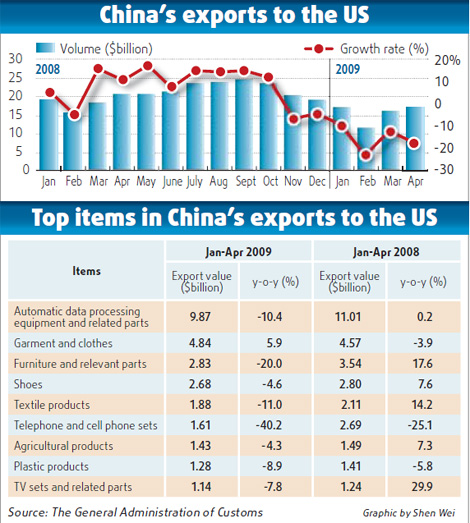
Despite such frictions, Sino-US trade still represents one of the world's more important trade relationships.
In the first half of this year, the United States remained China's second-largest trade partner, with bilateral trade volume totaling $132.09 billion -- down 16.6 percent from a year ago.
During the same period, China's trade with major trade partners saw a bigger decline, including a 20.9 percent drop in trade with the European Union, a 23.1 percent decline with Japan and 23.8 percent fall with the Association of Southeast Asian Nations.
The trade imbalance between the United States and China is not sustainable, and the two countries have a joint responsibility to reduce greenhouse gas emissions, US Commerce Secretary Gary Locke said last Wednesday in Beijing.
"There do exist some issues in our bilateral trade relations, including cooperation on high-tech products," Chinese commerce ministry spokesman Yao Jian told a press conference last Wednesday in Beijing.
China's big surplus in its trade with the United States has become a global concern, he said.
"Of course, it's a separate issue as to how to interpret the trade surplus. In a globalized world today, trade surplus does not necessarily mean trade benefits," Yao said, pointing out that China mainly exports labor-intensive products.
Assistant Minister of Commerce Wang Chao said "Made in China" products have become more important to US consumers, adding that the massive Chinese market also is translating into more profits for US enterprises.
He cited a report from the US Chamber of Commerce on the business environment in China.
That report stated that 74 percent of US enterprises investing in China are making a profit in China, and that 91 percent of those businesses plan to expand in China.
"US trade and investment in China also helps China upgrade its industries," Wang said.
He estimated bilateral trade between the two countries will exceed $500 billion in the next five years, and that relations will be more in balance within that time period.
As for trade frictions, Wang said China is not pursuing a trade surplus and is not taking measures to increase imports from the United States.
Wang did call on the United States to remove restrictions on exports to China to narrow the trade gap between the two countries.
Zhang Lijuan, a professor at the School of Economics at Shandong University, said trade relations likely will be a major topic during the first round of the Sino-US Strategic and Economic Dialogue scheduled later this month in Washington, DC.
"Free trade is no longer a keynote for the Obama administration, and instead, 'Buy American' is a focus of US stimulus bills," Zhang said.
"The 'free but fair' trade policy initiative can be interpreted as a new type of trade protectionism," she said.
Zhang said China has urged the United States to lift its ban on technology exports to partially offset its trade deficit with China, although the US-China trade imbalance won't be at the top of the agenda.
Inevitably, trade promotion and expansion will drive the direction of bilateral trade talks, she said.
Zhang said trade-related issues likely will be discussed at greater length at the fall meeting of the high-level Joint Commission on Commerce and Trade (JCCT).
"The two sides will exchange views on trade policies and attempt to intensify cooperation on global economic and financial issues," Zhang said.
"Trade-related issues such as intellectual property rights and standards on the environment, labor, and product safety will be addressed at both meetings," she said.
(China Daily 07/20/2009 page7)

 Night views of Harbin through the lens
 Tibetans take train home after pilgrimage or travelling
 World's largest shaftless Ferris wheel built in China
 Ancient cities to be connected by Xi'an-Chengdu high-speed railway
 Snow turns Harbin into winter wonderland
 Reed Catkin Festival held in Wuhan
 Is it a building or a bookshelf?
 First flight
 Polar icebreaker Snow Dragon arrives in Antarctic
 Xi's vision on shared future for humanity
 UN's top environmental honors go to three in China
 German trains collide near Duesseldorf, several people injured
 China beats Germany 7-4 in men's curling Olympic qualification
 Bayern beat Paris Saint-Germain 3-1 in UEFA Champions League


Copyright 1995 - . All rights reserved. The content (including but not limited to text, photo, multimedia information, etc) published in this site belongs to China Daily Information Co (CDIC). Without written authorization from CDIC, such content shall not be republished or used in any form. Note: Browsers with 1024*768 or higher resolution are suggested for this site.
License for publishing multimedia online 0108263 Registration Number: 20100000002731