Comments
  Print
Print  Mail
Mail  Large Medium Small
As an environmentally aware urbanite, you may wonder every now and then how much paper you dispose of every year.
Unless you're particularly mindful of the use of toilet paper, tissue paper or kitchen paper, it should be around 3 kg, which is how much the average Chinese consumer uses.
And the figure is rising. "As (Chinese) people become better off, their consumption of all kinds of household paper products will rise," predicted Jiang Manli, secretary-general of China National Household Paper Industry Association (CNHPIA).
China is expected to overtake the United States as the world's largest paper consumer in a few years.
Indeed, the use of household paper products in China, and other large emerging markets, has become so prevalent that it has spawned an industry which seems immune to economic cycles. The paper industry has joined the ranks of other recession-proof sectors that have proven to be most resistant to the impact of the global economic slump.
Surging demand
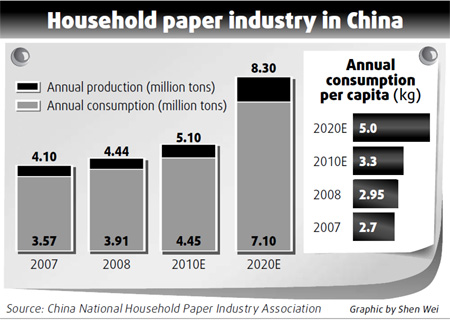
Household paper consumption volume in China grew rapidly in the last two decades to hit 3.91 million tons in 2008, accounting for about 10 percent of the global market, according to CNHPIA. Annual per capita consumption jumped from 0.59 kg in 1990 to 2.95 kg last year, more than 400 percent growth over 19 years.
"China has become the world's second-largest household paper consuming nation, next only to the US, and is expected to be the largest within a few years," said Jiang.
That is because the comparatively low per capita consumption in China leaves ample room for future growth. In the United States, for instance, each person consumes an average 5 kg to 6 kg of paper products a year, about twice as much as in China.
Jiang predicted that China's annual per capita consumption of paper products would catch up with that of developed countries by 2020.
Household paper consumption surged from 3.57 million tons to 3.91 million tons in 2008, an increase of 9.5 percent from the previous year. At the same time, sales jumped 20.3 percent from 34 billion yuan to 40.89 billion yuan.
"The increase in turnover was much higher, demonstrating that the market share of high-end products expanded and more consumers have become increasingly brand conscious," Jiang said.
Statistics from her association showed that the top 15 household paper brands, including both domestic and foreign ones, have a combined 44.8 percent share of the market in 2008, up 5.8 percentage points from 2007.
Among the top domestic sellers were Hengan of Fujian province, and Guangdong-based Vinda and Zhongshun. The foreign brands of Kimberly-Clark and APP were also among the top 15 in 2008.
In addition to toilet paper, Chinese consumers are using more facial tissues, sanitary napkins, diapers and paper towels.
"The new buying trend indicates that more and more Chinese consumers, especially younger urbanites, are embracing a modern lifestyle," said Song Ying of Shanghai ACNielsen Co Ltd.
Economists and market analysts agreed that the number of well-off urbanites is expanding rapidly in China.
A report from banking group BNP Paribas predicted that the number of middle-class families in China will exceed 100 million by 2010, while US investment bank Merrill Lynch forecast that China's middle-class population would reach 350 million by 2015.
Based on these demographic projections, analysts expected particularly rapid increases in the demand for heavy-duty kitchen paper towels and adult diapers.
Paper towels gained popularity in developed countries decades ago. They were introduced to China at the end of last decade, and rapidly gained popularity among young urbanites. Accounting for 10 percent of China's household paper market, kitchen paper towels have become the focus of competition between domestic and foreign firms.
Sales of adult diapers are expected to increase rapidly as Chinese society gets grayer. The low-end market for the product is dominated by local producers while a few foreign companies, notably Kimberly-Clark, has gained a stranglehold in the high-end segment.
Consuming habits
"Chinese people pay attention to brands and buy household paper in supermarkets and hypermarkets rather than at neighborhood shops," said Joy Huang, an analyst at global market research firm Euromonitor International.
Wang Jiayi, a 35-year-old consultant in a multinational public relations agency, said she prefers Kimberly-Clark's Kleenex despite the considerable price premium.
"I became familiar with the brand when I was living in the US," she said.
Her mother Fan Guihua, a 62-year-old Beijinger, thinks differently. Despite her daughter's objection, she insists on buying a cheaper domestic brand of toilet paper. "I can't see the difference," Fan said.
Mother and daughter both said that advertising, especially on television, exerts a considerable influence on their buying habits. "I also listen to recommendations from friends and relatives," Wang said.
Huang from Euromonitor noted that the buying habits of Chinese consumers vary greatly from region to region. Consumers in large cities, including Beijing, Shanghai and Guangzhou, use an average of 8 kg household paper products per person per year. The major brands enjoy a distinct advantage in these cities. Kleenex, for instance, has a 25 percent share of the paper tissue market in Beijing and Shanghai.
"The brand name is the top consideration in the minds of consumers in large cities," said Tong Mei, director of corporate development for Kimberly-Clark (China) Co Ltd.
In contrast, consumers in the less-developed central and western regions of China are more concerned about price. In those markets, lower-priced domestic paper products dominate the market.
So far, only 6 percent of China's household paper products are for export. "Producers are hard put to meet rapidly increasing domestic demand," Jiang explained.
(China Daily 06/08/2009 page5)

 Night views of Harbin through the lens
 Tibetans take train home after pilgrimage or travelling
 World's largest shaftless Ferris wheel built in China
 Ancient cities to be connected by Xi'an-Chengdu high-speed railway
 Snow turns Harbin into winter wonderland
 Reed Catkin Festival held in Wuhan
 Is it a building or a bookshelf?
 First flight
 Polar icebreaker Snow Dragon arrives in Antarctic
 Xi's vision on shared future for humanity
 UN's top environmental honors go to three in China
 German trains collide near Duesseldorf, several people injured
 China beats Germany 7-4 in men's curling Olympic qualification
 Bayern beat Paris Saint-Germain 3-1 in UEFA Champions League


Copyright 1995 - . All rights reserved. The content (including but not limited to text, photo, multimedia information, etc) published in this site belongs to China Daily Information Co (CDIC). Without written authorization from CDIC, such content shall not be republished or used in any form. Note: Browsers with 1024*768 or higher resolution are suggested for this site.
License for publishing multimedia online 0108263 Registration Number: 20100000002731