Comments
  Print
Print  Mail
Mail  Large Medium Small
|
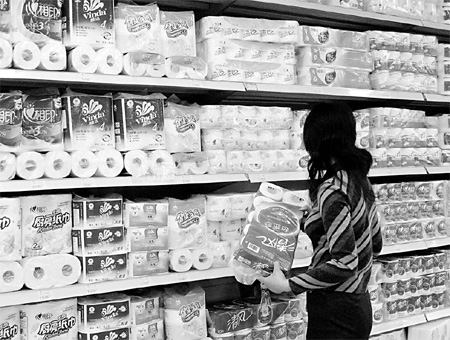
A woman chooses household paper at a supermarket in Yichang of Hubei province. Asianewsphoto |
China's household paper industry has not been affected by the global economic slowdown, with firms using a variety of tactics to get a greater share of this lucrative market.
"Our key theme this year is choice," said Tong Mei, director of corporate development at Kimberly-Clark (China) Co Ltd.
"We have to choose what is our focus, what we will do and what we will give up, we have to choose what kinds of consumers we can serve well."
The producer of Kleenex tissues, Huggies diapers, Scott paper towels and Kotex sanitary napkins, which entered the China market in 1994 with the acquisition of local sanitary napkin brand Shuermei for 200 million yuan, said it would continue concentrating on the high-end market.
"We have strength and expertise in this sector, so we should focus on it," Tong explained.
The No 1 tissue maker in the world and No 2 household paper brand in the United States has enjoyed good times in recent years in China thanks to this focus.
Kimberly-Clark had a difficult first decade in China, and it was not until 2003, when Stephen Shao took up the post of Kimberly-Clark's China president and kicked off the firm's high-end market focused strategy, that the US-headquartered household paper giant started to clean up its act here.
Kimberly-Clark's turnover in China has witnessed double-digit growth since 2004.
Tong said that the firm is focusing its efforts on the better-off and younger consumers in the nation's major cities.
The company's Kleenex tissue brand has a 25 percent market share in Beijing and Shanghai, while its Huggies diapers occupy 70 percent of China's premium baby napkin sector, according to Kimberly-Clark.
Consumer choice
"Chinese consumers, particularly urbanites born in the 1980s, are increasingly willing to spend more and Kimberly-Clark is striving to keep its quality high and at cost-effective prices," said Tong.
Competition from Procter & Gamble is a permanent theme for Kimberly-Clark both around the world and in China. Entering China in 1990, P&G's Whisper sanitary napkins and Pampers diapers quickly won over Chinese consumers.
But what sets P&G apart from Kimberly-Clark is that its Whisper and Pampers brands reach out to a wider range of consumers - from the well-off to those counting every penny.
The world's No 1 healthcare and household daily necessity provider occupies every corner of the market. Statistics from the China National Household Paper Industry Association said that in 2008, P&G made up 31.3 percent of China's diaper market with its Pampers brand, followed by Hengan's Anerler at 21.7 percent, while Kimberly-Clark's Huggies had just 4.6 percent.
The association also said that although transnational companies have the upper hand in terms of brand recognition, domestic players dominate China's household paper market. Among the top 15 household paper producers in China in terms of sales in 2008, 13 were local operators.
The top 15 occupied 44.8 percent of the market in 2008, compared to 39 percent in the previous year.
"The industry is consolidating, large players are becoming even larger, and small ones are being acquired or going under," said Jiang Manli, secretary-general of the China National Household Paper Industry Association.
Fujian Hengan and Guangdong Vinda were the top two among these 15 giants.
Hengan makes Xinxiangyin toilet paper and tissues, Anle and Anerle sanitary napkins, and Anerler diapers.
The annual report of the Hong Kong-listed company showed that its sales revenue totaled HK$8 billion last year, up 41 percent from HK$5.69 billion in 2007. Meanwhile, its profit jumped 33 percent from HK$1.01 billion to HK$1.34 billion.
The company, whose manufacturing facilities in Fujian, Shandong and Henan have a total production capacity of 360,000 tons, further expanded its Henan facility in February, despite the global economic downturn. The move will help its production capacity reach 600,000 tons by the end of next year.
Hengan is further diversifying its products portfolio, according to CEO Xu Lianjie. In 2008 it launched Pino tissue brand targeted at young consumers and professionals, which is 10 percent more expensive than its existing brands. And, to grab a greater share of the massive rural market, it launched Youxuan tissues, 10 percent cheaper than the average.
The household paper behemoth acquired snack food firm Fujian Qinqin this year for 299 million yuan. It also took over two healthcare brands.
"Our household paper is sold in supermarkets, which also sell food, daily necessities and skincare products. The distribution channels of those goods are similar, so what's stopping us from selling them?" said Xu, who refused to rule out more crossover mergers and acquisitions.
Conglomerate aim
"Hengan is setting its sights on becoming a household products conglomerate covering every corner of the market, something like P&G," said Wang Feng, an analyst of Guotai Jun'an Securities.
"But Hengan has no experience in those other areas, so the jury's still out on whether the Qinqin acquisition was a good idea. And, as far as other M&As are concerned, let's wait and see."
Hengan's archrival Vinda is sticking to its key business and making efforts to penetrate the rural market.
The company said its annual growth rate has remained over 20 percent since 2001 and that it has a "considerable" share of the high-end market.
"In addition to serving urban families and professionals, we will do more to tap into the rural market," said Li Chaowang, Vinda's chairman.
To this end, Vinda launched its Yazhi series, targeted at the third- and fourth-tier marketplaces, at the end of last year.
"The vast rural market remains virgin territory as far as we are concerned. It is still dominated by small firms producing cheap products that lack brand recognition.
"Moreover, overseas firms would find it difficult to get a foothold, given their limited local distribution and logistics resources," said Wang.
"The recent decline in the price of paper pulp means that the time is ripe for us to enter this market," Li pointed out.
The unit price of paper pulp, household paper producers' most important raw material, has dropped from $780 per ton in last May to between $400 to $500 in the international market now, which may help producers reduce costs and maintain healthy profit margins. Around 90 percent of the paper pulp used by Vinda is imported.
The company will also adjust its paper product prices to match local standards in rural China and second-tier cities, but this will not affect its gross profit margin as it plans to lower packaging costs at the same time, according to Li.
"If branded household paper manufacturers enter the rural market, many small factories will be squeezed out," said Jiang from the industrial association, adding that the central government's stricter environmental protection requirements will also force them to shut shop.
Jiang's association said that there are 1,066 registered household paper manufacturers in China, while there are also many unregistered small plants in rural areas. "This situation will change, by as soon as next year," she said.
But some small household producers are managing to keep their heads above water through technological upgrading or diversification. Chengdu-based Haosheng Huada Paper Co Ltd, has developed bamboo paper, aiming at environmentally aware consumers.
"Sichuan has rich bamboo resources, and bamboo grows fast and is recyclable, so we have low-cost raw materials and green products," said Su Desheng, the company's general manager.
(China Daily 06/08/2009 page5)

 Night views of Harbin through the lens
 Tibetans take train home after pilgrimage or travelling
 World's largest shaftless Ferris wheel built in China
 Ancient cities to be connected by Xi'an-Chengdu high-speed railway
 Snow turns Harbin into winter wonderland
 Reed Catkin Festival held in Wuhan
 Is it a building or a bookshelf?
 First flight
 Polar icebreaker Snow Dragon arrives in Antarctic
 Xi's vision on shared future for humanity
 UN's top environmental honors go to three in China
 German trains collide near Duesseldorf, several people injured
 China beats Germany 7-4 in men's curling Olympic qualification
 Bayern beat Paris Saint-Germain 3-1 in UEFA Champions League


Copyright 1995 - . All rights reserved. The content (including but not limited to text, photo, multimedia information, etc) published in this site belongs to China Daily Information Co (CDIC). Without written authorization from CDIC, such content shall not be republished or used in any form. Note: Browsers with 1024*768 or higher resolution are suggested for this site.
License for publishing multimedia online 0108263 Registration Number: 20100000002731