Comments
  Print
Print  Mail
Mail  Large Medium Small
The Danish Prime Minister Anders Fogh Rasmussen pointed out over a climate change dinner recently that the Chinese symbol for crisis is made of two symbols: danger and opportunity.
You could say this is the symbol of our times. The dangers are apparent, global destruction of value as stocks markets plunge and banks disappear, credit freezes, and a potential deep global recession.
Yet behind this lies the longer danger of climate change. In the corridors of Washington and Brussels some argue that this is no time to restrict greenhouse gas emissions and burden industry further. Danger can all too easily mask opportunity.
When the 1929 stock market crashed there was rush to maintain levels of production with subsidies and import tariffs used to defend jobs. Supply exceeded demand and people hung on to what money they had - just like the western housing market today with people frightened to buy today what may be worth thousands of dollars less in just days or weeks.
It took World War II to fully break the deflationary cycle - hardly a triumph for the economists of the day.
Yet there was a different response to the Asian financial crisis of 1998 as China unleashed a large scale infrastructure project.

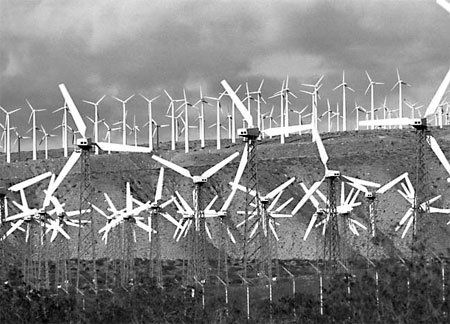
Tiny Denmark, with a population around half the size of Los Angeles or New York has built a world class wind energy system - through promoting domestic wind power that now provides around one-fifth of Denmark's electricity. Danish headquartered Vestas employs over 15,000 people and is the world's largest wind power company.
Germany, far from the sunniest country in the world, has created a world class solar industry through creating a market for solar cells within its own borders. These industries have attracted investment and created jobs on a scale to match any of the 20th century industries.
These were not artificially maintained jobs from propped-up, uncompetitive industries. They were part of creating a new low-carbon economy. This is part of the job of government - to take big decisions on behalf of society and to create a policy framework which allows business to deliver innovation and investment.
So, as we look to the future, how will the world change? President- elect Obama faces substantial challenges. In his words "the challenges that tomorrow will bring are the greatest of our lifetime - two wars, a planet in peril, the worst financial crisis in a century."
Will it be subsidies for traditional industries or will there be visionary leadership to build a new low-carbon economy. With the right framework the US can unlock a low-carbon economy at a pace that will surprise us all.
After all this is a country that got a man on the moon with less technology than you have in the cell phone in your pocket.
Meanwhile, China quietly proceeds with its own low-carbon revolution. Downtown Beijing has some 60,000 LED street-lights, the country has more installed solar thermal power than anywhere else in the world. Wind power is expanding at a staggering rate and the country is second only to Germany with the percentage of GDP invested in clean energy. China is becoming the world renewable capital.
Added to this was the commitment to invest 2 trillion yuan in creating a rail network fit for the 21st Century. A system built on determined five year planning.
Has the world fallen out of love with the market economy? Perhaps the relationship is a little bruised but the love affair is far from over. We have been reminded that the market needs a framework.
More than 60 years ago the foundations of the modern economy were laid in Bretton Woods. Against a recent backdrop of a World Financial Summit, labeled by some as Bretton Woods II, there is the opportunity to address what UK climate economist Lord Nicholas Stern describes as "the biggest market failure of all time" - our lack of pricing carbon.
Let's not simply stimulate the old economy but seize the opportunity to set the framework for a new low-carbon economy. This will not be tinkering at the edges but a complete change: zero emission electricity and smart grids, buildings that draw little power, electric vehicles, and every product designed to be clean and green from birth to recycling.
We must reduce emissions by about two-thirds by mid-century and by more than 80 percent in the developed world - at the same time the economy is likely to grow five or six times. We are entering the post-carbon age.
In our great cities we take it for granted that sewage and rubbish does not simply get thrown out of the window - as it did in centuries passed. We simply accept that sanitation is too important to question for those of us privileged enough to live in the parts of the world that experience it.
There is little debate over the cost to the economy of sewage works or garbage collection. Before long we will think the same of carbon pollution. It is essential we stop throwing our "waste" into the atmosphere - we don't have the luxury of choice. A low- carbon world is inevitable; it is simply a question of if we succeed in doing it fast enough.
President Harry Truman noted, "It is a recession when your neighbor loses his job; it's a depression when you lose yours." I would say "It is climate change when your neighbour experiences extreme weather; it's a climate crisis when it's you."In the long term, it is a simple choice: green growth or no growth.
We have had a space race and an arms race. The next great race will be the low carbon race. Where will the clean green future be designed and built? Europe gave itself a small head start, China is rapidly catching up, the US, except for a few states such as California, is just about to climb into the starting blocks. Let the race begin: If we run fast enough we can all be winners.
The author is the CEO of The Climate Group which he co-founded in late 2003. He has worked on a variety of social and environmental issues from within business, NGO and UN settings. All the views in the article are his own.
(China Daily 12/08/2008 page4)

 Night views of Harbin through the lens
 Tibetans take train home after pilgrimage or travelling
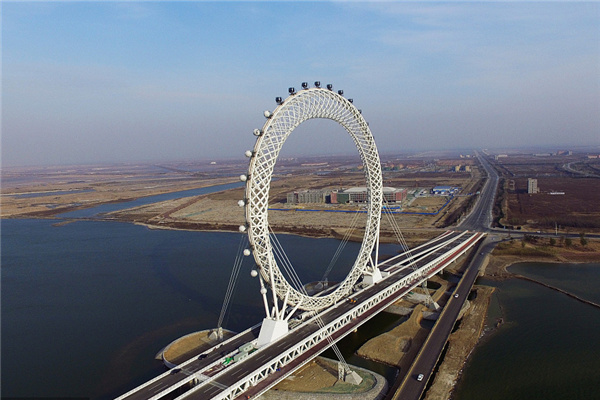 World's largest shaftless Ferris wheel built in China
 Ancient cities to be connected by Xi'an-Chengdu high-speed railway
 Snow turns Harbin into winter wonderland
 Reed Catkin Festival held in Wuhan
 Is it a building or a bookshelf?
 First flight
 Polar icebreaker Snow Dragon arrives in Antarctic
 Xi's vision on shared future for humanity
 UN's top environmental honors go to three in China
 German trains collide near Duesseldorf, several people injured
 China beats Germany 7-4 in men's curling Olympic qualification
 Bayern beat Paris Saint-Germain 3-1 in UEFA Champions League


Copyright 1995 - . All rights reserved. The content (including but not limited to text, photo, multimedia information, etc) published in this site belongs to China Daily Information Co (CDIC). Without written authorization from CDIC, such content shall not be republished or used in any form. Note: Browsers with 1024*768 or higher resolution are suggested for this site.
License for publishing multimedia online 0108263 Registration Number: 20100000002731