Comments
  Print
Print  Mail
Mail  Large Medium Small

Prior to the 1980s, few Chinese knew about Qinshan, a small town in Zhejiang province on the shores of the East China Sea.
But Qinshan became well known after China began building its first nuclear power plant there in 1985.
China's plans to build a nuclear power plant dates back to 1970. After reading a report that China's industrial center, the city of Shanghai, may face power shortages, the late Chinese Premier Zhou Enlai said on February 8, 1970 that in order "to ease the power crisis in Shanghai as well as in east China, we should develop nuclear power as a long-term plan.
"Nuclear power should not only be used for weapons. It should also be used to serve China's economic development," Zhou said.
China had exploded its first atomic bomb in 1964 and its first hydrogen bomb in 1967. Zhou's exhortations transformed the country's nuclear industry.
Many scientists from different parts of the country came to Shanghai to prepare for the first civilian nuclear power project. However, the preparations were fraught with controversy.
Safety was the foremost concern, especially after the accident at Three Mile Island nuclear power plant in the United States in 1979. Although it resulted in no deaths or injuries, the Three Mile Island accident engendered a heated debate on whether to develop nuclear power in China as well as across the globe.
Technology was another issue. Some scientists insisted that China should build its first nuclear power plant with domestic technology. Others thought China should use foreign technology, which was more advanced and reliable.
A site for a nuclear power plant also became a problem. Shanghai's Chongming Island, Jiangyin city in Jiangsu province, and Zhoushan Island in Zhejiang province were considered as possible sites, but were abandoned for safety or environmental reasons.
Qinshan was then taken into the consideration. Facing Hangzhou Bay with some hills, it was ideal geographically and convenient for transportation.
In 1981, China finally approved the construction of its first nuclear power plant at Qinshan with a Chinese-made pressurized water reactor with a capacity of 300 MW.
Construction began four years later. However, in 1986 when the Chernobyl nuclear power plant disaster occurred in the former Soviet Union, it again triggered concerns about nuclear power and the safety of the Qinshan project. The Chernobyl accident caused many deaths and long-term radiation pollution, and changed the pace of development of the nuclear power industry globally.
Additionally, because the Qinshan plant was designed and constructed domestically, some experts worried about safety during the construction process; others even wanted to halt construction.
In 1989, the Chinese government invited 11 experts from the International Atomic Energy Agency (IAEA) to conduct a safety evaluation of the Qinshan project. After three months of careful testing, the IAEA issued a report saying the plant was "safe and of good quality". It allayed many fears.
In December 1991, Qinshan's reactor was connected to the power grid. It began commercial operation in April 1994. The Qinshan project made China the seventh country in the world to build and operate a nuclear power plant.
By the end of last year, the plant had generated a total of 31 billion kWh of electricity, earning about 9.6 billion yuan in sales revenues and paying 1.8 billion yuan in taxes.
After 14 years of operation, nuclear power has proved to be a clean source of energy for China. In contrast, a thermal power plant with a 1000-MW capacity will consume three million tons of coal a year and produce heavy emissions. A nuclear power plant with the same capacity will use 250 tons of fuel, producing fewer emissions.
After tracking the area around the power plant for more than ten years, the Zhejiang provincial environmental authority has reported that the power plant has caused no environmental changes.
Booming industry
Based on the success of the first Qinshan nuclear power reactor, China started to build Phase II in 1996. Two domestically produced pressurized water reactors, each with a capacity of 650 MW, were placed in commercial operation in 2002 and 2004.
In 1998 China began building Phase III with two 728-MW heavy water reactors using technology from Canada. The plant started commercial operation in 2003.
With five reactors now in operation, Qinshan has become an important nuclear power base in China. It has met the voracious power needs of the Yangtze River Delta, one of the fastest growing and most prosperous regions in the country.
The Qinshan nuclear complex has also enabled the region to cut pollution significantly, according to Kang Rixin, general manager of China National Nuclear Corporation (CNNC), owner of the Qinshan project.
In 2005 CNNC began another round of expansion of the Qinshan complex by adding two 650-MW reactors.
As the world's fastest growing economy and the second largest energy consumer, China's nuclear power industry has seen accelerated development in recent years, according to the National Development and Reform Commission (NDRC).
In 2005, China had planned to increase its nuclear power capacity to 40 GW by 2020, when it would account for 4 percent of the nation's total power capacity.
The NDRC has readjusted its earlier goal in order to coordinate with the boom in industrial development, by increasing it to 5 percent of the total power capacity in 2020, Zhang Guobao, NDRC vice-minister has said.
Zhang, who is also director of the newly-established National Energy Bureau, says the bureau will help further boost the development of nuclear power in the country. During the reorganization of ministries at this year's session of the National People's Congress, the management of the nuclear sector was transferred from the former Commission of Science Technology and Industry for National Defense to the National Energy Bureau.
China now has 11 nuclear reactors in operation, with a combined installed capacity of 9,080 MW, according to the China Electricity Council (CEC). Besides Qinshan, the country has developed two other nuclear power bases, Daya Bay in Guangdong province and Tianwan in Jiangsu province.
Last year the Tianwan nuclear power plant in Lianyungang went into commercial operation. With two 1,060-MW pressurized water reactors using technology from Russia, the plant is now the largest joint project between China and Russia.
The 11 nuclear reactors generated 62 billion KW of nuclear power in 2007, a 14 percent increase from the previous year, according to the CEC.
(China Daily 10/20/2008 page2)

 Night views of Harbin through the lens
 Tibetans take train home after pilgrimage or travelling
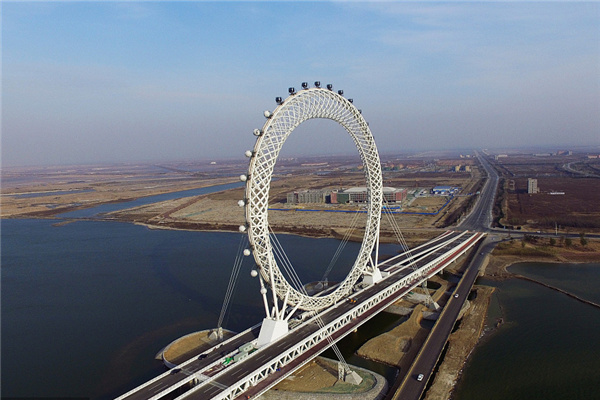 World's largest shaftless Ferris wheel built in China
 Ancient cities to be connected by Xi'an-Chengdu high-speed railway
 Snow turns Harbin into winter wonderland
 Reed Catkin Festival held in Wuhan
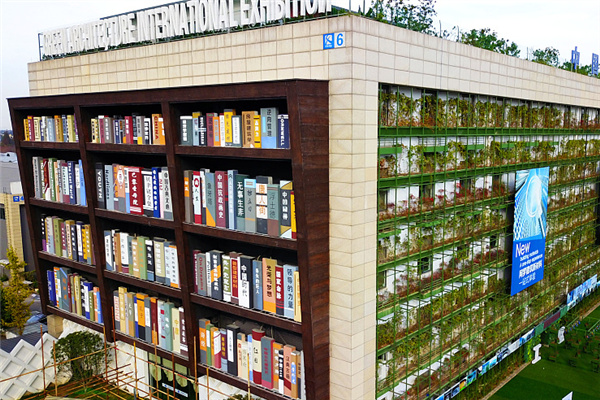 Is it a building or a bookshelf?
 First flight
 Polar icebreaker Snow Dragon arrives in Antarctic
 Xi's vision on shared future for humanity
 UN's top environmental honors go to three in China
 German trains collide near Duesseldorf, several people injured
 China beats Germany 7-4 in men's curling Olympic qualification
 Bayern beat Paris Saint-Germain 3-1 in UEFA Champions League


Copyright 1995 - . All rights reserved. The content (including but not limited to text, photo, multimedia information, etc) published in this site belongs to China Daily Information Co (CDIC). Without written authorization from CDIC, such content shall not be republished or used in any form. Note: Browsers with 1024*768 or higher resolution are suggested for this site.
License for publishing multimedia online 0108263 Registration Number: 20100000002731