Comments
  Print
Print  Mail
Mail  Large Medium Small

Twenty-one-year-old Zhen Bo has a dream. The young man, who works in a factory producing jeans in Foshan city, Guangdong province, manages one dyeing machine and four people.
Three years from now his dream is to manage the entire dyeing plant and all 12 employees. He also hopes his salary, which is 4,500 yuan, will be around 6,000 to 7,000 yuan by then.
Zhen comes from a small village in northern China's Hebei province, where his father, and grandfather are all farmers who never left the land. He quit school soon after finishing the nine-year obligatory education requirement. After helping his father with farm work for a while, he found a job as an apprentice dye worker in a State-owned garment-making plant in Shijiazhuang, the capital city of Hebei.
Three years later, his master recommended him as an honest, hard working guy to a factory in Xintang Area of Guangzhou city, where he could earn 3,800 yuan a month in the Pearl River Delta, three times the wages he made back at home. A year after that, Zhen found his current job in Foshan, where he is making 800 yuan more.
Zhen is one of millions of migrant workers who have left their rural homes to find better employment in factories in Guangzhou, Shenzhen, Suzhou and elsewhere in the Pearl River and Yangtze River deltas. Like Zhen, most expect that their wages and careers will improve with the relocation.
A report released by Fudan University at the beginning of the year says the average monthly income of Chinese migrant workers reached 1,200 yuan in 2007, an increase of 200 yuan over the previous year. The figure was around 500 to 800 yuan in 2005. Comparatively, a rural Chinese worker averaged 360 yuan a month in the same year, according to the National Statistics Bureau.

For the past three decades, it has been the longing to live better and learn more that has pushed these young laborers to leave their mostly rural hometowns. These migrant workers feed their dreams in cities primarily along the eastern or southern coasts - which required a large amount of men and women to work in the growing factories.
As these cities continue to expand, these young workers' ambitions grow with them, coming together to forge the strength to power a factory, a city's growth and a country's development.
China's migrant workers now account for more than 13 percent of the country's population. The provinces of Sichuan, Hunan, Hubei, Jiangxi and Guangxi Zhuang autonomous region are areas that have seen the greatest outflow of migrant workers.
A research report published in January 2006 in the Study Times showed in 2004, Sichuan province had 14.9 million migrant workers. This number, accounting for 30 percent of Sichuan's population, is equal to the total population of a medium-sized country. And 2 million rural households in the province saw the whole family working outside the province.
This phenomenon is by no means a mere transfer of rural laborers, rather it's a massive social change from farmers to workers and a mass migration from rural areas to cities, or "urbanization".
A migrant life
With the establishment of Shenzhen as the country's first special economic zone, the Pearl River Delta witnessed the first influx of foreign joint ventures and the first generation of rural laborers.
"Even though I had imagined it thousands of times before I came here, I still felt shocked when I first saw Shekou (district in southwest Shenzhen). No highway, no trees, no flowers, and everywhere everything was under construction. Isn't it countryside?" In a Shenzhen Economic Daily column about the first generation of female migrant workers, Zheng Yanping recalled her early working experience in the Kaida Toy Factory located in the Shekou district of Shenzhen in 1982.
Many young people aged around 18 to 20, came to Shenzhen at the beginning of the 1980s. In 1996, the total population of Shenzhen was 3.45 million, while the number of original residents was 880,000, which means more than two thirds of the "citizens" were migrant workers. Of these, 68 percent were female who worked in manufacturing factories. Their average age was 23.
"The wages were good and mine was 80 yuan per month, more than my mother who had 20 years' working experience," Zheng recalled. The salary was partly paid in yuan and partly in Hong Kong dollars, and some were paid with foreign exchange coupons, which they could trade for imported goods, such as Hitachi TVs, rice cookers and name brand toothpaste, all of which were "luxuries" for most Chinese people at the time.
Though the good pay encouraged many young people such as Zhen to work hard, it took its toll. In order to finish the mounting orders from overseas, the toy factories often forced laborers to work overtime. They had to sacrifice their Sundays, and some had to work until 4 to 6 am before getting a brief sleep and returning to work again.
Back at his original Shijiazhuang jean factory, Zhen Bo worked six days a week, eight hours a day. He used to go out with friends after taking off work at 4 pm in Shijiazhuang, doing some shopping or eating. Now in Foshan all his leisure time is spent sleeping and he rarely has any time to go out.
But Zhen believes it's worth it. Youth and a healthy body is the only thing he can pay for a brighter future. "I have calculated. I earned 44 yuan per hour back in Shijiazhuang, but the factories had too many penalties. Often you have to pay a 5 for 10 yuan fine for any small quality problems. Here I can make 150 yuan a day. Plus there are seldom fines."
Things are getting better. Though in Foshan, Zhen has to work 12 hours a day, seven days a week with one day off a month, occasionally he can also enjoy some national holidays. This year, he and his colleagues took one day off work for the Dragon Boat Festival, which they never would have expected in the past. "The boss has to let us take one day off work, otherwise, the government will punish the company," he says.
But what is more important to Zhen is that the working environment is improving.
"The machines are imported from Hong Kong. They are much better than a few years ago," he emphasized. By "better" Zhen not only means they are more efficient, but also do less harm to workers.
A few years ago in many textile factories exposure to toxic materials was widespread. Many factories used toxic chemical materials to dye jeans, and inhaling the fumes was harmful. But many of them had to work in such an environment as long as 16 hours a day and received no compensation.
According to Zhen, the new machines greatly reduce workers' exposure to toxic materials. "There is much more space for one machine to operate now. And people are separated from the harmful working space."
Actually, most of the hundreds of factories in the Pearl River and Yangtze River deltas' manufacturing parks have made changes in environmental protection and improved laborers' working conditions due to increased pressure from employees and the government in the past few years.
The improvement
In the past 30 years, one city after another has expanded on the mainland, the growth of these cities has greatly outstripped the wages paid to migrant workers. For years, migrant workers have had to work in harsh environments, living in cities like strangers or refugees without insurance, pensions, education or homes in which to settle down. As the country tries to bridge China's widening income gap, fair compensation for migrant workers is an issue at the top of the government agenda.
In January, three migrant laborers, Zhu Xueqin from Shanghai, Hu Xiaoyan from Guangdong and Kang Houming from Chongqing were elected as NPC deputies. This marks the first time that the migrant workers could sit down with the nation's decision makers as equals.
A healthy working environment, medical insurance, old-age pensions and low-rent housing are the problems migrant workers care most about, says Zhu, a native of Jiangsu province.
"The fact that I am elected to the NPC speaks for itself," Zhu says. "Thirty years after China launched its reform and opening-up drive, the role played by migrant workers and the contribution they have made are finally being given due recognition."
The Labor Contract Law, effective since January, makes it compulsory for companies to sign open-ended contracts with workers with more than two years' service and to provide insurance and overtime pay.
In 2007, the Ministry of Housing and Urban-Rural Development of China announced it would expand the coverage of the Housing Accumulation Fund to migrant workers, which means they can also be funded to buy apartments in cities.
"I want to settle down in Guangzhou. Here, you can learn so many things," Zhen says.
Six months ago, Zhen brought his girlfriend to the same factory. The couple now live in a one-bedroom apartment rented from the employer. The two, who plan to buy an apartment in the city, are waiting for more preferential housing policies to come out for migrant workers.
Another issue is education. Steps will be taken to ensure children of migrant workers in cities enjoy the same access to compulsory education as others.
Dai Shihua, a 37-year-old female worker, is in charge of a whole plant in Neoglory Jewelry Co Ltd, a leading jewelry producer based in Yiwu city in Zhejiang province.
Six years ago, Dai left her husband and little girl who lived in a poor village in Hubei province and came to Zhejiang alone. She started as a low-level worker and earned 1,000 yuan a month at first. Now Dai is managing dozens of people in a whole plant, and earning 3,000 yuan a month.
In the past, rural laborers had to pay an extra "sponsor fee" in order to let their children go to local schools. This accounted for one third of the total fees they paid for their children's education. Because of that, Dai had to leave her daughter and husband, though she has made a successful career.
In 2008, the Zhejiang provincial government canceled the sponsor fee and Dai brought her whole family to Zhejiang soon after that, where her husband found a job in the same factory and her daughter can receive a better education. The family is living in a two-bedroom company apartment.
"The life is much better here," Dai says. She now wants to settle down in the town permanently.
(China Daily 10/06/2008 page2)

 Night views of Harbin through the lens
 Tibetans take train home after pilgrimage or travelling
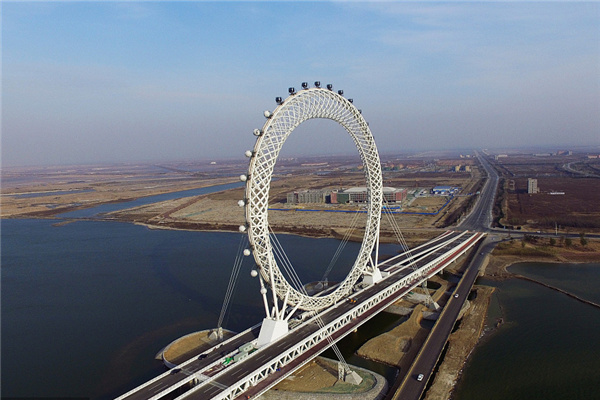 World's largest shaftless Ferris wheel built in China
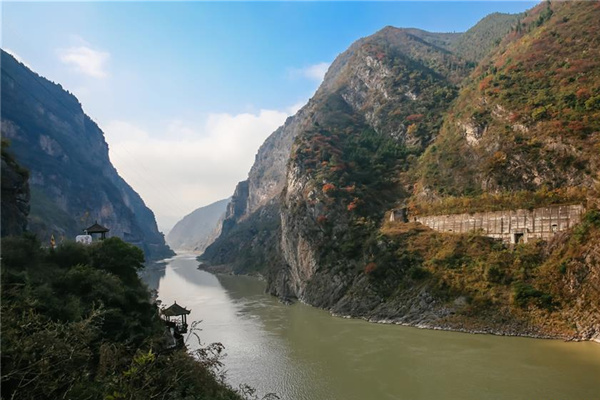 Ancient cities to be connected by Xi'an-Chengdu high-speed railway
 Snow turns Harbin into winter wonderland
 Reed Catkin Festival held in Wuhan
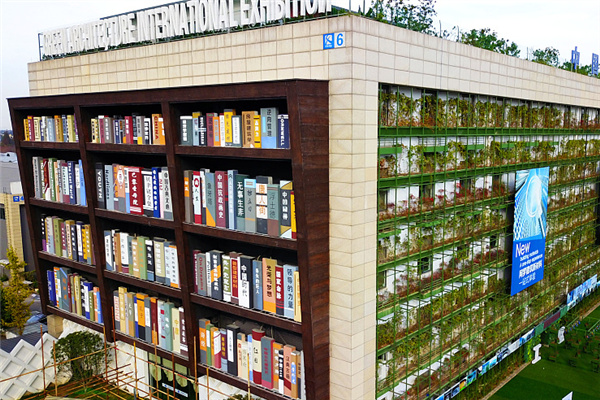 Is it a building or a bookshelf?
 First flight
 Polar icebreaker Snow Dragon arrives in Antarctic
 Xi's vision on shared future for humanity
 UN's top environmental honors go to three in China
 German trains collide near Duesseldorf, several people injured
 China beats Germany 7-4 in men's curling Olympic qualification
 Bayern beat Paris Saint-Germain 3-1 in UEFA Champions League


Copyright 1995 - . All rights reserved. The content (including but not limited to text, photo, multimedia information, etc) published in this site belongs to China Daily Information Co (CDIC). Without written authorization from CDIC, such content shall not be republished or used in any form. Note: Browsers with 1024*768 or higher resolution are suggested for this site.
License for publishing multimedia online 0108263 Registration Number: 20100000002731