Comments
  Print
Print  Mail
Mail  Large Medium Small
On a radio program in late April, the National Broadcasting Company (NBC) asked travel agencies and tourism spots across the US: "Are you ready? The Chinese tourists are coming!"
On June 17, China's first tour group to the United States will depart from Beijing, Shanghai and Guangzhou. In December 2007, the United States became the latest and the 134th Beijing-approved Chinese tourist destination. Chinese can now visit the United States in tour groups. In the past, the US issued relatively few individual tourist visas and more business travel visas to Chinese.

The US however, is not the only country where the tourist industry is gearing up for an upsurge in Chinese tourists.
"The Chinese are coming! The Chinese are coming! and travel operators, hotel companies and airlines worldwide are all counting them on to drive demand," according to a February 29 Financial Times Web article.
Last year, 40.95 million Chinese went abroad, an 18.6 per cent increase from the previous year, according to the China National Tourism Administration. "This year, we will see another 10 percent increase with the total number expected to reach 45 million," Tourism Administration Director Shao Qiwei said at the administration's annual meeting in January. This is in contrast to a total of 10 million in the 12 years between 1988 and 2000.
Earlier, the United Nations World Tourism Organization, (UNWTO), the leading international organization in the field of tourism, had forecast that by 2020 the number of Chinese tourists will reach 100 million and China would become the world's fourth largest source of tourists. Many now believe that forecast is too conservative.
"International travel is no longer something a dream for the Chinese people," said He Jian, an employee of a German company in Beijing who has traveled to over 20 countries in the past several years. "For me, it is part of my lifestyle."
An industry takes off
Twenty years ago, it was a dream for most Chinese. China's first approved foreign tourist destination for Chinese travelers was Thailand in 1988. In November of 1988, travel agencies in Guangzhou, capital of South China's Guangdong province, started to organize Chinese travelers to visit Thailand. Before that, beginning in 1983, mainland residents could only tour Hong Kong and Macao.
For a whole generation of Chinese who still had vivid memories of how people with overseas relatives or connections were investigated and persecuted during the "cultural revolution" (1966-76), going abroad seemed to be out of question.
For one thing, travelers had to submit proof of financial sponsorship from relatives or friends overseas to obtain permission to go abroad. For another, in 1988, Chinese had an average annual disposable income of only 1,119 yuan. Even traveling to a scenic spot in a neighboring province was a luxury reserved for honeymooners. Travel abroad was just out of the question. But in the 1990s, with growing prosperity and a rising numbers of nouveau riche, the tourism industry took off. The first batch of local tour agencies obtained business licenses in 1991 to do overseas tours. Many industry experts regard this as the beginning of China's overseas tourism industry.
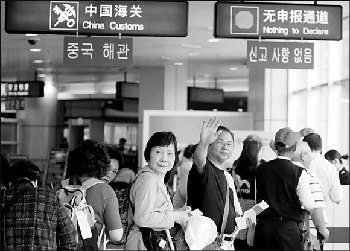
Only a dozen Asian countries and Australia and New Zealand were accessible to Chinese tourists before 2000, and Singapore, Malaysia and Thailand were the prime choices at that time. A trip to these three countries which cost 10,000 yuan, was widely used by some companies to reward hard-working employees, by sons and daughters as gifts to their parents, and even by students to show gratitude to their teachers. Many newlyweds chose these three destinations for their honeymoon.
Even now, these three countries remain the first trip abroad for Chinese tourists. As described in a May 27, 2006 New York Times article about a cruise on the Chao Phraya River in Thailand, every few minutes, one boatload of Chinese tourists would encounter another boatload of Chinese tourists. "The passengers hailed one another back and forth cheerfully, in their own language, of course," the article said.
A breakthrough came in 2004 when 12 major countries in the European Union became destinations for Chinese tourists. The first Chinese tour group to Europe left Beijing on September 1, 2004 and received a red-carpet welcome at Charles De Gaulle Airport in Paris. The French minister of tourism and other high-ranking tourism officials lined up to greet the 55 members of the tour group. The media reports at the time said the mayor of Paris even guided part of the tour.
Tours to Europe marked an important transition for Chinese tourism. Asian destinations were no longer enough. Now, Chinese tourists can be found at most of the major tourist attractions around the world, from the Eiffel Tower in Paris to Sun City in South Africa, from the Taj Mahal in India to the Gold Coast in Australia, and from the rain forest in Brazil to Red Square in Moscow.
"From Southeast Asia, to Europe, to Africa, Chinese tourists are now going further and further," a manager with China Comfortour Travel Service told The Beijing Times. Now, they are ready to explore New York City, Las Vegas, Disney World and the Grand Canyon.
Impact
While Chinese tourism is confined to cultural and natural wonders, Chinese tourists often find department stores, boutiques with luxury merchandise, and duty free shops as - or even more attractive - than museums and scenic spots.
Although many of the world's luxury brands have set up shop in China, most of their stores are located in major cities such as Beijing, Shanghai, Guangzhou and Shenzhen. Moreover, due to high tariffs, luxury products are much more pricy on the Chinese mainland than in Europe and Hong Kong.
That explains why shopping is an indispensable part of Chinese tourism. Most tourists have long shopping lists as they are not only shopping for themselves, but for relatives and friends.
Seeing Louis Vuitton and Gucci boutiques packed with Chinese tourists is a common sight in major cities now. In department stores, they buy handbags, perfumes, watches, diamonds, and fashion, and leather products. In 2006, a Chinese delegation to Helsinki, Finland bought all the reindeer hides in the city's biggest department store.
There were even reports of anxious Chinese tourists near the Louis Vuitton boutique on the Champs-Elysees in Paris asking other Asians if they could borrow their passports in order to buy more Louis Vuitton handbags. That Louis Vuitton store only allowed the purchase of two handbags per foreign passport.
The consulting firm Ernst & Young has predicted that China will surpass the United States to become the world's second largest consumer of luxury goods by 2015, next only to Japan.
Sales of luxury goods would exceed US$11.5 billion in 2015, or 29 percent of the world's total, according to the Ernst & Young.
An AC Nielson report released in 2007 showed that the average expenditure of Chinese tourists abroad is $3,000. In Europe, where there is more access to luxury products, the average expenditure was $5,253. The report was based on a survey on 1500 people in Beijing, Shanghai and Guangzhou who traveled abroad in 2006.
According to the report, Chinese tourists spend an average of $987 on shopping in one trip abroad, which is among the highest worldwide.
Some 70 per cent of visitors from the Chinese mainland to Hong Kong said their priority is shopping, particularly for cosmetics. Beijing Daily reported that the average expenditure of Chinese tourists in Australia was about 20,000 yuan. In addition to luxury brands, they also love the wool products and precious stones produced in that country.
Manners
Besides buying sprees in department stores and boutiques, Chinese tourists can also stand out in restaurants.
If you go to a restaurant in a quiet town in Europe and are surprised by the noisy atmosphere inside, it is very possible that it's generated by a Chinese tour group.
Talking loudly, spitting, refusing to line up, smoking in no-smoking areas, and disregarding traffic lights have been some of the bad manners displayed by Chinese tourists.

"Some tourists also take pictures regardless of whether they are permitted to or not, and jump over barriers when signs say 'No trespassing'," Liang Yuan, manager of China Travel International's overseas tourism marketing department told China Daily in an earlier interview.
In the week-long May 1st and National Day holidays in 2006, tens of thousands of people flocked to Disneyland in Hong Kong. Some were caught on camera littering, spitting, and being ill-mannered. Many of these pictures were published in newspapers and on the Internet, triggering a heated debate on the manners of Chinese tourists abroad.
As a result, the China National Tourism Administrations and nine other government departments joined forces last year to launch a nationwide campaign to educate people to mind their manners when they travel.
"The behavior of some Chinese travelers is not compatible with the nation's economic strength and its growing international status," an administration circular stated.
After seeking public input, the administration issued guidelines instructing people on what they should do and should not do. The campaign received 30,000 suggestions from home and from abroad. More than 3 million people participated in the discussions.
Posters, brochures and TV ads promoting the campaign and its new logo appeared at bus stations, railway stations and airports in early 2007.
Travel agencies were also urged to remind travelers to watch their behavior, and to explain to them the social conventions and etiquette of their destination countries before departure.
In March, Wu Zixiang, a deputy of the National People's Congress, even suggested banning some tourists with bad records of behavior overseas from traveling abroad again.
Observers say this should be a long-term campaign. Chinese tourism abroad has only been going on for 20 years. It takes time to nurture a mature travel culture.

(China Daily 06/09/2008 page2)

 Night views of Harbin through the lens
 Tibetans take train home after pilgrimage or travelling
 World's largest shaftless Ferris wheel built in China
 Ancient cities to be connected by Xi'an-Chengdu high-speed railway
 Snow turns Harbin into winter wonderland
 Reed Catkin Festival held in Wuhan
 Is it a building or a bookshelf?
 First flight
 Polar icebreaker Snow Dragon arrives in Antarctic
 Xi's vision on shared future for humanity
 UN's top environmental honors go to three in China
 German trains collide near Duesseldorf, several people injured
 China beats Germany 7-4 in men's curling Olympic qualification
 Bayern beat Paris Saint-Germain 3-1 in UEFA Champions League


Copyright 1995 - . All rights reserved. The content (including but not limited to text, photo, multimedia information, etc) published in this site belongs to China Daily Information Co (CDIC). Without written authorization from CDIC, such content shall not be republished or used in any form. Note: Browsers with 1024*768 or higher resolution are suggested for this site.
License for publishing multimedia online 0108263 Registration Number: 20100000002731