Homegrown hearts power domestic smartphone sector
 |
|
A researcher works on a semiconductor product at Tsinghua Unigroup research center in Beijing. [Photo/Agencies] |
Mobile chip market is no longer dominated by foreign brands as local manufacturers fight back to grab a slice of the market
A nanosecond is a long time in the semiconductor sector while three years is an eternity.
Back in 2013, Chinese smartphone chipmakers had a mountain to climb against global rivals such as Qualcomm Inc in the United States.
They barely even had a presence in the low-end segment of the market.
But all that changed after the government rolled out new policies and domestic players broke through technological barriers.
"Three years ago, we relied chiefly on a price war to crack the market," said Li Liyou, CEO of Spreadtrum Communications Inc, one of the largest chipmakers on the Chinese mainland.
"But as more resources were poured into research and development, we saw a fundamental change," Li added.
Plans to upgrade the homegrown chip industry are in line with the central leadership's call to turn China into a manufacturer of quality.
"We will move Chinese industries up to the medium-high end of the global value chain, and foster a number of world-class advanced manufacturing clusters," Party General Secretary Xi Jinping said at the opening of the 19th National Congress of the Communist Party of China in Beijing on Wednesday.
Data from research agency IC Insights revealed that 11 Chinese companies were on the global top 50 list for integrated circuit designers in 2016. Only one domestic business was on it in 2009.
Spreadtrum Communications Inc is a classic example of what is happening inside the industry. It produced more than 600 million smartphone chips last year, accounting for over 25 percent of the world's total shipments.
Huawei Technologies Co Ltd, the world's third largest smartphone manufacturer, is also making inroads with its in-house Kirin chips.
In 2014, China's largest telecom equipment maker was struggling to upgrade its semiconductor division, despite putting together a program a decade earlier.

But now most of its smartphones, including high-end models, are powered by Kirin chips. Last month, the Shenzhen-based business unveiled its first artificial intelligence chip, Kirin 970, with superfast computing and strong image-recognition capabilities.
It powers Huawei's new Mate 10 smartphone, which was launched on Monday to compete with Apple Inc's 10th-anniversary iPhone.
"AI can enable real-time language translation, heed voice commands, or take advantage of augmented reality, which overlays text, sounds, graphics and video on real-world images," said Yu Chengdong, CEO of Huawei Consumer Business Group.
Figures released from the China Semiconductor Industry Association showed that the domestic chip sector reported sales of 434 billion yuan ($65 billion) last year, an increase of 20 percent compared to 2015.
Xiang Ligang, a telecom expert and CEO of industry website Cctime, pointed out that Chinese companies are now benefiting from the government's policy to cultivate a domestic chip industry.
The program was put in place amid concerns that a heavy reliance on foreign technology would affect national security.
There were also other reasons, such as the fact that China was spending more on overseas chips than crude oil imports.
In 2014, Beijing set up China's Integrated Circuit Industry Investment Fund to support the sector and spur private financing.
One of the biggest beneficiaries was Tsinghua Unigroup, the parent company of Spreadtrum.
Earlier this year, it signed financing deals worth 150 billion yuan to carry on R&D into new homegrown chips.
This will give the State-owned technology group enough cash to fulfill its grand ambitions in the semiconductor sector, and join the ranks of global giants, such as Intel Corp, Qualcomm and Samsung Electronics Co.
Among the investors are China Development Bank and China's Integrated Circuit Industry Investment Fund.
"The next several years are key ... there is an enormous market out there," said Zhao Weiguo, chairman of Tsinghua Unigroup.
To illustrate that, Tsinghua Unigroup is now working on a $30 billion domestic memorychip production complex in Nanjing, Jiangsu province.
It will become China's largest plant when completed.
Private companies, such as Xiaomi, are also making major strides. The smartphone manufacturer unveiled its first in-house chipset in March.
Named Surge S1, the chip combines four powerful and efficient cores, which can help strike a balance between performance and power efficiency.
"Chip technology is the crown in the smartphone sector, but it is highly cash intensive," said Lei Jun, founder and CEO of Xiaomi.
"If we want to challenge the world's top three players, we need to devote our long-term efforts into the research and development of chips," Lei added.
 |
|
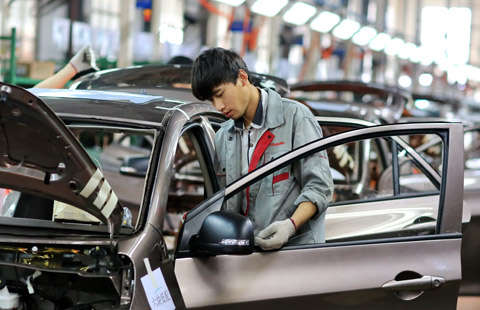
Workers on a production line of chip and main board products at a FiberHome Technologies Group factory in Wuhan, capital of Central China's Hubei province. [Photo provided to China Daily] |