Boost your AIQ-China's Transformation into an AI economy
Rarely does a new technology transform consumption, production and society. But with artificial intelligence (AI), that technology has arrived. Yet new research conducted by Accenture has found that many large businesses do not fully appreciate the value of AI. The same cannot be said for entrepreneurs and startups, who are in the vanguard of this revolution. Many of them are based in China, which has become a powerhouse of innovation in deep learning, sensors, predictive maintenance and intelligent robotics.
Funding for AI startups worldwide has grown at a compound annual growth rate of nearly 60 percent since 2010. China has filed more than 8,000 AI patents in the five years to 2015, a 190 percent growth rate that outpaces other leading markets significantly.[i] Growth is driven partly by the largest digital user base in the world. China is generating new data, particularly from mobile users, faster than any other country.
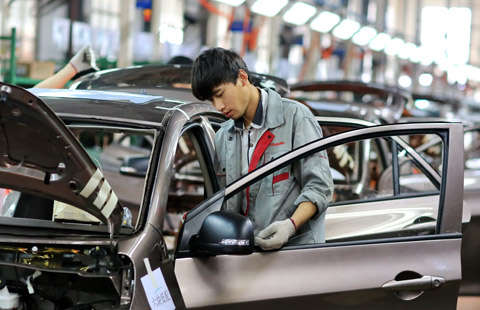
For many, AI is a solution to a common problem: the need to improve efficiencies and reduce costs. Accenture analysis shows that AI could boost China's productivity by 27 percent by 2035. There is no doubt that AI can automate many processes, strengthening the bottom line.
But AI has a far greater opportunity to create entirely new categories of products and services. It will establish new markets and drive growth. AI's boost of the topline is reflected in our estimate that annual economic growth rates in China could increase from 6.3 percent to 7.9 percent in 2035 if companies harness AI to transform their entire business models. That would generate additional economic output of more than $7 trillion at that time.
To achieve this growth potential means going beyond using AI to do things differently and, instead, using it to do different things. For example, JD.com, the online retailer, is exploring AI to improve internal operations through unmanned warehouses and drone delivery, but is also applying it to personalize the shopping experience and develop new products and services. Alibaba partners with SAIC to connect their cars to the internet and is introducing new cloud-based AI services targeting the health care and manufacturing sectors.[ii][iii] Tencent, the provider of WeChat, is developing virtual assistants and autonomous driving among other applications.
China also has many successful AI startups. For example, Malong Technologies' product recognition AI uses deep learning, which among other uses, that it applies to analyze worldwide fashion color trends to help thousands of textile makers predict global fabric demand.
Breakthroughs such as these require businesses not just to develop innovations, but also to scale them. This means pivoting wisely the bulk of investment from core products and services to new ones while, at the same time, continuing to transform the core. Do companies build in-house capabilities, work with partners or buy technologies from the outside? When looking at a global sample of Fortune 100 companies and Accenture's global index of 100 AI-driven enterprises, we found that 27 percent did one or the other well, and 56 percent did neither sufficiently. Only 17 percent scored high on both counts. This gives these 'Collaborative Inventors' a higher AIQ than the rest (see graph).

Companies with a high AIQ use it to focus on three strategic priorities: technology, data and people. 'Collaborative Inventors' know how to integrate combinatorial AI technologies, embracing a platform-based approach.
Most important, people are at the heart of AI. And AI-driven companies need to source a diverse range of talents – from data scientists to behavioral experts to those steeped in functional or industry contexts.
One of the core differentiators of China's AI scene is the establishment of a multi-stakeholder environment that involves both the private and public sectors. For example, Baidu has been appointed by the National Development and Reform Commission to lead the national lab on deep-learning technologies and applications. The lab will not exist in a physical structure, but via a virtual, digital network of researchers working on problems from their respective locations.[iv] China also benefits from having a fast-growing domestic platform economy which provides a foundation from which its AI startups can succeed abroad.
These are early days for AI. In the rush of investment and innovation that we can expect in the coming years, it is therefore important that AI leaders in China remain committed to responsible AI. That means AI-based business practices and technologies must be transparent, accountable and fair. Above all, it means that AI must be human-centric. Responsive and responsible innovators in China will appreciate that AI is not about eliminating people, but elevating them. It's not just about automating what people do, but augmenting their capabilities.
As China advances the Fourth Industrial Revolution through its strength in AI, it can do no better than to adhere to the principle: AI for the people, by the people.
Paul Daugherty is chief technology & innovation officer at Accenture, and Francis Hintermann is managing director, Accenture Research.
________________________________________
[i] http://asia.nikkei.com/Business/Trends/China-AI-patent-submissions-shoot-up
[ii] http://www.scmp.com/business/companies/article/1986325/saic-alibaba-launch-internet-connected-car-aimed-chinese-mass
[iii] https://venturebeat.com/2017/03/28/alibaba-cloud-launches-ai-services-for-health-care-manufacturing/
[iv] The Chinese government is funding a new lab from China's most powerful AI company, Business Insider, February 2017.http://www.businessinsider.com/baidu-artificial-intelligence-lab-funded-by-chinese-government-2017-2http://www.businessinsider.com/baidu-artificial-intelligence-lab-funded-by-chinese-government-2017-2