BEIJING - An orange fish swims along an underwater pipeline, searching for leaks. After finding the holes, it alerts workers on shore with a loud sound.
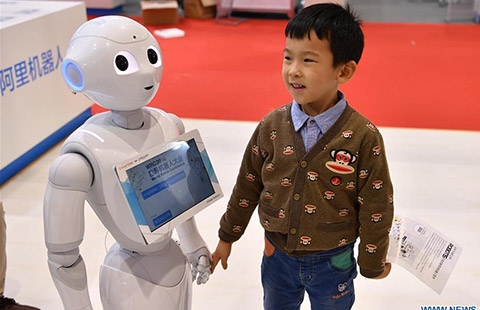
This isn't a trailer for the latest Disney cartoon, but a real-life demonstration at the 2016 World Robot Conference (WRC) in Beijing.
The clever "mechanic" here is SmartTuna, a robot developed to help fix leaking underwater pipelines.
"Sometimes it's dangerous to go down into the water, so we developed the robot," said one of the demonstrators. "It is precise, small and smart."
More than 2,000 competitors from over 10 countries and regions, along with 300-plus top experts from 11 countries, are in Beijing to show off and share ideas during the five-day conference.
With an aging workforce and rising labor costs, China is determined to drive robot development. According to statistics released by the Qianzhan Industry Research Institute, the output value of China's homegrown robots in 2015 stood at 1.64 billion yuan (243 million U.S. dollars), a year-on-year increase of 55 percent.
At the conference, Vice Premier Liu Yandong urged enhanced research and development of the industry. She said related policies should be improved, human resources should be developed and global communication should be enhanced.
"I see a bright future in robots," said one of the visitors at the conference. "Our society is progressing, and so are our needs for robots in our daily lives."
Industrial robots dominate
Industrial robots were well-represented at this year's WRC. According to the organizer, industrial robots account for about 40 percent of all robots on display at the show, while the rest are service robots and specialized robots.
One conference participant showed Xinhua an industrial robot designed to produce "ejiao," or donkey-hide gelatin, a Traditional Chinese Medicine tonic made by boiling and refining donkey skin.
"With the robot, we can cover the entire ejiao production process automatically, including boiling, refining, storage, transportation, cutting and packaging," said Zhu Lei, vice president of HIT Robot Group based in northeast China's Harbin Province. "It is faster than traditional methods and saves on labor."
The Chinese market for industrial robots is huge. According to the China Robot Industry Association, 68,000 industrial robots were sold in China in 2015, up 20 percent compared to the same period of 2014. China accounted for about a quarter of robot sales globally in 2015, making the country the biggest market for industrial robots for three consecutive years.
Meanwhile, 32,996 industrial robots were manufactured in China last year, up 21.7 percent year on year.
The country wants to be able to make 150,000 industrial robots in 2020, 260,000 in 2025 and 400,000 by 2030. If achieved, the plan should help generate a market value of 600 billion yuan over the next decade.
Helpful and "human"
Among the conference highlights are service robots, which industry insiders say have been used in catering, education, banking services, government institutions and sports.
Shanghai-based Hefu Holding Company Limited displayed a smart robot that plays badminton, one of the most popular sports in China. Holding a racket, the robot played with a human partner, always knowing just where and when to hit the shuttlecock.
"This is so interesting," said a visitor surnamed Wang. "I want a robot like this!"
At a booth nearby, an old man robot in traditional Chinese clothes was writing strokes with a brush on white paper, its eyes blinking occasionally. The android is based on the appearance of ancient Chinese philosopher and psychologist Wang Yangming. The robot not only writes Chinese characters, but also gives psychological counseling to the public.
In another booth, a robot named Alan was meandering about on wheels. The developer told Xinhua that Alan was trying to familiarize itself with its environment.
"After it remembers all the routes, you can control it through orders," said a staff member with Robot4u Technology Co. Ltd, the developer. "Alan can do a lot of tasks, such as cooking, picking up garbage, and even sewing."
This year, the company has already received orders worth more than 100 million yuan.
Service robots have seen a rise in numbers at the show. Last year, they accounted for about 30 percent of all robots on display at the WRC, but this year the number has jumped to 35 percent, according to the organizer.
"I think there are bright prospects for service robots in China," Wang Xiangyi, vice president of Turing Robots, said in an interview with Beijing Business Today.
"Service robots for housekeeping, entertainment and caring for the sick are already having a big impact."
Xu Xiaolan, secretary-general of the conference, said that service robots are becoming smarter and "more human," allowing them to communicate better with people. "There is huge demand for such robots, and related technology is improving greatly," she said.
More favorable policies
As demand rises, the government is seizing the opportunity to boost robot development in China.
In April, the Ministry of Industry, the Development and Reform Commission, the Ministry of Finance and other ministries jointly issued a development plan for the next 5 years.
The plan lays out the industry's five tasks, including key breakthrough products, key components, and significant improvement of technical reliability, market share and competitiveness of leading enterprises.
Despite government support, challenges remain, said Niu Nutao, a national lawmaker and an official in charge of the information sector in east China's Anhui Province.
"China has yet to see the wide use of robots, and the sector is hindered by a shortage of talent and industry leaders that can face global rivals, such as ABB and Kuka," Niu said, adding the Chinese market is still dominated by overseas products as homegrown companies have not mastered core technology.
Niu advised policymakers to include the robot sector in its national strategy.
"The government should make more efforts to support R&D, nurture skilled technicians, foster leading enterprises and formulate guidelines to prevent overcapacity," said the official.


Copyright 1995 - . All rights reserved. The content (including but not limited to text, photo, multimedia information, etc) published in this site belongs to China Daily Information Co (CDIC). Without written authorization from CDIC, such content shall not be republished or used in any form. Note: Browsers with 1024*768 or higher resolution are suggested for this site.
License for publishing multimedia online 0108263 Registration Number: 130349