Comments
  Print
Print  Mail
Mail  Large Medium Small
 |
|
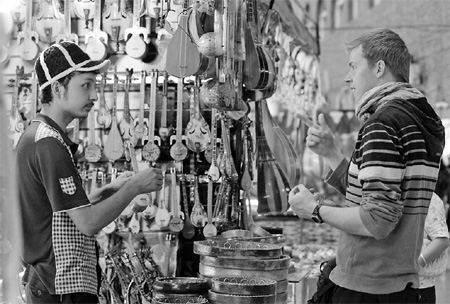
Bazaars, usually built along Islamic style, offer a chance to walk back in time to the days of the Silk Road in ancient China.[Photo/China Daily] |

It is a land that is wild and unfettered, a land of snowcapped mountains and highland pastures. Wang Ying explores the natural paradise that is Xinjiang.
My impressions of Xinjiang started even before my plane landed. From my cabin window, I marveled at the unscarred beauty of Tianshan, the "heavenly mountains" and one of the longest ranges in central Asia, cutting across the middle of Xinjiang Uygur autonomous region before continuing into Kazakhstan.
A fellow traveler told me in the cabin that this was the perfect time to enjoy the magnificent view.
"Imagine purifying your soul and shedding any spiritual burden when you are embraced by this magnificent view," she said.
We finally landed at Urumqi, capital of Xinjiang, on a sunny afternoon after a five-hour flight of more than 3,000 kilometers.
Urumqi means "beautiful pasture" in Mongolian and the city hosts a population of 2.31 million made up of 47 ethnic groups, including the Uygur, Han, Kazakh and Hui.
Walking along the main streets of the city, you find it no different from any other major Chinese city, except that two languages are both written and spoken here, and a few people are wearing traditional Islamic robes and scarves.
Urumqi was already a prefecture as early as 640 AD in the Tang Dynasty, but it did not develop rapidly until the reign of Qianlong (1711-1799), the fourth emperor of the Qing Dynasty. Progress was spurred by cuts in agricultural tax and the encouragement of commerce and manufacturing.
Over thousands of years, the city has maintained its traditions, including culinary ones such as its famous kebabs.
Strolling through the streets, you can be easily distracted by the enticing smell of braised mutton or the aroma of kebabs being grilled. Although there are many cities across the nation that sell kebabs, the Xinjiang kebabs are in a class of their own, as synonymous with the region as duck is with Beijing.
Here in Xinjiang, the mutton cubes are dusted with pepper, cumin and other spices and they send out a unique fragrance as they cook.
Polo, or pilaf, is known as shouzhuafan - literally, rice eaten with the hands. The rice is cooked with spicy mutton and lots of carrots and onions. Visitors are allowed to use a fork or spoon until they master the art of using their fingers, the locals say.
It is usually washed down with a bottle of pomegranate juice or yogurt, the perfect accompaniment to a delicious Xinjiang lunch. Thanks to the special geographical conditions, such as stronger sunshine and steeper diurnal temperature ranges, Xinjiang's fruits are sweeter and tastier than those from other provinces. Produce include raisins, figs, watermelons and its famous hami melons.
Yogurt is also typically eaten here as Xinjiang has a very developed pastoral industry. Various products made from milk titillate your taste buds.
Another spectacular place to visit in Xinjiang is the bazaar, which means market in the Uygur language.
When I arrived at the Xinjiang International Grand Bazaar, it was already 3 pm, but the sun was still shining very bright and strong. If you go, remember your cap and sunglasses.
The bazaar is constructed in an Islamic style, representing the predominant religion and culture. It spreads across 100,000 square meters and is the largest in the world.
In the middle of the bazaar is an 80-meters high tower where tourists can scan the surroundings and capture the panoramic view of the city.
The bazaar is really a huge trade fair, selling Xinjiang specialties of every kind from raisins, jujubes, prunes, traditional embroidered hats, knives, Etles silk - a type of traditional silk that is tie-dyed, Pakistani bronzes and jade articles.
Striding from one stand to another, hearing vendors talk in different languages, and looking at ethnic women and young girls in their finery, I felt like I was walking back in time to the days of the Silk Road in ancient China.
In the morning, I cannot wait to see Tianchi, the Heavenly Pool or lake. After an hour and a half of driving, we finally arrived at the crescent-shaped lake. The early spring sunshine was still too mild, so the lake was covered with thick ice.
Many tourists braved the cold to walk on the ice, and the scenery looked to me like a Chinese ink-and-brush painting come to life.
According to our guide, the beautiful lake is an ideal resort in the summer. Boaters on the lake can watch the ever-changing mountains soar into the blue sky, their slopes blanketed by verdant meadows full of alpine flowers. The lake also attracts fishermen at dusk, when the scenery becomes almost fairyland-like.
Tianchi has a romantic legend as well. It is said that the Queen of the West (Xiwangmu) met King Mu of the Western Zhou Dynasty (1100 BC-771 BC) at the lake, and they fell in love with each other. Nobody knows why the king did not return as promised, but the placid lake and the silent mountains became the setting for the lovesick queen as she waited and wilted and changed from a young beauty to a sad old lady.
My two-day visit barely scraped the surface of this charming city, and it will take tourists several more days to fully explore and enjoy the attractions of Urumqi and the other parts of Xinjiang such as scenic spots like the Red Hill, Nanshan Pastures, Grape Valley, Flaming Mountain, Karakul Lake, and perhaps take the Silk Road tour.
 |
|
Tianchi, the Heavenly Pool or lake, is like a Chinese ink-and-brush painting come to life.[Photo/China Daily] |
 |
|
Left: Fruits here are said to be sweeter and tastier than those from other provinces. Hami melons are the most famous. Right: Polo, or pilaf, is known as shouzhuafan - literally, rice eaten with the hands.[Photo/China Daily] |
 Top 10 emerging cities on the Chinese mainland
 Christmas comes early to Santa's workshop in Yiwu
 World's top 10 largest shipping centers
 Aircrafts show aerobatics at 2015 Shenyang Faku Intl Flight convention
 Top 5 Chinese smartphone vendors targeting India
 Eight sectors that benefit from Chinese Valentine's Day
 Modern 'feng shui master' revamps ancient discipline
 Lanzhou New Area Free Trade Zone in the pipeline
 Caixin flash China manufacturing PMI hits 77-month low in August
 Chinese provincial regions see faster H1 GDP growth

 Hot air balloon festival kicks off in Czech Republic
 Sail Amsterdam 2015 nautical festival kicks off
Copyright 1995 - . All rights reserved. The content (including but not limited to text, photo, multimedia information, etc) published in this site belongs to China Daily Information Co (CDIC). Without written authorization from CDIC, such content shall not be republished or used in any form. Note: Browsers with 1024*768 or higher resolution are suggested for this site.
License for publishing multimedia online 0108263 Registration Number: 20100000002731