More than 10 percent of China's land area has been shrouded in thick smog for the past few days, with the level of PM2.5 (particulate matter with a diameter of 2.5 micrometers or less and very harmful to humans) frequently exceeding the danger level in many cities.
Recent meteorological conditions such as temperature inversion, high humidity and low wind speed could be blamed for the smog. But in the final analysis, excessive consumption of coal and the high rate of emissions are the key causes of air pollution.
China is the largest consumer of coal. Coal makes up 70 percent of its energy structure. In 2000, the country consumed 1.4 billion tons of coal. By 2012, that figure had increased by 152 percent to more than 3.5 billion tons, or half of the global consumption. The burning of coal - intense in the power generation, steel and cement industries - is the primary source of air pollution in China, making it the top emitter in the world. Latest data show that coal burning accounts for nearly 90 percent of the sulfur dioxide discharge, and about 70 percent of nitrogen oxides and smoke.
It is thus high time for China to rethink its energy structure. For example, it should cut its coal consumption to reduce emissions and control air pollution. While doing so, however, the authorities need to pay immediate attention to certain factors.
First, the government should impose strict measures to reduce emissions, because data suggest that emissions have to be reduced by at least half for the air quality to show any substantial improvement. This is also important because despite achieving some results in emission reduction, power generation companies still emit huge volumes of nitrogen oxide. So only a rigid emission standard and the fear of being heavily penalized for violating it can prevent industries from burning excessive coal and aggravating pollution.
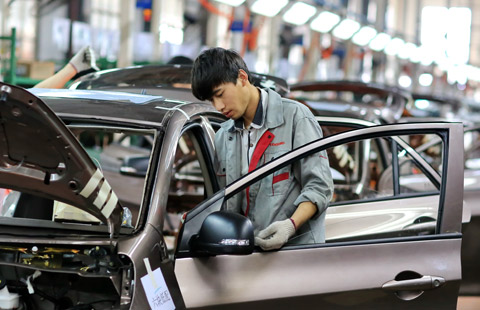
Second, the functioning of the coal industry should be tightly controlled to get the optimum benefits from China's industrial structure. Although the outputs of China's power, steel and cement industries account for half the world's total, the utilization capacity of the steel and cement sectors are 72 percent and 74 percent of the global average, which means overcapacity. Moreover, media reports say China is building a new coal power base in the western region to generate 70 million kilowatt in the initial stage, accounting for 8 percent of the country's total installed coal power capacity. If such high-energy-consuming and pollutant-emitting industries cannot be effectively controlled, the air pollution problem will certainly worsen. So imposing restrictions on polluting industries and improving the utilization capacity of all sectors are two of the best ways to improve air quality in China.
Third, the authorities have to impose stricter pollution-control measures in some key areas. The emission of air pollutants in China's central and eastern regions is above the national average because coal consumption there is very high. Therefore, stricter pollution-control measures should be imposed on the Beijing-Tianjin-Hebei and Yangtze River Delta regions. The Beijing-Tianjin-Hebei region has already worked out a specific plan to reduce coal consumption while the Yangtze River Delta region has vowed to realize negative growth in coal consumption. However, other areas like Shanxi province and the Inner Mongolia autonomous region have not yet come up with any control policy, which the authorities need to change immediately. Finally, the government should expedite the process of adjusting the energy structure of the country and decrease the coal consumption both in quantity and in ratio to total energy consumption. In the existing energy structure, the coal consumption ratio is much higher compared with that in developed countries such as the United States and Japan, which creates difficulties in the path of China's transition to clean energy. By setting strict coal consumption standards and accelerating the development of new energy, like wind power and solar energy, China can eventually change its industrial structure.
The use of coal is closely related to air pollution in China. With the dense smog making people's life difficult in a good part of the country, the government needs to seriously rethink its coal use policy. If the central and local governments make fighting the smog an important political assignment, reducing coal consumption will become an economic and political opportunity for China to transform its economic growth model and ease the pressure on the environment.
The author is an analyst with Greenpeace.


Copyright 1995 - . All rights reserved. The content (including but not limited to text, photo, multimedia information, etc) published in this site belongs to China Daily Information Co (CDIC). Without written authorization from CDIC, such content shall not be republished or used in any form. Note: Browsers with 1024*768 or higher resolution are suggested for this site.
License for publishing multimedia online 0108263 Registration Number: 130349