Domestic industry battles to scale sunlit uplands
It's hard not to notice the huge tilting solar walls at the headquarters of Suntech Power Holdings, the world's largest producer of silicon solar modules, located in Wuxi city, East China's Jiangsu province. Through the use of solar power, the walls provide 80 percent of the electricity required by the building, with zero emissions of air pollutants.
The solar power industry, globally, is being overshadowed by falling prices and slowing demand. Moreover, Chinese solar panel manufacturers are facing the possibility of stiff new tariffs from the US Commerce Department which, if approved, could come into force in October. However, there are few signs of recession at Suntech's manufacturing base.
"The production line is operating normally. And we are well prepared with our internationalized production," said Zhang Jianmin, senior manager of the CEO's office. Suntech exported 460 megawatt modules to the US last year, accounting for 23 percent of the company's total global shipments.
Since the beginning of the year, all the modules Suntech has exported to the US have been fitted with solar cells made outside the Chinese mainland, mainly in Taiwan which will not be subject to the proposed tariffs.
|
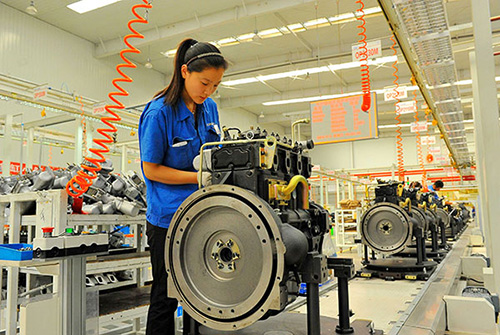
 A workshop at Suntech Power Holdings, the world's largest producer of silicon solar modules. Its products could be subject to a levy of 31 percent, if proposed new tariffs on Chinese-made solar panels are approved. [Photo/China Daily]
|
Smaller producers are suffering the most. "We have lost all overseas orders and are relying simply on domestic orders now. So, we have stopped half of the production lines and lost almost 20 million yuan ($3.2 million)," said a man called Sun from Taizhou city, Zhejiang province, who was reluctant to reveal the name of his solar-module company for fear of alerting rivals to his problems.
Sun said he and some friends invested 200 million yuan in the company, which began production in 2009, but they now may have cause to regret their decision because of the current industry malaise.
Avoiding the tariff
On May 17, the Obama administration proposed the imposition of stiff new tariffs on Chinese-made solar panels, claiming that Chinese companies are improperly flooding the US market with government-subsidized products. While 61 specific Chinese companies, including Suntech, will be subject to the duty of about 31 percent, others will be subject to a rate of 250 percent. "It is impossible to remain price-competitive with a tariff of 31 percent," said Zhang. However, the duties only apply to solar cells, not to the modules in which they are assembled, which means manufacturers on the Chinese mainland can serve the US market with cells from alternative sources. And that is exactly what they are doing.
|

 |
Zhang admitted that the use of solar cells manufactured in Taiwan will push the price of his company's modules higher, and while he declined to provide figures, he insisted that the company's products will remain competitive in the US market.
At present, Taiwan has the capacity to manufacture solar cells capable of generating 7,300 mW, more than double the expected size of the US market, which is on course to be about 3,000 mW this year. The price of the cells is about 10 percent higher than those made on the mainland, according to PVMate, a photovoltaic industry magazine.
CEOs from other big solar players, including Changzhou-based Trina Solar and Suzhou-based Canadian Solar, also confirmed that they are using cells made outside the Chinese mainland to avoid the prospective tariff.
"The cost will be higher with the US duties on Chinese solar products. However, the increased cost will be transferred to the downstream US distributors, installers, and consumers," said Gao Jifan, CEO of Trina Solar, noting that several downstream US companies have been forced to delay their own projects because of uncertainties over policy and prices.
No one wins
In October, the US manufacturer SolarWorld, along with six other companies, complained that their Chinese counterparts were dumping panels at below cost, thus driving US manufacturers out of business. The alleged dumping has been cited as one of the reasons that the Silicon Valley-based manufacturer Solyndra closed its doors and filed for bankruptcy in 2011.
The Associated Press reported that the collapse of Solyndra embarrassed Obama and prompted sharp criticism from presidential hopeful Mitt Romney and other Republicans critical of Obama's green-energy policies. Those factors prompted the USDC investigation and the proposed new tariffs.
Industry insiders in China said the use of solar cells made in Taiwan would alleviate the problem, but would also narrow their profit margins. Furthermore, the new tariff will form a trade barrier and make the US market less accessible.
However, those affected by the fallout from the spat could also include downstream US industry insiders and consumers. AP reported that the new tariff could result in job losses, because US companies are both buyers of Chinese products and suppliers of materials.
The majority of US solar-panel installers oppose the tariffs, arguing that less-expensive imports have helped make the panels more affordable to US customers, in line with efforts by Obama and others to promote renewable energy, according to reports from AP.
Cheap Chinese-made solar panels helped to double the scale of installation in the US last year. Meanwhile, US solar companies are also concerned that China will retaliate.


Copyright 1995 - . All rights reserved. The content (including but not limited to text, photo, multimedia information, etc) published in this site belongs to China Daily Information Co (CDIC). Without written authorization from CDIC, such content shall not be republished or used in any form. Note: Browsers with 1024*768 or higher resolution are suggested for this site.
License for publishing multimedia online 0108263 Registration Number: 130349