'Made in China 2025' sees China's economy upgrade
Xinhua | Updated: 2017-06-13 17:04


BEIJING - The Internet of Things, artificial intelligence, smart homes and wearable devices are just a few of the high-tech concepts being pioneered and turned into products by Chinese companies.
A visit to the recently-concluded CES Asia in Shanghai, one of the largest exhibitions for high-tech products in Asia, offered a glimpse into how far China has advanced in smart manufacturing, with Chinese firms such as Huawei, Baidu and Haier exhibiting the latest in a series of sophisticated high-tech products, including self-driving vehicles.
Once a world factory known for producing low-value products, China is focusing on the next stage of its development. The "Made in China 2025" strategy aims to avoid "premature deindustrialization," according to Richard Kozul-Wright and Daniel Poon, two senior U.N. officials who recently wrote an article on the strategy.
"If it succeeds, it will have laid the institutional foundations for new sources of growth. And, as the benefits of innovation are diffused throughout the economy, China will move closer to its goal: becoming a high-income country," they wrote.
The "Made in China 2025" strategy, a roadmap released by the State Council in 2015 to guide the country's advanced industrial manufacturing, has seen steady progress in industrial capability, smart manufacturing, innovation, as well as product quality and branding.
A recent case in point was the home-grown passenger jet C919 that took its first test flight last month.
"The top-down design of the strategy is generally in shape, with other complementing plans going smoothly," according to Xin Guobin, deputy head with the Ministry of Industry and Information Technology.
"On the one hand, China has been increasing investment in research and development, leading to fast growth of patents and inventions, while on the other hand, the country has made breakthroughs in developing fundamental technologies, components, material and techniques," Xin added.
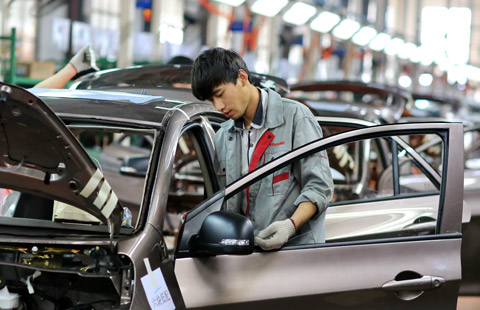
Average productivity was up by 38 percent for China's first 109 pilot projects in smart manufacturing, while operating costs dropped 21 percent.
The ministry has approved 12 pilot regions for the strategy, including cities such as Ningbo in Zhejiang Province and three city clusters in provinces such as Jiangsu. Some of them will be designated as national demonstration areas, which will receive favorable policies in investment, financing and other fields.
"The strategy has sometimes been portrayed as a return to old-school top-down mercantilist practices and import-substitution policies. But that reading overlooks China's active experimentation with industrial and financial policies. In fact, that experimentation may hold valuable lessons for policy evaluation and innovation elsewhere," according to Kozul-Wright and Poon.
Still there is much room for improvement, especially in the safety and stability of some products, and China has to import high-end equipment, core chips and key materials, according to Luo Wen, another senior official with the ministry.
"China will prioritize developing new information technologies and new material, while keeping steady industrial investment, expanding consumption and promoting international capacity cooperation," Luo said.
The European Union Chamber of Commerce claimed in a report in March that China's support for high-tech manufacturing would lead to worsening treatment of foreign companies, while allowing government-subsidized homegrown players to compete unfairly.
However, many have been eager to point out that central support of such industry is a common practice worldwide.
"Government guidance and financial support towards the high-tech sector are common global practices as the market entails huge investment and poses much risk and uncertainty," according to Xin. "Policies and measures under 'Made in China 2025' are applicable to both domestic and foreign businesses, and all companies will be treated equally."
A visit to the recently-concluded CES Asia in Shanghai, one of the largest exhibitions for high-tech products in Asia, offered a glimpse into how far China has advanced in smart manufacturing, with Chinese firms such as Huawei, Baidu and Haier exhibiting the latest in a series of sophisticated high-tech products, including self-driving vehicles.
Once a world factory known for producing low-value products, China is focusing on the next stage of its development. The "Made in China 2025" strategy aims to avoid "premature deindustrialization," according to Richard Kozul-Wright and Daniel Poon, two senior U.N. officials who recently wrote an article on the strategy.
"If it succeeds, it will have laid the institutional foundations for new sources of growth. And, as the benefits of innovation are diffused throughout the economy, China will move closer to its goal: becoming a high-income country," they wrote.
The "Made in China 2025" strategy, a roadmap released by the State Council in 2015 to guide the country's advanced industrial manufacturing, has seen steady progress in industrial capability, smart manufacturing, innovation, as well as product quality and branding.
A recent case in point was the home-grown passenger jet C919 that took its first test flight last month.
"The top-down design of the strategy is generally in shape, with other complementing plans going smoothly," according to Xin Guobin, deputy head with the Ministry of Industry and Information Technology.
"On the one hand, China has been increasing investment in research and development, leading to fast growth of patents and inventions, while on the other hand, the country has made breakthroughs in developing fundamental technologies, components, material and techniques," Xin added.
Average productivity was up by 38 percent for China's first 109 pilot projects in smart manufacturing, while operating costs dropped 21 percent.
The ministry has approved 12 pilot regions for the strategy, including cities such as Ningbo in Zhejiang Province and three city clusters in provinces such as Jiangsu. Some of them will be designated as national demonstration areas, which will receive favorable policies in investment, financing and other fields.
"The strategy has sometimes been portrayed as a return to old-school top-down mercantilist practices and import-substitution policies. But that reading overlooks China's active experimentation with industrial and financial policies. In fact, that experimentation may hold valuable lessons for policy evaluation and innovation elsewhere," according to Kozul-Wright and Poon.
Still there is much room for improvement, especially in the safety and stability of some products, and China has to import high-end equipment, core chips and key materials, according to Luo Wen, another senior official with the ministry.
"China will prioritize developing new information technologies and new material, while keeping steady industrial investment, expanding consumption and promoting international capacity cooperation," Luo said.
The European Union Chamber of Commerce claimed in a report in March that China's support for high-tech manufacturing would lead to worsening treatment of foreign companies, while allowing government-subsidized homegrown players to compete unfairly.
However, many have been eager to point out that central support of such industry is a common practice worldwide.
"Government guidance and financial support towards the high-tech sector are common global practices as the market entails huge investment and poses much risk and uncertainty," according to Xin. "Policies and measures under 'Made in China 2025' are applicable to both domestic and foreign businesses, and all companies will be treated equally."
Related Stories



Most Viewed in 24 Hours