Buoyant bond yields land firms in financing muddle


 |
|
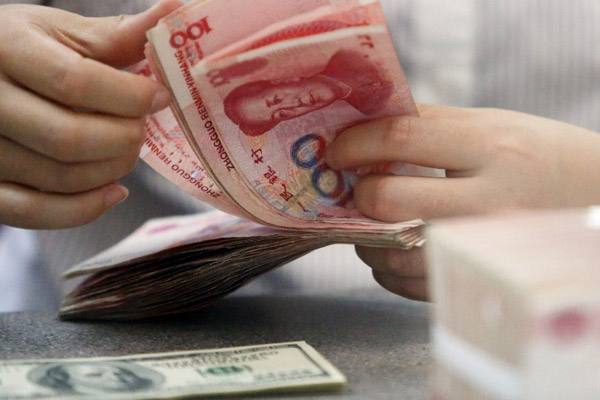
A worker counts Chinese currency renminbi at a bank in Linyi, East China's Shandong province, Aug 11, 2015. [Photo/Xinhua] |
For instance, the yield on five-year, AAA-rated corporate bonds reached 6.14 percent in May, in contrast to 3.12 percent in December, and the current five-year bank lending rate of 4.75 percent, according to Hithink Royal Flush Information Network, a financial information provider.
The uptrend began in December when Chinese policymakers drove money market rates higher to rein in companies' rising leverage and prevent systemic risks.
Ever since, the cost of selling corporate bonds has been rising, forcing companies to look for other ways of financing.
The People's Bank of China twice raised the cost of open market funds and medium-term loans this year, while keeping benchmark lending and deposit rates unchanged since October 2015.
While most blue chip companies are turning to bank loans in the short term, some of the rest are issuing dollar-denominated bonds overseas because of their relatively lower cost.
In some odd cases, bonds were issued at yields of 7 percent or more (Guizhou Logistics Park Project issued at 7.8 percent).
Some 394 bonds, which had sought to raise 369.43 billion yuan ($54.35 billion), the highest for the January-May period, were canceled, according to 21st Century Business Herald.
Bloomberg quoted Shen Bifan, an analyst at First Capital Securities, as saying that "with the benchmark lending rates on hold, companies might as well turn to bank loans if they can", rather than braving the bond market.
The rare interest-rate inversion is likely to be temporary, said a bond department director at a listed commercial bank who sought anonymity. "Adjustment of benchmark interest rates lags the bond market yields, but with supervision tightening and corporate leverage reducing, the cost of bank loans must rise finally.
"Companies that are able to get the benchmark interest rates are few, and in most cases, bond-issuers have to accept banks' buoyancy, which is more than 20 percent. So, the cost of loans may end up higher than direct financing costs."
Tian Yizhong, president of China Construction International Investment Fund, said that for companies seeking financing, the combined cost of loans and bond issuances cannot be directly compared with interest rates.
Dollar debt issuance overseas surged in the January-May period. Industry data show that as of late April, Chinese corporate bond-issuers, including enterprises and financial institutions, raised $71.4 billion from the G3 bond market overseas (bonds denominated in dollars, euros and yen), up 175 percent year-on-year.
"For firms of relatively better credit profiles and some large companies with their own businesses abroad, overseas bond issuance is a good choice, given the dollar appreciation and large spreads," said the bond department director.
But that option may cease in the wake of Moody's downgrade on May 24 of China's credit rating to A1 from Aa3, the same as that of Japan and the Czech Republic.
A Bloomberg report said Moody's downgrade may push Chinese companies to fall back on the local debt market. So, it is conceivable that they may borrow even more from domestic banks as overseas debt becomes more expensive.
"Even if the benchmark interest rate remains unchanged at 4.9 percent, the practical lending rates are not at a constant level of 4.9 percent," said Wang Yiqin, general manager of the asset management division of New Times Securities Co Ltd.
"In addition, the benchmark deposit and lending rates are expected to be raised in the near future, because they are now at the lowest level historically."
So, no matter which way companies raise finance, the related cost will continue to rise, piling up more pressure, he said.
"Periodical achievements of the leverage-reducing measures by the central government have already appeared. On Thursday, the central bank injected 498 billion yuan via its medium-term lending facility to ease a seasonal liquidity strain," the bond department director said.