Provinces pin high hopes on FTZs


Provinces prepare for new world of FTZs
By ZHONG NAN in Beijing and SHI XIAOFENG in Ningbo, Zhejiang
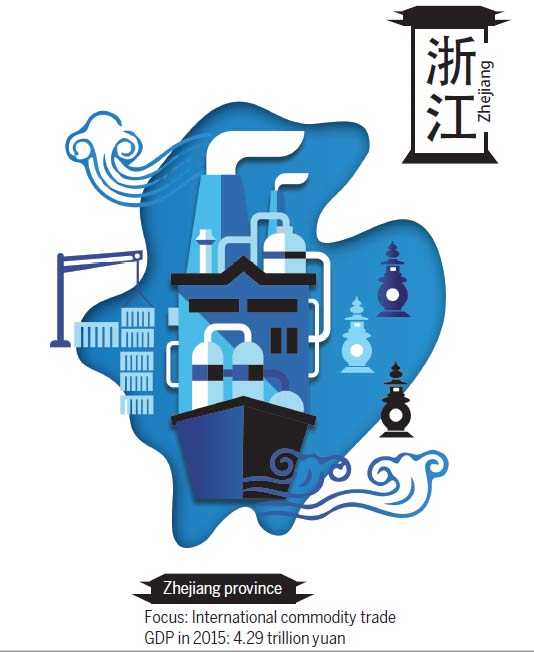
The group, which operates five giant ports, including Ningbo-Zhoushan Port, Jiaxing Port and Yiwu Port in Zhejiang, will invest 18 billion yuan ($2.61 billion) in the new facilities at selected ports and an industrial zone by 2020.
It will diversify its earnings ability to compete with established rivals such as the ports of Hong Kong, Singapore and Busan in South Korea.
"Many of these opportunities come from the eastern province's ability to rebuild itself as a free trade zone, as it is proficient in manufacturing, retail, e-commerce, food processing and other businesses," said Mao Jianhong, chairman of Zhejiang Seaport.
Mao said because China has a surging demand for importing crude oil, refined oil and liquefied natural gas, as well as allowing more foreign companies to set up businesses in the FTZ, it is necessary to develop energy-related services in the port areas.
Designed as a testing platform for economic reforms, an FTZ is able to lower the threshold for businesses to set up new companies, cut restrictions on capital flows, and offer more market access to foreign investment.
Even though the central government hasn't announced any date when the third batch of FTZs will be established, local governments, including Shaanxi, Sichuan and Hubei, have already begun preparing for the FTZs.
Zhao Runmin, director-general of the Shaanxi provincial department of commerce, said the experiences of the other four established FTZs would be looked at before the department makes any administrative reforms.
The central government approved the applications of FTZs in seven provincial-level regions in August 2016. They are Liaoning in the northeast, Shaanxi in the northwest, Zhejiang in the east, Henan and Hubei in Central China, and Sichuan and Chongqing in the southwest. Sichuan is expected to become a growth engine for the less-developed western region and improve the opening up of inland regions.
Chongqing will help to implement China's western development strategy. Hubei will build a base for high-tech industries and facilitate the development of the Yangtze River Economic Belt. Shaanxi will diversify trade connections with countries and regions along the Belt and Road Initiative. Henan will build itself up into a major logistics and transportation center. Zhejiang will accelerate trade liberalization and improve its capability in expanding e-commerce businesses and global allocation of commodities. Liaoning will conduct market reforms to reinvigorate the old industrial heartland in the northeast.
Selecting a province or a municipality to build an FTZ depends on the characteristics of the area, such as the existence of well-developed industries, financial service abilities, logistics and infrastructure facilities.
"The FTZ boom certainly will encourage a large number of foreign companies to either establish or extend operations in these seven provincial-level regions to benefit from favorable tax policies and simplified goods trade procedures," said Li Gang, chairman of the Sichuan provincial branch of the China Council for the Promotion of International Trade.
With the new FTZs, China will have 11 such zones. The policy has also led to a growth in the number of startups. A total of 4,923 foreign-funded firms were established in the earlier four FTZs in the first half of 2016, with investments reaching 359.2 billion yuan, data from the Ministry of Commerce showed. Foreign investments in the four FTZs range between 41.3 percent and 87.4 percent of the total foreign investments.