HANGZHOU - Much has, and still can, be written about China's development journey since the late 1970s, but drastic changes could be said to have occurred in the last two years in shouldering international responsibility.
From APEC Beijing Summit in 2014 to G20 Hangzhou Summit in 2016, China has used the international stage to champion a holistic approach to development and global governance, which acknowledges that domestic wellbeing relies on a nation's regional neighbors and the international community at large.
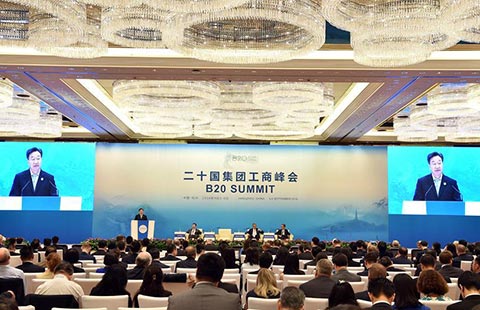
As the host of this year's G20 Summit, China set the theme as "Toward an Innovative, Invigorated, Interconnected and Inclusive World Economy." The message is clear: this suite of concepts can only bear fruit on the global stage if all the players act out their roles.
Although China's economy has entered a "new normal," with economic growth shifting to a slower and more sustainable rate, it continues to be an engine driving the world economy.
In the past five years, China has contributed 35 percent of global economic growth, and it will continue to contribute 30 percent of world economic growth before 2020.
Thanks to China's outward development policy and the overseas strategies of Chinese enterprises, the benefits of its economic growth are being felt beyond its borders.
Stronger together
Pang Zhongying, with Renmin University of China, said China had taken advantage of multilateral venues, such as the APEC and G20, to further the agenda of inclusiveness.
At the APEC summit in Beijing in November 2014 and days later at the G20 Brisbane Summit, Chinese President Xi Jinping reached consensus with US President Barack Obama and other world leaders to take necessary actions to help those African countries struggling to contain the Ebola outbreak.
Liang Xiaofeng, deputy head of the Chinese Center for Disease Control and Prevention, spent three months in Sierra Leone at the height of the Ebola outbreak.
In November 2014, he led a public health training panel, funded by the central government, to help the African country control the outbreak. His team helped establish a laboratory, trained more than 6,000 local medical workers, and designed reporting and quarantine systems. Their efforts proved to be invaluable, and helped Sierra Leone manage the epidemic.
It has been China's largest foreign aid project in the health sector to date, and it shows China's preference to share its knowledge and experience beyond its own borders -- the focus is cooperation, not instruction.
At the APEC Beijing Summit, China was a vocal advocate of connectivity and cross-border collaboration.
China's work on the Paris Agreement in 2015, which was ratified by the national legislature Saturday, offers an example of China practicing what it preaches.
Obama said the decision by the United States and China to formally join the landmark climate agreement may be seen as "the moment that we finally decided to save our planet." After all, a united world is a stronger world.
The international economy and globalization face myriad challenges, which must be addressed. As Brexit and the presidential election in the United States show, anti-globalization, isolation and trade protectionism are on the rise. Despite this unfavorable environment for cooperation, China has shown, time and time again, that it is committed to this course of action.
The current economic climate is the result of an outdated, defective global economic governance model. To explore the alternatives to the current order, in October 2015, the Political Bureau of the Communist Party of China Central Committee held its first ever study on global governance.
At the seminar, it was agreed that cooperation was the only way to successfully address global challenges and that China would promote the reform of the existing global governance system.
In terms of trade, the Beijing Roadmap for APEC's Contribution to the Realization of the Free Trade Area of the Asia-Pacific (FTAAP) has been hailed as a milestone document. With the aim of facilitating trade and cutting tariffs in the region, the FTAAP has successfully evolved from a concept to a practical goal, and the process continues to advance smoothly.
At the G20 Hangzhou summit, Xi championed a Chinese remedy for the febrile world economy -- strengthened coordination of macroeconomic policies and joint efforts to boost world economic growth and maintain financial stability.
Xi, in his opening address for the G20 Summit Sunday, also urged G20 members to break a new path for development, improve global economic governance, build an open world economy, promote trade and investment liberalization and implement the UN 2030 Agenda for Sustainable Development.
In his book "China's Historical Choice in Global Governance," former Chinese Vice Foreign Minister He Yafei said China's own development practices -- opening up and reform, promoting balanced development, providing the poor with the tools needed to lift themselves out of poverty, and focusing on improving people's livelihood -- had influenced its foreign aid policies. Case in point, every year tens of thousands of officials from developing countries are trained in China on development strategies, with no political conditions.
Benefiting other countries
China has created ample opportunity for cooperation programs that will lead to win-win results, for example the Asian Infrastructure Investment Bank (AIIB), which was formally founded at the end of 2015, with its 57 founding members from Asia, Europe, South America, Oceania and Africa.
In August, work began on the 64 km M4 motorway linking Shorkot and Khanewal in Punjab Province, Pakistan. It is the first project financed by the AIIB, together with the Asian Development Bank and Britain's Department for International Development.
The $273 million ?project will not only improve the nation's transportation network, it will also help with poverty alleviation efforts.
The AIIB and other initiatives that have made progress since APEC Beijing summit, such as the BRICS New Development Bank and the Silk Road Fund, will help meet Asia's enormous infrastructure needs.
"These are substantial contributions to complementing the post-war Bretton Woods system by meeting the needs of the developing world," Douglas Paal, vice president of the Carnegie Endowment for International Peace, told Xinhua.
The G20 Hangzhou Summit saw the initiation of a proposal supporting the industrialization of Africa and the least developed countries.
China will push G20 members to cooperate in helping those countries realize industrialization and achieve the goals in poverty relief and sustainable development by building capability, increasing investment and improving their infrastructure, Foreign Minister Wang Yi has said.
"Compared to APEC Beijing summit in 2014, China is now shouldering more international responsibility," said Pang, who believes that China's contributions are taking the lead to adhere to multilateral ways to address global challenges in a world in trouble.
In addition, as a reformer, good coordinator and a provider of new solutions, China can help exert G20 and other institutions' roles in addressing global issues, in a bid to improve global governance, Pang said.


Copyright 1995 - . All rights reserved. The content (including but not limited to text, photo, multimedia information, etc) published in this site belongs to China Daily Information Co (CDIC). Without written authorization from CDIC, such content shall not be republished or used in any form. Note: Browsers with 1024*768 or higher resolution are suggested for this site.
License for publishing multimedia online 0108263 Registration Number: 130349