 |
|
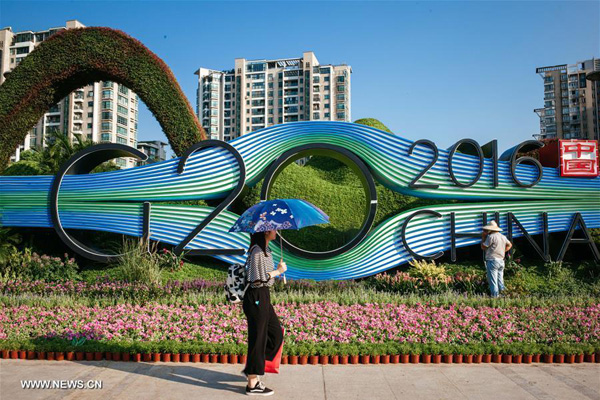
A citizen walks past a flower bed in the shape of the logo of G20 summit in Binjiang district of Hangzhou, capital city of east China's Zhejiang province, August 25, 2016. [Photo/Xinhua] |
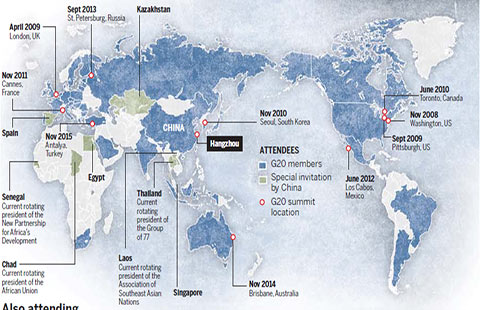
Hangzhou will host the 11th G20 Summit between September 4 and 5 under the auspices of the Chinese government. Apparently the world is currently suffering from twin problems: a prolonged global economic recession, which is believed to have been around for quite some time and was caused by the repercussions of the 2008 World Financial Crisis; and an intensifying geopolitical conflict, instigated by a blend of complicated economic and political factors.
Against this messy backdrop, China is expected to take the lead on reaching coordination between major economies for pushing a growth strategy so that the geopolitical divides around the globe will disappear. This is indeed what the G20 has been designed to do.
However, things might not go on as well as expected. The Global Times reported on August 17: "Hype is swirling among foreign media that some countries will raise the South China Sea disputes during the Summit in September."
The fact of the matter is that even if this perceived speculation does not materialize, the problem of global governance under current circumstances makes it impossible to avoid geopolitical considerations. This could not be better explained than by referring to what was debated in the recent T20 Summit in Beijing on July 28 and 29.
Participating scholars at the event fell under one of two categories: those who pushed for global economic structural reform, industrial transformation and sustainable development, and those who were confused by the recent developments in the US presidential elections, the Brexit vote, the failed military coup in Turkey and ASEAN's divide on the South China Sea ruling.
It is true that China is trying to capitalize on "functional integration," in Parag Khanna's terminology, as a geopolitical tool deployed for the economic development service and hopes to eliminate the chance of geopolitical conflicts via the Belt and Road and AIIB initiatives. Nevertheless, for these projects to gain momentum, China needs to maintain a balance on the three following aspects:
An expectation balance: The Chinese leaders might be impressed by recalling the nice telephone conversation that President George W. Bush made in 2008 to ask President Hu Jintao's opinion on holding a G20 meeting. However, this memory now belongs to the past. Not only is mutual trust lacking between the US and China, but more often than not some Americans think that "coordination" is the pure outcome of having "strong leadership" while forgetting the role of "good will" as a prerequisite for sustainable and fruitful relationships.
A mindset balance: China needs to maintain a balance in its mindset as being a "developing country" versus being "the second biggest world's economy." To help maintain this balance, China needs to qualify statements made about both its strengths and weaknesses. To realize why, it suffices to have a look at what was published on Sept. 6, 2014, in the New York Times under the title of "Foreign Powers Buy Influence at Think Tanks" and its updated version on August 8, 2016 titled "Researchers or Corporate Allies? Think Tanks Blur the Line."
A connectivity balance: The Chinese government defines connectivity between East Asia and the Middle East through the "Belt and Road" and "AIIB" initiatives on purely economic grounds as a geopolitical instrument. However, one should not forget about geopolitical and cultural connectivity. A balanced approach in this regard through accumulated logic of integration will better position China to play its role as a responsible global player and move towards building new global relationships. Otherwise, persistent conflict in the South China Sea will push China back to its historical past as a stationed civilization with persistent and prolonged vulnerabilities.
The author Ali Biniaz has a PhD in economics, IPIS representative and first counselor for research, Embassy of the Islamic Republic of Iran in Beijing.


Copyright 1995 - . All rights reserved. The content (including but not limited to text, photo, multimedia information, etc) published in this site belongs to China Daily Information Co (CDIC). Without written authorization from CDIC, such content shall not be republished or used in any form. Note: Browsers with 1024*768 or higher resolution are suggested for this site.
License for publishing multimedia online 0108263 Registration Number: 130349