|
|
Customers pick fruits at a supermarket in Beijing. [Photo/VCG] |
Many companies are eyeing a piece of the e-commerce pie in China, but many are getting their hands burnt in the process as well
It is no secret that China is the world's largest e-commerce market, thanks to the staggering amounts of money Chinese consumers have been spending online. According to China's National Bureau of Statistics, online retail transcations in the country hit 3.877 trillion yuan ($589.61 billion) in 2015, a 33.3 percent increase from a year earlier.
But while China may be the global leader in e-commerce, online sales actually only contribute to about 11 percent of the total retail sales in the country, based on findings by global information company Nielsen.
However, Nielsen also estimates that online sales are growing at a staggering rate of 53 percent year-on-year, an indication of the immense potential of China's e-commerce industry. Naturally, many companies have rushed to establish e-commerce platforms to sell their products, but not all of them, even the big players, have tasted success.
"China's e-commerce market is evolving very quickly and it is difficult for an internet platform to keep up without strong China-centric funding and resources," said Ben Cavender, principal of China Market Research Group.
"There are tremendous opportunities for e-commerce to grow further but right now it is still at an early stage. In three to five years, two to three dominant players will emerge from the competition," said Cavender.
Metao.com, a Chinese cross-border e-commerce provider that entered the scene in October 2013, is reportedly facing imminent closure despite receiving $35 million in investments in 2014. One of its customers had apparently lodged a complaint to the Economic Information Daily claiming that she has yet to receive her orders which were placed a month ago, and that her calls to the customer service hotline have gone unanswered.
On April 7, suppliers of local grocery platform Yummy77.com gathered in front of the company to demand for payment, only to discover hours later that the Shanghai-based company went bankrupt, according to a Xinhuanet report.
Yummy77.com, which was officially launched in May 2013, was regarded as a leading grocery e-commerce company in Shanghai, thanks to its prompt delivery services and generous discounts. In May 2014, Amazon China made its first investment in the Chinese mainland by injecting $20 million into Yummy77.com, swelling its evaluation to $100 million.
Li Chengdong, an independent e-commerce strategy analyst, said that the fall of the e-commerce site was largely due to factors such as the lavish spending on the construction of warehouses and a logistics network, an inexperienced management team, and the fact that buying fruit and vegetables online is still a novelty to the majority of Chinese consumers.
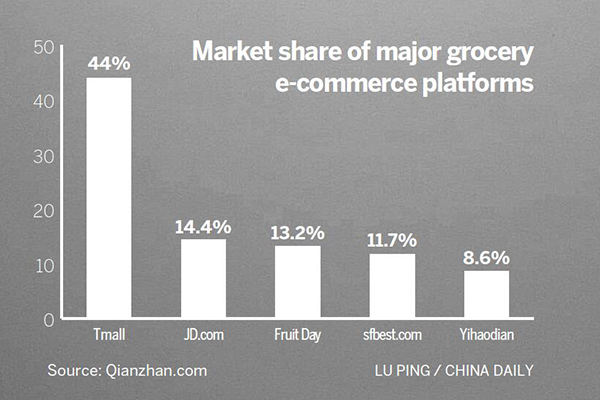
It also did not help that competition in this particular e-commerce segment was stiff. Data from Forward (Qianzhan) Intelligence Co Ltd shows that China's fresh grocery e-commerce market expanded from 1 billion yuan in 2011 to 56 billion yuan in 2015. The consultancy also projects the market size to reach 128.3 billion yuan by 2018.
This promising outlook naturally lured several major players to vie for a slice of the pie. Among them were Chinese e-commerce giants Alibaba, Yihaodian, and JD.com.
To exacerbate matters, buying fresh products online is more expensive than doing so at a physical store. Consulting firm Analysys.cn revealed that the average cost for fresh produce sold online in China is twice that of other products because they are expensive to store and transport.
Li said that most e-commerce sites for fresh produce in China are still struggling to make ends meet, and that having adequate financing is key to survival.
Coincidentally, British online fashion and beauty retailer ASOS also met its Waterloo in China on April 7, announcing that it would discontinue local operations (asos.cn). ASOS CEO Nick Beighton also said that the company will continue to do business in China via its main website (asos.com) and that the decision was made to "serve our growing customer base in China in a more efficient and less costly manner".
Despite the growth in online apparel sales in China-according to a report by the China National Textile and Apparel Council, 723.2 billion yuan worth of apparel was traded online in 2015, a 20.57 percent growth from the previous year-ASOS posted a total loss of 8.6 million euros?($9.8 million) since entering the Chinese market in 2013. In contrast, the brand boasts an average growth rate of 20 percent in the international market.
Li said that the poor performance of ASOS is caused by its unsuccessful marketing in China by failing to reach its target consumers.
Cavender believes that more players will exit the highly competitive e-commerce scene in China unless they can effectively differentiate themselves from competitors.
"While e-commerce is growing quickly, it is a very competitive market with a lot of online stores fighting for customers. Because they have to offer both a high level of service and competitive prices in order to attract customers, margins are very thin," said Cavender.
"Companies need to be responsive to consumer needs, both in terms of brands and products offered, and in terms of service quality. If a site has the same products as everyone else and cannot deliver faster or offer something different, consumers will just choose the cheaper, more established option."


Copyright 1995 - . All rights reserved. The content (including but not limited to text, photo, multimedia information, etc) published in this site belongs to China Daily Information Co (CDIC). Without written authorization from CDIC, such content shall not be republished or used in any form. Note: Browsers with 1024*768 or higher resolution are suggested for this site.
License for publishing multimedia online 0108263 Registration Number: 130349