A member of medical staff operates big-screen online diagnostic equipment at a medical center in Hangzhou, capital of Zhejiang province. LONG WEI / FOR CHINA DAILY
Tech firms revolutionize sector by partnering with public hospitals and acquiring private ones

Like many people in China, Chen Hua (not her real name), a 60-year-old resident of Guangdong province, used to hate visiting hospitals because she had to wait in serpentine queues every time she required to see a doctor, pay medical bills and buy the prescribed drugs from the hospital pharmacy.
But now, she has a better alternative. Chen visits a nearby drugstore where she gets to interact with doctors at big hospitals via video calls. Using online tools, the drugstore people transmit readings of her blood pressure and temperature to the doctors concerned.
Chen recently suffered from backache and had an online diagnosis with a doctor from the Guangdong Internet Hospital, which is operated by the Second People's Hospital of Guangdong province.
"The doctor prescribed medication online, which I could immediately buy," she said, "Previously, it took me four fours to see a doctor, but now the entire process takes less than 10 minutes."
Chen is among a growing number of patients who are benefiting from the country's booming internet-based or online medical services. Technology companies are rushing to revolutionize the sector by partnering with public hospitals and acquiring private ones.
Dozens of online or internet-based hospitals have popped up across China since the end of last year. Starting March 29, at least six new internet hospitals have been established in six provinces within a week, fueled by strong support from local governments.
Internet heavyweights Alibaba Group Holding Ltd and Tencent Holdings Ltd, as well as a string of startups and local companies, are all eyeing the niche.
Jiang Xinwei, an analyst at Beijing-based internet consultancy Analysys International, said the domestic internet-based healthcare industry has entered a new stage, after several years of explosive growth in basic online medical services such as making appointments with doctors and paying medical bills.
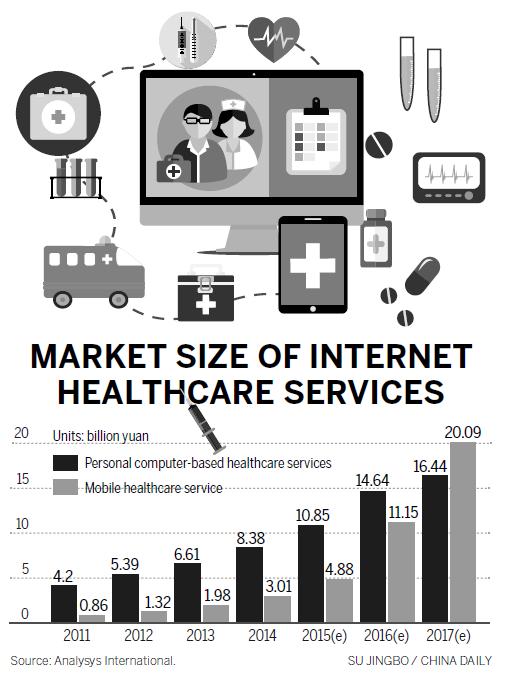
A report by Analysys International said the online healthcare industry was worth 11.3 billion yuan ($1.75 billion) in 2014, up from 5 billion yuan in 2011. The figure for 2015 will likely be 15.7 billion yuan, Analysys predicted.
 |
|
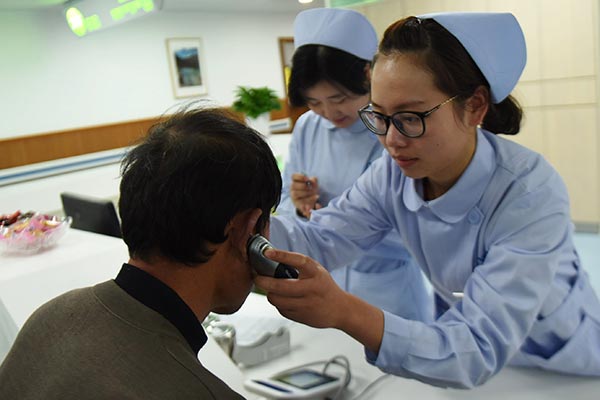
A nurse measures body temperature of patients at a medical center in Hangzhou, Zhejiang province. LONG WEI / FOR CHINA DAILY |
Qin Zexi, an analyst at Beijing-based iResearch Consulting Group, said the internet-based healthcare industry will continue to gain steam, thanks to the swift development of the mobile internet technology and the government's intensified efforts to push forward medical reform.
"Public hospitals used to be very reluctant to embrace the internet. But now, that has been gradually changed by the government," Qin said.
In March, Li Bin, minister for the National Health and Family Planning Commission, called for more widespread use of the internet to direct patients to different medical institutions based on their needs, so as to reduce the pressure on big hospitals and improve the efficiency of medical resources.
Unlike other internet-enabled services such as e-commerce which first boomed in rich eastern provinces, online medical service providers have ventured into less-developed western regions from the very beginning.
We Doctor Group, which has raised more than $100 million from Tencent, opened an internet-based hospital for northwestern Gansu province earlier this month by teaming up with a local public hospital.
"The internet can help expand medical services to secluded villages and remote regions such as Tibet," Liao Jieyuan, CEO and chairman of We Doctor Group, said, adding patients can enjoy video diagnosis, e-prescription and drug delivery service from its platform.
Alibaba also moved in the same direction by running a similar project in a village in central Hubei province, hoping to help villagers deal with common and chronic illnesses like hypertension and diabetes.
But other players are eyeing the higher-end of the online healthcare market, which includes handling of serious and complicated illnesses by pooling top-level doctors.
"Every year, thousands of people travel to top-tier cities, looking for experts to treat diseases which local doctors fail to cure," said Wang Hang, CEO of Haodf, which claims to have 100,000 qualified doctors on its service.
"By leveraging the internet, patients can first have a video call with experts to see whether they need to be treated in person. This helps reduce unnecessary transportation costs. Local doctors will also be present to offer the most accurate descriptions of patients' symptoms," Wang said.

Haodf inked a deal with the municipal government of Yinchuan, capital of Ningxia Hui autonomous region, earlier this month to build an internet-based or online hospital that connects top-level doctors from big cities with patients and doctors in local clinics.
The system can work even better for re-diagnosis, given that experts can offer training and technical guidance to doctors in local clinics, who will then be able to properly treat patients, according to him.
Jiang of Analysys International said: "The two models are still nascent, but I am more optimistic about the high-end medical services market because of the enormous demand (for it). And patients of this group are more willing to pay (for such services)."
But Tian Junzhang, president of the Second People's Hospital of Guangdong province, thinks it is next to impossible to attract so many experts to offer online diagnosis.
"The more renowned a doctor, the less willing he or she is to treat a patient online because it is too difficult and risky to handle complicated diseases through the internet," he said, adding internet-based hospitals by nature are more suitable to deal with chronic diseases which require frequent re-diagnosis.
Huang Jinchang, director of the oncology department at the Beijing University of Chinese Medicine Third Affiliated Hospital, said, "The key to internet-based services is whether doctors can make accurate diagnosis based on the information they get from the internet and video calls."
Huang said time is not a factor because doctors can freely budget their time as long as they adopt an efficient way to treat patients. Currently, he spends 40 minutes to an hour every day answering questions that patients pose online.
"Online medical service is a growing trend. But it just complements face-to-face diagnosis, which is still the most efficient way. In the near term, I won't consider shifting to video diagnosis. After all, the technology is not that mature yet," he said.
In addition to technological bottlenecks, analysts said the issue of getting internet-based medical services covered by the National Medical Insurance System remains thorny, especially for prescription drugs sold online.
Ni Jianwen, vice-president of Alibaba's health business division, said in an interview with Caixin.com that due to the different regional policies, drug sales receipts sometimes are not accepted by local medical insurance authorities, creating difficulties for people buying medicine from online stores.


Copyright 1995 - . All rights reserved. The content (including but not limited to text, photo, multimedia information, etc) published in this site belongs to China Daily Information Co (CDIC). Without written authorization from CDIC, such content shall not be republished or used in any form. Note: Browsers with 1024*768 or higher resolution are suggested for this site.
License for publishing multimedia online 0108263 Registration Number: 130349