BEIJING - As China's economy shifts from manufacturing and investment to consumption and innovation, the landscape for foreign investment in the country is changing too.
The change is best summed up by two seemingly inconsistent figures from a computer company invested in by electronics multinational Samsung in the industrial park of the eastern city of Suzhou.
While its sales slumped by 40 percent each year in 2013 and 2014, the company achieved an annual profit growth of 10 percent.
The firm relocated its low-end, labor-intensive production lines to Vietnam, but made Suzhou a base for research and development on new high-end products due to the mature investment environment and complete industrial chain, Han Jiang, an official at the park, said.
"That move is quite typical," Han told Xinhua. "The land in the park is being used up. The workers are no longer cheap. Our focus in introducing foreign investment should be different in the future."
While some foreign investors in China feel the pinch of slowing GDP growth, rising wages and more expensive resources, others find success in adapting to the economy's pivot by turning their business towards higher-end products and services.
Foreign investment in manufacturing in China barely increased last year, but that in hi-tech manufacturing rose 9.5 percent year on year, accounting for 23.8 percent of the total, official data showed.
The change was in line with the broader upgrade of the "world's factory," as China has been dubbed, into a true manufacturing powerhouse.
The country's bid to arrest overcapacity, boost efficiency and increase the added value and technology content of its manufacturing sector created opportunities for foreign investors as well.
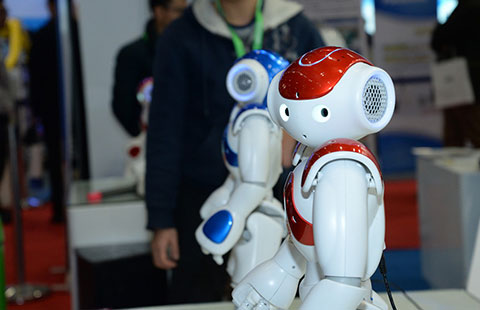
From robotics to 3D printing, a number of emerging industries are increasingly lucrative for foreign businesses as China's economy moves up the value chain.
In eastern economic hub Shanghai, German robotics maker KUKA produces 5,000 industrial robots every year, a third of the company's global output. It has received increased orders from both foreign and Chinese companies and plans to expand its presence in the country.
"In the past, a client of our Shanghai factory could book, at most, a few dozen robots at a time," said Kong Bing, China head of KUKA. "Now one client might order hundreds of them."
Diminishing labor supply and growing demand for high-quality products will lead to more automated logistics and workshops, boosting China's robotics market, Kong said in an interview.
Materialise, a Belgian provider of 3D printing software and services, shares a positive outlook for business in China. It established a research and development center in Shanghai in May 2014 and set up its first China branch six months later.
The company has witnessed stronger interest for 3D printing in China as the country upgrades its manufacturing industry, said Kim Francois, managing director of Materialise China.
Apart from high-end manufacturing, the service sector is also luring more foreign money, attracting a bigger share of foreign investment in China than manufacturing did for the past five years in a row.
Services outweighed manufacturing in foreign investment for the first time in 2011 and accounted for 61.1 percent of the total foreign investment last year, official data showed.
Global logistics provider FedEx is one of the foreign companies riding the tide. The firm has beefed up investment in China, setting up distribution centers in Shanghai and Guangzhou and branching out to smaller cities.
"Despite fluctuations in China's foreign trade, FedEx still finds brisk demand for cross-border logistics in the country," said Eddy Chan, senior vice president and China head of FedEx. "That judgement has not been changed."
Over 60 percent of small Chinese companies are expected to engage in cross-border business in the coming five years, according to a survey sponsored by FedEx last year.
Chan noted Chinese people's growing appetite for overseas consumer goods and the country's increasing trade in hi-tech products will boost the demand for higher-quality delivery services, which FedEx specializes in.
The shifting pattern of foreign investment spoke of China's increased openness in the service sector, said Wang Xiaohong, an economist with the China Center for International Economic Exchanges.
Chinese leaders have pledged to further advance the opening up of the service industry and lower the market threshold for banking, insurance, securities and old-age care for foreign investors in the next five years.

Copyright 1995 - . All rights reserved. The content (including but not limited to text, photo, multimedia information, etc) published in this site belongs to China Daily Information Co (CDIC). Without written authorization from CDIC, such content shall not be republished or used in any form. Note: Browsers with 1024*768 or higher resolution are suggested for this site.
License for publishing multimedia online 0108263 Registration Number: 130349