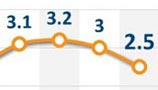
What we are likely to see in 2016 and beyond is disparate performance, with emerging economies that are able to adapt to the new world forging ahead. Even while this happens, high- and middle-income countries will come under strain, as their workers compete for jobs in the globalized labor market. Their income disparities will tend to rise, as will the frequency and intensity of political conflict. To respond to this by blocking outsourcing, as some politicians propose, would be a mistake, for such countries' higher production costs would cause them to be out-competed in global markets.
As the march of technology continues, these strains will eventually spread to the entire world, exacerbating global inequality - already intolerably high - as workers' earnings diminish. As this happens, the challenge will be to ensure that all income growth does not end up with those who own the machines and the shares.
It is a challenge comparable to what the United Kingdom faced during the Industrial Revolution in the early nineteenth century. Until then, child labor was rampant and viewed as normal; workers routinely labored for 14 hours or more per day, with conservatives arguing that continuous toil helped build character (other people's, needless to say). The activism of progressive groups, the writings of intellectuals, and the enormous effort that went into crafting the Factory Acts curtailed these abhorrent practices, enabling the UK to avert disaster and become a powerhouse of growth and development.
The time has come for another round of intellectual and policy reform. As labor income is squeezed, this disparity will widen, causing a variety of economic and political crises.
Heading them off will require, above all, greater effort to spread education, build skills, and provide universal health care. Innovative thinking will be needed to achieve these goals. But we also need to think of new ways to bolster labor income.
One example is certain forms of profit sharing. If workers have a stake in their companies, technological innovations will not be a source of anxiety, because wage losses will be compensated by the rise in equity income.
Several economists and legal scholars - including Martin Weitzman, Richard Freeman, and Robert Hockett - have written on this subject. But, as with all innovations, a lot of research is needed to get it right. What we learned in 2015 is that we do not have the luxury of doing nothing.
The author is senior vice-president and chief economist of the World Bank, and professor of economics at Cornell University.
Project Syndicate

Copyright 1995 - . All rights reserved. The content (including but not limited to text, photo, multimedia information, etc) published in this site belongs to China Daily Information Co (CDIC). Without written authorization from CDIC, such content shall not be republished or used in any form. Note: Browsers with 1024*768 or higher resolution are suggested for this site.
License for publishing multimedia online 0108263 Registration Number: 130349