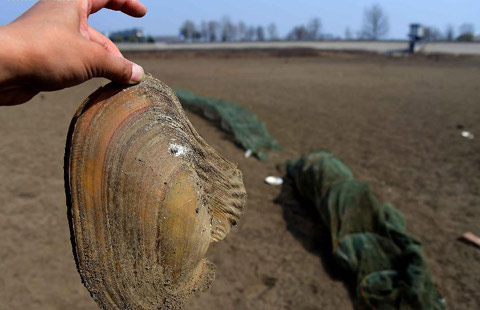
Much has been said about the state of China's natural environment. At least $5 trillion, or about 50 percent of the country's annual GDP, is needed to repair the damage done over recent decades.
Some 20 percent of agricultural land is toxic to human health. Up to 1 million people die prematurely each year as a result of air pollution, with lung cancer rates increasing by almost 500 percent in the past three decades. Those concerned with climate change know that nothing can be fixed unless pollution is dramatically reduced, and those focused on international developments understand the importance of greening China's rapidly growing outward investment.
Fortunately, the country's high profile climate agreement with the US is the tip of an iceberg of efforts to curb environmental pollution on many fronts. China's coal consumption fell by more than 2 percent last year, signaling what might be the most important fossil fuel peak in modern times. Clean energy investment jumped 32 percent in 2014 to a record $89.5 billion, as compared a meager 1 percent growth across Europe. Even Beijing's infamous smog levels fell last year, according to the municipal Environmental Protection Agency.
Such advances provide grounds for optimism, but it will take far more to pivot China's massive economy to green.
Redirecting finance has to be part of the answer. Financial market reform is central to China's overall reform efforts. Familiar reforms are under development that if successful will deliver a better governed and more extensive and diversified financial and capital markets. Until recently, however, such plans have not explicitly embraced the policy goal of greening China`s development.
"Green finance" has risen up China's policy agenda. In 2007, the China Banking Regulatory Commission established its Green Credit Guidelines as an innovative attempt to raise awareness and action on the environment.
More recent have been signs of a mainstreaming of green finance. The prestigious Finance Institute of the Development Research Center of the State Council (DRCFI) has been working with the International Institute for Sustainable Development, in association with the UNEP Inquiry and a group of international experts, in developing policy recommendations to advance green finance across China's financial system.
Further evidence of this mainstreaming has been the initiative of China's powerful central bank, the Peoples Bank of China, to establish a Green Finance Task Force, co-convened by the UNEP Inquiry, to identify practical steps to green China's financial market reform, which will report next month.
Green financing, according to new data developed through the DRCFI-led research launched at the China Development Forum, has increased at an annual growth rate of 23 percent in the five years to 2012, to about $260 billion in 2012, equivalent to more than 2 percent of GDP. Investment needs across key green sectors in China, the study estimates, will be about $460 billion per year from 2015 to 2020, or about $2.8 trillion from now to 2020, probably an under-estimate according to the authors. Two thirds of this will need to come from domestic and international financial and capital markets, given fiscal limitations and priorities.
The DRCFI-led report sets out wide-ranging recommendations to advance green finance in China, covering banking, investment, insurance and monetary policy.
In banking, recommendations include allowing eligible green loans to be excluded from the loan-to-deposit ratio indicators in banking risk management, offering preferential treatment for green assets in use as collateral against loans, introducing environmental stress tests as part of banking regulations and building up securitization channels for green credit.
Building on international experience in green bonds, the report recommends a government-endorsed system or third-party assurance system for the green claims of corporate bond issuers, providing a price differential for green compared to "brown" loans to create more deal flow for green bonds, and offering tax credits for green bonds.
Innovative recommendations covering the role of central banks include the establishment of green refinancing facilities, consideration of green steering of asset purchases in the context of quantitative easing, including environment-related risks in the models for "stress testing" in relation to financial stability and more broadly eliminating sector biases in current monetary policy that are misaligned with the objectives for a green economy.
Implementing even a fraction of these recommendations would make China the world's most ambitious experiment in greening a major financial system. Centrally, China's ambitious thinking sees green finance as core, not additional to the financial market reform agenda. From this perspective, a lack of green financing delivers poor allocation of capital, mispriced risks and weaker long-term economic growth, creating stresses that ultimately lead to financial market instability and underperformance.
Greening the financial system, on the other hand, would improve its efficiency, effectiveness and resilience, making it fit for purpose in serving the needs of China's and international economic development in the 21st century.
The author is a co-Director of the UNEP Inquiry into Design Options for a Sustainable Financial System, the international project lead in the DRCFI-led study into China's green finance, and the international co-Convener of the Green Finance Task Force initiated by the People's Bank of China.

Copyright 1995 - . All rights reserved. The content (including but not limited to text, photo, multimedia information, etc) published in this site belongs to China Daily Information Co (CDIC). Without written authorization from CDIC, such content shall not be republished or used in any form. Note: Browsers with 1024*768 or higher resolution are suggested for this site.
License for publishing multimedia online 0108263 Registration Number: 130349