 |
|
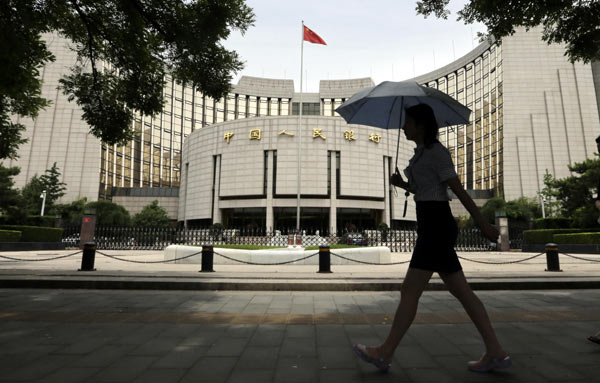
A woman walks past the headquarters of the People's Bank of China (PBOC), the central bank, in Beijing, in this file picture taken June 21, 2013. [Photo/Agencies] |
BEIJING - China's stock markets edged down after the central bank lowered the reserve requirement ratio (RRR) on Thursday for the first time in over two years, underscoring the powerful sway of this unique monetary policy tool.
The RRR specifies the share of a commercial bank's deposits that must be held on reserve at the central bank, and which can not be used for loans or other investments. Large financial institutions tend to face a higher RRR than small ones.
China established the RRR mechanism in 1983 and rolled out an improved version in 1998 which is still in place.
Though a monetary policy tool seldom used elsewhere in the world, the RRR is considered a powerful weapon in the arsenal of the People's Bank of China (PBOC) to manage money supply. Simply put, a higher ratio means liquidity tightening and a lower ratio means loosening credit controls.
However, adjustments of RRR do not necessarily imply loosening or tightening in China. Analysts believe that the RRR is also a key method for "sterilization", which means digesting the foreign money flowing into the economy, particularly from its huge trade surplus.
Double surpluses on both the current and capital accounts have swelled China's foreign exchange reserves and boosted domestic money supply during most of the past decade.
The PBOC raised the RRR steadily to cushion these inflows and fight inflation. China raised the ratio 10 times in 2007, and the RRR for China's large banks surged from 8 percent in 2005 to 20.5 percent in late 2012.
However, China's trade and investment balances both neared equilibrium last year, calling for the lowering of the RRR to manage base money growth.
In recent months, with the US dollar continuing to strengthen, net capital outflows have accelerated. Foreign exchange reserve accumulation has been absent in recent quarters. The PBOC's recent but limited use of MLF was not sufficient to offset such a scale of drainage on domestic liquidity.
Compared with other liquidity measures such as open market operations, SLO, SLF and MLF, which all have relatively short maturity durations, an RRR cut unleashes liquidity on a permanent basis with consequently longer-lasting effects on interbank liquidity.
China also uses differentiated RRR fine-tuning measures to meet specific ends. It may lower the RRR across the board to cover all banks or roll out targeted RRR policies to guide money inflows into needy sectors to support rural areas and small and medium-sized enterprises.
Thursday's RRR cut was the first time that the central bank has tried both universal and targeted adjustments at the same time.
The existence and importance of the RRR mechanism in China is also considered a result of a lack of a deposit insurance system to contain financial institutions' moral hazards and over-leveraging.
Deposit insurance is implemented in 112 economies to protect depositors, in full or in part, from losses caused by a bank's inability to pay its debts when due.
China's financial institutions mainly depend on sovereign credit, which keeps deposits relatively safe during periods of panic withdrawal.
China's cabinet, the State Council, proposed a deposit insurance?plan in November. It would see financial institutions required to pay insurance premiums to a special fund, which will pay maximum compensation of 500,000 yuan ($81,520) per depositor if a bank suffers insolvency or bankruptcy.
The?plan is an important part of any financial safety net. It is considered a precondition for China to free up deposit rates--the last step in interest rate liberalization.

Copyright 1995 - . All rights reserved. The content (including but not limited to text, photo, multimedia information, etc) published in this site belongs to China Daily Information Co (CDIC). Without written authorization from CDIC, such content shall not be republished or used in any form. Note: Browsers with 1024*768 or higher resolution are suggested for this site.
License for publishing multimedia online 0108263 Registration Number: 130349