 |
|
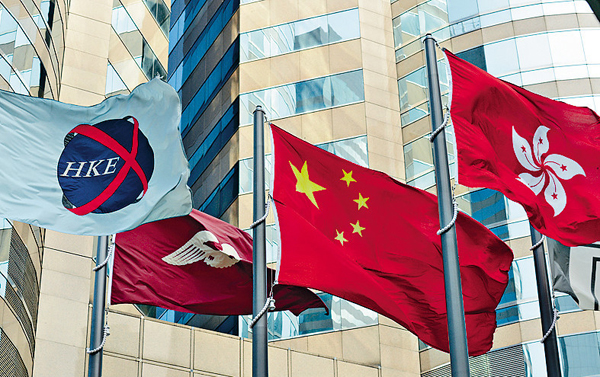
Persistently high listing costs in Hong Kong have discourage many enterprises, especially those from the Chinese mainland, from floating there.[Photo/IC] |
Despite strong end to the year, lower valuations scare off potential offerings
Hong Kong is likely to end this year as the world's second-largest market for initial public offerings after New York, thanks to several recent mega deals-but it is facing an uphill fight to lure newcomers in 2015, according to analysts.
A prolonged market slump in Hong Kong IPOs began in September apparently triggered by an outflow of capital back to the United States, and its persistently high listing costs have discourage many enterprises, especially those from the Chinese mainland, from floating in Hong Kong.
The New York Stock Exchange remained the most favored destination for companies to list. From Jan 1 to Dec 15, more than $73.4 billion was raised by companies from around the world, a 60 percent rise on a year earlier, according to data provided by Dealogic.
Boosted by the potential $3.7 billion IPO of Dalian Wanda Commercial Property and the earlier $1.4 billion raised by BAIC Motor Corp (a State-owned car maker), Hong Kong has, however, managed to trump the Nasdaq and London Stock Exchange by a small margin to win runner-up spot in the global list.
Investment bankers say that several recent IPOs in Hong Kong-particularly Guangdong-based nuclear operator CGN Power and Dalian Wanda Commercial Properties-were oversubscribed many times, showing strong global demand.
But difficulty in securing high valuations in Hong Kong, as indicated by the slashing of the size of the Wanda IPO, may cause other potential candidates to balk.
Wanda was not the only IPO to be given the cold shoulder, at least at the initial stage, by Hong Kong investors. Chinese pork producer WH Group, which bought Smithfield Food last year, also had to slash its IPO from $5 billion to $2.4 billion in August in the face of nagging skepticism from the local investment community.
"Investor preferences have profoundly changed, as the Chinese economy is going through an uncertain rebalancing," said one senior capital markets banker with a State-owned investment bank.
Banks, commodity firms and real estate companies that used to enjoy high attention and valuations have become less favored by investors, while businesses related to environmental protection, healthcare, or rising middle-class consumption were given more preference, he said.
Back in 2006, Industrial Commercial Bank of China Ltd raised $21.9 billion in a Shanghai-Hong Kong listing, which was then the world's largest.
The clamor for its shares led to a nearly 75 times oversubscription and then the price rose 134 percent in the year after its IPO, according to The Wall Street Journal.
But similar stories rarely happen nowadays. Heilongjiang province-based Harbin Bank priced its IPO at 0.86 times the book value, and raised $1.1 billion in March, but it has traded below that for most of the time since.
Although offering higher valuations, IPO candidates choosing to try their luck on mainland exchanges have had to tough out the long and often unpredictable verification and approval process imposed by the China Securities Regulatory Commission, the market watchdog.
Of course if a company has a strong enough business performance, it has another choice-to go public in the US market to avoid both the mainland queuing to list, and Hong Kong's valuation discounts.
Alibaba Group Holding Ltd, China's Internet giant, raised $25 billion on the New York Stock Exchange in September, becoming not only the biggest IPO this year, but the biggest in history.
PricewaterhouseCoopers data show that of the 195 Chinese technology IPOs between 2010 and 2014, 138 of them, or 70 percent, went public in the US. Norman Chan Tak-lam, chief executive of the Hong Kong Monetary Authority, admitted recently that Hong Kong is no longer the sole agent for Chinese mainland IPOs.
And now with the launch of the Stock Connect program, launched in mid-November linking Hong Kong with Shanghai, the importance of Hong Kong has been further tapered as international investors can directly trade Chinese mainland listed shares, although there are still trading limits during the scheme's initial stages.
Nathan Wei, who leads an IPO preparation team for a mainland-based auto dealer, said the company decided a month ago to move back to the A-share market. He noted the bullish secondary market in the Chinese mainland is now luring more companies as stronger share price appreciation has provided a better chance of financing.
Vincent Chan, an analyst with Credit Suisse, said he remains "cautious" on the Hong Kong economy in the wake of the recent protests and with the US interest rate cut cycle now turning.
"There is probably a risk to trading in Hong Kong retail and/or property stocks. The financial sector is likely the only area which can hold up. Among Hong Kong stocks, we suggest investors pick those with more global or regional exposure," he said.
Francis Kwok, marketing director of Hong Kong based Bright Smart Securities, is slightly more optimistic.
"The dropping oil price suggests inflation is still low and the US is unlikely to raise interest rates early next year. The local equity market will lift with market sentiment gradually revived," he said.
Kwok insists that the Hong Kong market is still the best choice for most mainland-based firms, as it provides financing channels that directly connect to the global market, as well as linking with the mainland.
"The US is definitely the biggest market with the most sufficient capital," he said, "but many entrepreneurs would like to keep the linkage to the Chinese mainland. It is very emotional."

Copyright 1995 - . All rights reserved. The content (including but not limited to text, photo, multimedia information, etc) published in this site belongs to China Daily Information Co (CDIC). Without written authorization from CDIC, such content shall not be republished or used in any form. Note: Browsers with 1024*768 or higher resolution are suggested for this site.
License for publishing multimedia online 0108263 Registration Number: 130349