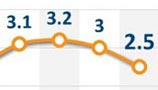
Amount of capital per capita: The higher the amount of capital available to each person, the more the economy-and each person on average-can produce. China's amount of capital per person appears to contradict the idea that China is awash with capital. While capital per person has risen steadily over the last few years, it remains far below the levels seen in developed economies such as the US and Japan. In fact, it is only about 10 percent that of the US. On this reading, China has plenty more room to accumulate capital.
So, let us answer the question-Is China putting too much of its resources into capital accumulation? The ICOR and levels of capital per person suggest that the answer is no. China continues to deliver a high return on its investments and has a long way to go before maturity. In short, our research strongly suggests that capital will continue to be an important source of economic growth for China.
How do we reconcile the conventional story of over-investment with some of the other indicators? If we look beyond the aggregate economy level to the sectoral level, a new picture emerges: China's real capital crisis is in how capital is distributed.
One sign that capital has been misallocated can be seen by looking at disparities in return on assets between State-owned and privately owned enterprises. On average, private enterprises have a higher return on assets than SOEs. This means that capital could be better utilized by private firms. Similarly, there is a gap in capital efficiency between China's small to medium-sized enterprises and large industrial enterprises.
This tells us that capital could be better distributed to smaller firms, not least because they can generate better returns and are playing a critical role in the economy. However, SMEs remain starved of adequate funding. These findings suggest potential constraints on the distribution of capital that inhibit the flow of adequate financing to the most productive sectors and industries.
A review of China's infrastructure investments shows that more targeted allocation is needed. Take the example of transportation. Though China has made impressive strides in high-speed rail, it still needs to invest more in upgrading essential bus services and local railway networks. Investment in these areas will generate considerable returns.
If the capital challenge in China is essentially a distributional one, in what ways could the allocation of capital be significantly improved? What kinds of investments would generate the best returns in the long run?
We believe they include those that help small private businesses, raise living standards for the middle class and working poor, and build the country's knowledge and digital capital.
The country could also make high-return investments in organizational decision-making and processes to improve capital productivity. In other words, China needs to put its enterprises-small and large-on the road to high performance. Organizations must ensure that their money is spent wisely-on improving people's livelihoods and stimulating business activity. Investments in technology and infrastructure must work in concert with business growth.
In less than four decades, China has traversed a path that took the countries of the developed world a couple of centuries to travel. Now China is entering a new stage. Can China continue to grow rapidly? With business and policy leaders increasing their efforts to make capital count by investing it where it's needed most, it can.
The authors are researchers at Accenture Institute for High Performance in the United States. The views do not necessarily reflect those of China Daily.

Copyright 1995 - . All rights reserved. The content (including but not limited to text, photo, multimedia information, etc) published in this site belongs to China Daily Information Co (CDIC). Without written authorization from CDIC, such content shall not be republished or used in any form. Note: Browsers with 1024*768 or higher resolution are suggested for this site.
License for publishing multimedia online 0108263 Registration Number: 130349