A recent survey shows that the average salary of more than 350,000 college graduates across the country this year is only 2,443 yuan ($397). The survey on post-1990 generation graduates, conducted by Peking University Market and Media Research Center and information portal website Ganji.com, also shows that more than 30 percent of the graduates have to live off their parents and about 40 percent spend all the money they earn.
Amid all this, many universities have raised their tuition fees this year, up to 50 percent in some cases, prompting some observers to say that the twin developments could undermine the attraction of college education.
Some media reports have highlighted how parents stopped their children from enrolling in colleges, mainly because some graduates' incomes are even lower than that of migrant workers. Many parents used to regard college education as a way of enhancing their children's social status, and perhaps theirs too.
The challenge for education authorities, therefore, is to change the concept of "status education" through reform. For years, higher education in China has been associated with status: Getting admitted to a college is seen as change in "destiny".
In the early years of reform and opening-up, college students were quite valuable because they were few in numbers. In 2013, however, China had over 33 million college students. Given these facts, fresh college graduates can hardly expect to get priority or preference in the job market.
Students are mistaken if they thought higher education means only a college diploma, or a diploma from a well-known institution. Those who do think that way are bound to find themselves in an unwelcoming job market. The discouraging truth now is that, although students spend four years in colleges, many of them fail to learn things that will help them in the job market. Perhaps colleges are to be blamed for failing to impart practical education to students - education that will help them not only in the job market but also in other spheres of life.
If college students, instead of just trying to earn a college diploma, make more efforts to acquire knowledge and learn skills to meet the challenges of life, they will enhance their competitiveness in the job market. And even if they get a relatively low salary in the beginning, they will perform well in the long run.
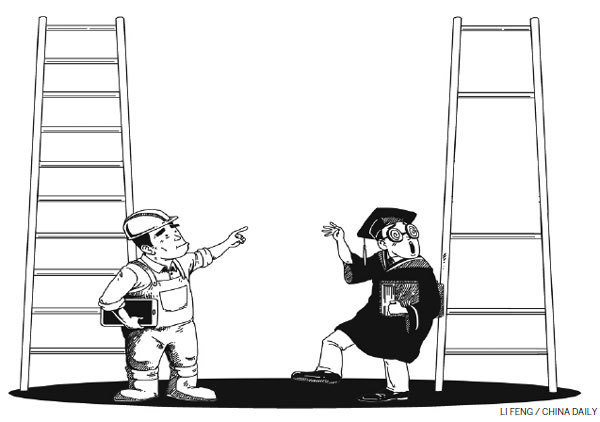
Also, college graduates should not restrict their search to white-collar jobs, whatever career prospects the specific jobs may have. Many people think college students should look for jobs that suit their "status". Some even regard a college student who drives a taxi or takes up some other non-office job as a waste of education resources. But such people turn a blind eye to the reality of the job market and the high rate of college enrollment.
The development of higher education is aimed at improving the quality in all sectors of society. Only when high-quality talents are employed in all sectors of the economy can society as a whole make real progress. Some college graduates who have chosen to work as construction workers, plumbers or carpenters not only earn more money than their counterparts employed in public institutions but also are helping improve the work and service quality of the sectors where they are employed.
A person should be judged according his/her abilities rather than the diploma he/she carries. Once we start doing that, students will concentrate on acquiring practical knowledge and colleges will be forced to help them do so.
The author is vice-president of the 21st Century Education Research Institute.

Copyright 1995 - . All rights reserved. The content (including but not limited to text, photo, multimedia information, etc) published in this site belongs to China Daily Information Co (CDIC). Without written authorization from CDIC, such content shall not be republished or used in any form. Note: Browsers with 1024*768 or higher resolution are suggested for this site.
License for publishing multimedia online 0108263 Registration Number: 20100000002731