|
 |
|
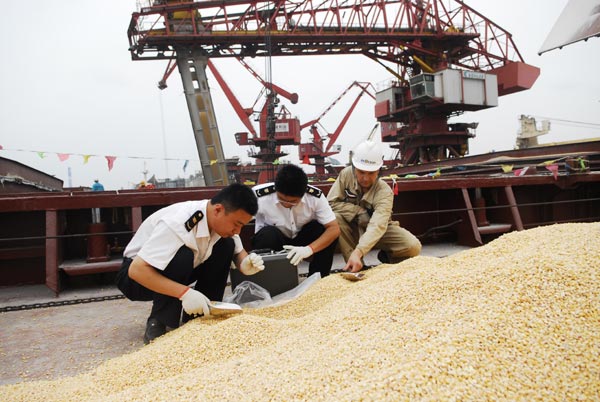
Customs officers inspect imported corn at a port in Lanshan, Shandong province. [Photo/China Daily] |
Bigger cereal purchases from global markets help ensure adequate stocks
China has increased the flexibility of its grain imports by purchasing more cereals from the global markets at cheaper prices to ensure sufficient domestic stocks, prevent unexpected supply risks and ensure long-term food security.
 |

|
Li Guoxiang, deputy director of the Rural Development Institute at the Chinese Academy of Social Sciences in Beijing, said that the rising grain imports do not pose any threat to the nation's food security.
In China, grains refer to cereals, beans and potatoes, while food includes grains, edible vegetable oil, meat, poultry, eggs, dairy and marine products. The nation's grain imports mainly cover wheat, rice and corn.
"International cereal prices are much lower than those prevailing in the domestic markets. Demand for various cooked wheat food goes up in China between January and July. Due to the lower prices in the global markets, the nation has increased its imports," said Li.
With domestic wheat prices continuing to remain at high levels, many grain dealers have turned to imports to ensure adequate supplies in the market.
China introduced price floors for farm products in 2006 to protect farmers from price volatility. The government buys products such as wheat, corn and cotton for State reserves when market prices fall below the price floor.
Farm product prices in the United States and European Union are more market-driven, partly because of supply-demand relationships and the function of commodity markets such as the Chicago Board of Trade and London Commodity Exchange.
Ding Lixin, a researcher at the Chinese Academy of Agricultural Sciences in Beijing, said that China still relies on stockpiling, floor purchase prices and government subsidies to regulate prices.
But the nation's minimum grain purchase prices have remained above world levels in the past three years, which prompted more imports of products such as soybeans, corn and cotton from the US, Argentina and India in 2013.
Ding said the rising imports will hamper China's food security only if the production capacity declines. China has, however, managed a stable growth of grain output in the past 10 years.
Summer grain output in the country hit a record high of 136.6 million metric tons in 2014, up 3.6 percent from last year, data from the National Bureau of Statistics show.
"Despite a severe drought that hit China's major corn-producing provinces such as Henan, western Liaoning and a part of the Inner Mongolia Autonomous Region, it is still too early to judge whether China's grain security has worsened or not," said Ding. "It still needs another week to see the maturation of corn in other corn-producing provinces."
Wang Suiyuan, vice-president of the China Feed Industry Association, said many pig farms have already started to buy wheat to replace corn as animal feed to ensure sustained production. More than half of the world's pork is now produced and consumed within China.
Corn prices rose by 4 yuan to 2,380 yuan per metric ton on Monday, according to the corn future prices traded in the Dalian Commodity Exchange.
"Flexible imports of foreign corn, wheat and soybeans will not only save China's water resources but also help rehabilitate selected parts of the country's already exhausted farmlands," said Wang from the China Feed Industry Association.
 |
 |
| Wheat harvest season in China | Grain output grows for 11th straight year |

Copyright 1995 - . All rights reserved. The content (including but not limited to text, photo, multimedia information, etc) published in this site belongs to China Daily Information Co (CDIC). Without written authorization from CDIC, such content shall not be republished or used in any form. Note: Browsers with 1024*768 or higher resolution are suggested for this site.
License for publishing multimedia online 0108263 Registration Number: 20100000002731