The Chinese market is more optimistic these days than in the past few months. The capital market can now heave a sigh of relief as government policies and monetary weapons are apparently working toward achieving the annual targets, such as a 7.5 percent GDP growth.
Therefore, there is less doubt and unease among investors compared with earlier months. The possibility of a general local debt crisis breaking out, which investors feared, looks distant.
As more public infrastructure projects are undertaken and one city after another lifts the three-year restrictions on housing purchases, economic statistics are likely to remain strong through the remainder of the year.
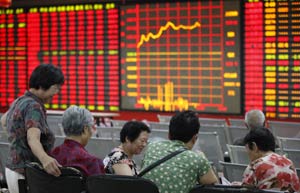
With all these developments, some securities dealers forecast earlier this month that the Shanghai Composite Index could soon rise to 2,400 points or even higher from its present 2,200 level (it was below 2,000 not long ago).
If the lifting of restrictions can generate more sales in the housing market, and if the reactivated housing market can boost retail business (in the form of sales of materials for interior decoration, for example), investors may find Chinese stocks more attractive in the second half of the year.
However, one cannot afford to be overly optimistic.
Although real estate developers can do more business now than before, it remains to be seen how many people will be willing to spend on new housing units. Except for a few large cities, and just a few areas in other cities, investment in property doesn't seem to generate the expected returns.
Despite the lifting of restrictions, the development of the urban residential-unit market (as opposed to government-subsidized units for low-income families) just cannot serve as the main engine of future economic growth.
There is even less chance of the government allowing the urban housing market to function like a speculative market-similar to a stock market, for example. The government holds plenty of policy weapons to prevent it from becoming so, and it will use them whenever it feels it is necessary.
Apart from the housing market, investors have to avoid another kind of company-one whose productivity is tapering off at a time when other companies are making progress.
The recent blast at a factory in Kunshan, an industrial town near Shanghai-which experts say is likely to have been an aluminum dust explosion in which more than 70 lives were lost-shows the risk facing many industrial facilities built in the 1990s, when China had just begun to open up.
After the disaster, a report from Suzhou (the city of which Kunshan is a part) said 135 aluminum processing factories, similar to the one where the explosion occurred, had been ordered to shut down for safety reasons.
This indicates that many of them were built during the same period following the same standards-or a lack of them.
A whole generation of low-tech manufacturing companies will require new investment even if they are running profitably and may not be typical sweatshops. But letting such 20- to 30-year-old facilities continue to run around the clock can be a hazard, for human lives as well as production.
It is thus important for industrial parks that used to attract companies by offering tax holidays and lax rules to change their style of administration.
So we can see why China says it is in transition. It can still manage to maintain healthy economic growth thanks to the size of its economy and its government's political and monetary means to keep pace with the market.
But despite the growth and the means at the government's disposal, the country still lacks worthy companies to attract more investors-in the industrial as well as the services sectors.
And although the stock market may see certain short rallies, based primarily on small positive changes, it doesn't have the fundamentals to sustain a powerful northward journey.
The author is editor-at-large of China Daily.
 |
 |
|
|
Top 10 underwriters in China |
Copyright 1995 - . All rights reserved. The content (including but not limited to text, photo, multimedia information, etc) published in this site belongs to China Daily Information Co (CDIC). Without written authorization from CDIC, such content shall not be republished or used in any form. Note: Browsers with 1024*768 or higher resolution are suggested for this site.
License for publishing multimedia online 0108263 Registration Number: 20100000002731 

