Meat scandal exposes loopholes in quality control and supervision, reports Wang Zhuoqiong
A meat supplier's practice of selling expired chicken and beef to top fast-food chains in China has highlighted loopholes in ensuring quality and safety in the food supply chain in the country, pushing companies to be more proactive in auditing and testing, experts said.
|
Restaurants that have used products from Shanghai Husi Food Co Ltd A number of fast food restaurant chains are clients of food producer OSI’s subsidiary in Shanghai, but food authorities had not released a list of the company’s clients by Monday evening. Following are responses from some of the fast food restaurants in China that have been accused of using outdated food from the company. McDonald’s McDonald’s said on Sunday night that it had informedall franchises in the country to stop using or selling the questionable products and keep all the meat from Shanghai Husi Food Co. They have organized a professional team to investigate the case and will release the results as soon as possible. Burger King A few Burger King products have meat from the Shanghai Husi FoodCo and all of them have been removed, the company said. KFC and Pizza Hut Yum! Brands, which manages KFC and Pizza Hut, said on Monday that it ordered all KFC and Pizza Hut franchises to stop using meat from Shanghai Husi Food Co and launched an investigation into OSI’s subsidiary in Shanghai. It may lead to a shortage of two hamburgers sold at breakfast at some KFC outlets and a beefdish at Pizza Hut. Yum promised to resume supplies as soon as possible. Starbucks Starbucks said on Monday that only one product used chicken provided by Shanghai Husi Food Co, adding that this product has been sold in only 12 provinces. All the outlets in these areas have stopped selling that product. Dicos Dicos confirmed on Monday that it was supplied by Shanghai HusiFood Co, and said it has required all outlets to seal up all meatproduced by the company and stop selling one kind of breakfastsandwich. It also launched an? investigation into OSI’ssubsidiary in Shanghai and related companies to guaranteefood safety. Source: China Daily REPORTS; ZHENG JINRAN, GRAPHIC: G. MUNRO / CHINA DAILY |
|
Punish harshly for bad food, experts say Food safety experts said China needs tougher measures in its laws to effectively supervise food makers and sellers. |
|
Top chains may suffer a backlash that lingers? Leading fast food chains in China - McDonald's, KFC and Pizza Hut - are expected to suffer a lingering impact from recent media reports involving a food supplier allegedly using meat products past their expiration dates. |
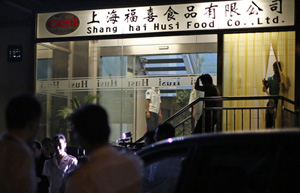
The Shanghai Food and Drug Administration confirmed on Tuesday that the Shanghai Husi Food Co Ltd was found in violation of the law, after five batches (5,108 boxes) of their chicken, beef and pork were discovered to have problems.
The meat supplier, wholly owned by Chicago-based food company OSI Group LLC, sells meat to nine fast-food chains, including McDonald's Corp and KFC parent Yum Brands Inc, coffee chain Starbucks Corp and Burger King Worldwide Inc.
The involved brands have halted using products from Husi. McDonald's and Yum said they will resume purchases when they can ensure the food complies with laws and standards. Neither said what suppliers they would use in the meantime.
The scandal came as multinational food producers and retailers have expanded their outlets and factories aggressively in China, one of their most important markets.
Yum, the parent company for KFC and Pizza Hut, has opened 6,387 outlets in China so far, and it had a market share of about 5 percent in 2013.
McDonald's has 2,000 outlets, which accounted for 2.6 percent of the fast-food market last year. About half of Yum's revenue and 35 percent of its operating profits came from the Chinese market last year.
But their rapid expansion was not accompanied by a similar improvement in managerial capacity and training, resulting in continued food safety scandals, said Zhao Ping, deputy director of the Chinese Academy of International Trade and Economic Cooperation, which is under the Ministry of Commerce.
Fast-food chains, which have developed quickly in China in recent years, many through franchising, have been weak in implementing the industry standards and ethical principles that they follow in developed markets, she said.
"Multinationals should require their operations in China to follow the same standards in terms of food safety as in developed markets," Zhao said. "It is an excuse for food producers to lower their standards only because local regulations are loose and food safety and security awareness are weaker."
Companies should invest in internal training and set up appraisal systems that involve food safety issues, she said.
Zhao said fast-food restaurants are also responsible for unsafe food purchased at their outlets, because they should have supply chain controls at their logistics centers that deal with this issue before products are shipped to the stores. Even when products are labeled as qualified, fast-food chains should send samples for third-party testing.
The latest incident is "a wake-up call for Chinese consumers, who have long believed that foreign fast-food brands follow higher standards than domestic ones", Zhao said.
These fast-food brands should be prepared to lose a number of loyal customers, she added.
The incident is not a simple case of negligence by an individual company but an exposure of the systemic risk in the food supply chain, which damages consumer trust and brand loyalty, she said.
Ben Cavender, an analyst at Shanghai-based China Market Research, said the reason why it appears that multinational food companies are involved in more misconduct in China than in other markets is because most of the markets are not as big or fast-growing as the market here in China.
In many ways, suppliers in China are still "professionalizing" their operations and do not always hold same standards that apply in Western Europe and the United States, he said.
Because of all these issues, it is difficult for foreign-invested suppliers to maintain quality and offer consumers safe products the way they should, even though the supplier situation has improved a lot, he said.
Hu Min, leader of the professional team of the China Federation of Logistics and Purchasing and its specialized committee for purchasing and supply chain management, said that food safety testing standards and frequency should be improved at all stages of the logistics and supply chains.
In recent years, many international retailers have learned a lesson and put more resources into food testing to prevent food safety scandals.
Wal-Mart Stores Inc came under the spotlight early this year after a supplier's donkey meat was found to contain fox meat. It also came under fire for selling expired duck meat in 2011.
Walmart China said the company will increase its investment in food safety to more than 300 million yuan ($48.6 million) between 2013 and 2015, focusing on Increasing supplier audits and tests for suppliers.
It will increase DNA testing on meat products and spend more on facility audits and inspections of primary producers. The number of facility audits and inspections of primary producers was up 50 percent in 2013 compared with a year earlier, it said.
 |
 |
|
|
|

Copyright 1995 - . All rights reserved. The content (including but not limited to text, photo, multimedia information, etc) published in this site belongs to China Daily Information Co (CDIC). Without written authorization from CDIC, such content shall not be republished or used in any form. Note: Browsers with 1024*768 or higher resolution are suggested for this site.
License for publishing multimedia online 0108263 Registration Number: 20100000002731