Comments
  Print
Print  Mail
Mail  Large Medium Small
As China's emerging middle class becomes increasingly urbanized, there's a need to shift from being a nation of savers to one of smart investors and consumers, former US treasury secretary Henry Paulson told a panel of executives at the Fortune Forum in Chengdu on Friday.
"The Chinese economy is getting bigger and bigger and its growth is set to slow down in the future," he said.
"China should adopt a different development model for long-term prosperity and sustainable development."
Offering a word of praise to China's "strong" new leadership, Paulson said the Chinese people's expectations have never been higher.
But in order to meet those expectations, China must open up to the idea of investing in long-term projects, and banks must focus on interest rate liberalization, he added.
"The country's economy is heading in the right direction. This is more important than achieving short-term growth," said Paulson, who is also a former CEO of Goldman-Sachs.
Joining in the panel discussion, Dominic Barton, global managing director of McKinsey & Co, backed Paulson's assessments, adding that the population shift from rural areas to cities is a positive factor for China's continued economic growth.
"The good news is that there is an underlying force of growth and that's urbanization. What we're basically seeing is more than 250,000 people moving from rural areas to cities every week," Barton said.
That shift, he added, was unaffected by outside influences, such as the fluctuation of the euro or other Western economic woes.
In coming years, he said, urbanization will create a strong market for consumer goods, which will dominate more than a quarter of the world's GDP.
"We're only at a 52 percent urbanization point today in China, so we're at the end of the beginning."
As more people move into cities, the spending power of China's middle class will increase, creating an economic situation Barton described as "phenomenal".
"We think that by 2025 there will be 225 cities in China that will account for 29 percent of the world's GDP growth," he said. That's compared with only 75 cities today with what is considered a strong economic impact.
"We've got many more cities to go," said Barton.
Cai Hongbin, dean of the Guanghua School of Management at Peking University, added that China's transition from being an investment-driven economy to one fueled by consumption was a major challenge, in part, due to cultural influences.
"The drive towards consumption is a big cultural factor. My parents' generation, and my generation, don't like to borrow to consume.
"But the younger generation borrows a lot to consume, to buy iPhones and things like that. So I think consumer financing is much more about the younger generation," said Cai, adding that the power of growth now lies in the consumer, and all the signs point to a positive transition.
"The good news is that consumption growth has outpaced GDP growth in recent years," Cai said.
China's GDP grew 7.7 percent year-on-year in the first quarter of this year after growth of 7.9 percent in the fourth quarter of last year, which ended a slowdown lasting seven quarters.
According to Cai, consumer growth has maintained a steady 9 to 10 percent growth rate over the past few years.
"But the key for a successful transition lies in the quality and efficiency of investment, rather than the investment amount," Cai said.
Stephen Roach, a senior fellow at Yale University's Jackson Institute for Global Affairs, agreed that structural reform is crucial for an economy as large as China's.
"I am optimistic about China, and China's reaction to the external world is appropriate and swift," Roach said.
"Difficulties not only lie in the restructuring of that growth model, but also in the scope, array and strength of its reforms," he added.
"Financial market reforms will be an important task, and I expect those will be the first reforms."
Yang Yuanqing, the president and CEO of Lenovo Group Ltd, said that China's ongoing urbanization is the most important driver for China to expand domestic demand and for it to sustain economic growth, as consumption still contributes a much smaller share of China's GDP compared with other big economies.
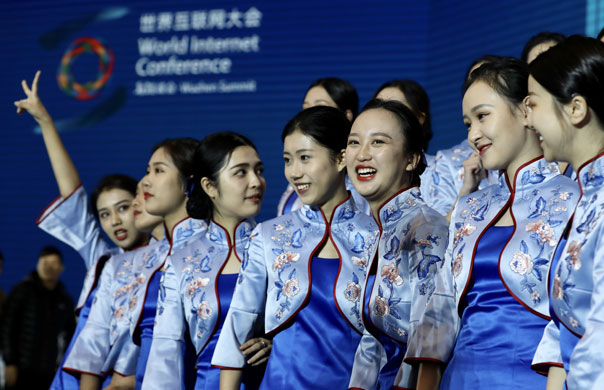 4th World Internet Conference concludes
 Starbucks Reserve Roastery set to open in Shanghai
 Smile to get discounts in Tmall's unmanned supermart
 Top 10 richest Chinese women in 2017
 World leading internet sci-tech achievements released in Wuzhen
 Top tech CEOs take to the stage as Wuzhen Summit opens
 Major topics at 4th World Internet Conference
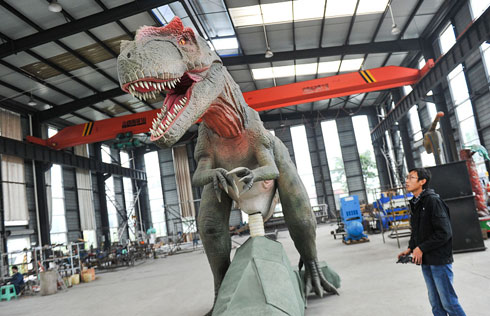 'Made in China' dinosaurs amuse the world

Copyright 1995 - . All rights reserved. The content (including but not limited to text, photo, multimedia information, etc) published in this site belongs to China Daily Information Co (CDIC). Without written authorization from CDIC, such content shall not be republished or used in any form. Note: Browsers with 1024*768 or higher resolution are suggested for this site.
License for publishing multimedia online 0108263 Registration Number: 20100000002731