Comments
  Print
Print  Mail
Mail  Large Medium Small
|
 Rice products of Jinjian Cereals Co on display at a trade fair in Hunan. Photos by Wang Jing / China Daily |
Conversely, foreign investment in Hunan is also being encouraged by the provincial government's move to cut red tape.
"There are 131 enterprises of the Fortune 500 enterprises in Hunan," Xie says. "From January to September, the utilization of foreign capital reached $6.5 billion, with year-on-year growth of 19.1 percent. We have undertaken 2,518 industrial transfer projects, among which 309 are international projects."
Between January and September this year, Xie says 351 Asian investment-backed projects went ahead in Hunan, representing almost 86 percent of all foreign investment.
Chen Zhaoxiong, vice-governor of Hunan, says the current economic condition of the province "provides a solid foundation for future development".
Much of the success is attributed to a plan that was set in motion about six years ago. At the end of 2007, the State Council approved a blueprint to develop three Hunan cities - Changsha, Zhuzhou and Xiangtan - into a pilot zone for building a resource-saving and environmentally friendly society.
The plan, called the "two-oriented society", was later expanded to include another five cities - Changde, Yiyang, Yueyang, Loudi and Hengyang - all within an hour-and-a-half drive of Changsha, Zhuzhou or Xiangtan.

The interconnectivity of the cities, and their ability to share resources and reduce redundancies, has been the lynchpin of a series of changes and reforms in the province that have enabled the market to begin to drive ahead and innovate. More than 80 industrial zones and parks with varying incentives and favorable taxation conditions have further stimulated growth.
On the floor of a factory in Changsha, the founder and CEO of Hunan Farsoon High-Tech Co proudly shows off a futuristic-looking machine that epitomizes the kind of innovation Chen is keen to see more of.
Established in 2009 by Dr Xu Xiaoshu, Farsoon is now China's biggest and the world's third-largest manufacturer of selective laser sintering equipment, the technology driving the 3D printing industry that many have heralded as the dawn of a new industrial revolution.
"Our company does not make products; our company makes the machines and the materials," Xu says.
He says business is booming and Farsoon is expanding to keep pace. "We move to a new facility next year and will be able to make 40 at a time."
The company's own formula of SLS Nylon powder, which its machines can turn into anything from moving car parts to prototypes for prosthetics, has been exported to overseas markets including the US, Sweden and Italy since last year.
Next year, the machines will be available for sale overseas, too. At present the roaring demand in China coupled with limited production capacity means each of Farsoon's machines are sold for more than 1 million yuan.
With the US pushing hard to maintain an edge on what is tipped to be a technology capable of revolutionizing the manufacturing and medical prosthetics industries, Xu says his work is vital to China.
"Metal, ceramics, all of these materials are in research (for use in 3D printing) right now," he says. "We have already made some metal parts. If we want to keep manufacturing jobs in China, we need to improve technology. This technology will replace traditional industry in the long run. In theory, you can use it to make a car or a plane. But at the moment it's too expensive. We invest a lot in research and development."
Down the road at Broad Homes, CEO Fen Tang says its automated lines are pumping out pre-fabricated walls that are fast becoming the building blocks of a greener China and a cleaner world.
"We are a link between traditional and new sectors," she says, touting the environmental credentials of the company's product.
The construction industry accounts for one-third of all waste generated in Chinese cities, Broad Homes says. In comparison with traditional construction, the company says its process requires 80 percent less water. The insulation quality of the finished product also generates a 70 percent energy saving over the lifetime of its buildings.
With nine manufacturing bases across China and a new factory being built in South America, Fen says by 2015 the Hunan heavyweights will have a 5 percent market share of the Chinese construction industry and will continue to expand overseas operations in regions such as Russia, Africa and the Middle East.
 Lamborghini launches Aventador LP 720-4 50° Anniversario
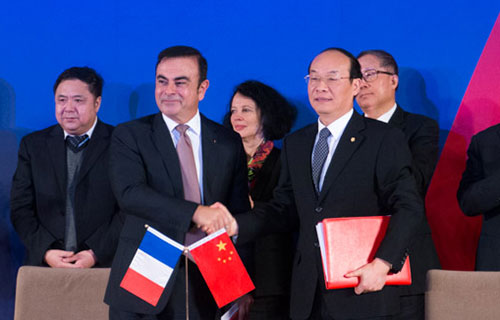 Dongfeng Renault expects 1st China-made Renault SUV in H1 2016

Copyright 1995 - . All rights reserved. The content (including but not limited to text, photo, multimedia information, etc) published in this site belongs to China Daily Information Co (CDIC). Without written authorization from CDIC, such content shall not be republished or used in any form. Note: Browsers with 1024*768 or higher resolution are suggested for this site.
License for publishing multimedia online 0108263 Registration Number: 20100000002731