Comments
  Print
Print  Mail
Mail  Large Medium Small
BEIJING -- Beijing launched carbon emissions trading on Thursday, making it China's third market for carbon trading.
An initial 490 companies, whose carbon emissions account for 40 percent of the city's total, have been included in the plan, according to the Beijing Municipal Commission of Development and Reform.
Under the trading program, companies which produce more than their fair share of emissions will be able to buy unused quotas on the market from companies that cause less pollution.
The market is based on the Beijing Environment Exchange. Five deals worth 40,800 tons in carbon quotas have been traded thus far at prices ranging from 50 to 52.25 yuan ($8.16-$8.36) per ton.
On Tuesday, Shanghai launched its compulsory carbon trading market, the country's second such market, and South China's Shenzhen city started its market in June.
The National Development and Reform Commission (NDRC), the nation's top economic planner, has also approved pilot carbon emissions trading schemes in Tianjin, Chongqing, Hubei and Guangdong.
With the expanding of the plan, China is predicted to become the world's second-largest carbon emission trading market, covering 700 million tons of carbon emissions.
Emission trading is a widely adopted, market-based approach initially adopted by the European Union to control pollution.
Xie Zhenhua, deputy head of the NDRC, called for placing more emphasis on market-based methods.
While experts hailed the pilot plans as a landmark for China in building a nationwide emission trading market, they said fundamental problems including legislature, statistics gathering and quota allocation, monitoring and assessment systems, should be resolved before a market mechanism for curbing greenhouse gas emissions can be called a success in the country.
"Statistics of the companies should be monitored by a third-party organization, and the carbon emission quotas for different regions of the country should be determined by its economic development, industrial structure as well as residents' environmental protection awareness," said Wu Libo, a professor with Fudan University's economic department.
Du Shaozhong, chairman of the Beijing Environment Exchange, applauded the trading system, saying it will promote industrial reconstruction, and accelerate the invention of new industries.
To tighten its regulation on polluting industries and put the economy on a greener path, China has also considered levying a carbon tax.
Experts believe this tax will bring many benefits, including penalizing companies for environmental damage and forcing them to improve their production technology.
The country has also been working to reduce emissions of greenhouse gases through industrial restructuring.
The government has stepped up energy conservation evaluations and examinations, environmental impact assessments and preliminary examinations of land used for construction projects.
It has raised the entry threshold for certain industries and strictly limited new projects in sectors with high energy consumption, pollutant emissions or excess capacity. It has also rigorously controlled the export of products that involve such factors.
In its 12th Five-year Plan period (2011-2015), China is aiming to boost industrial transformation and upgrading in a number of key industries, including iron and steel, non-ferrous metals and building materials.
The NDRC's Xie noted that China must also vigorously develop low-carbon technologies and industries, as its economy-fuelling resources are limited in per capita terms and its environment is fragile.
Du Shaozhong echoed Xie's idea and called on people to purchase more low-carbon products to support the development of low-carbon industries.
 Honda models at 2013 Guangzhou auto show
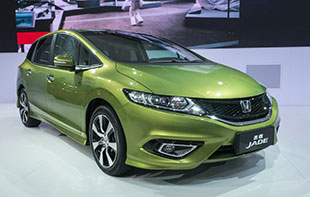 Honda Jade at the 2013 Guangzhou auto show
 Toyota's new Reiz debuts at 2013 Auto Guangzhou
 Jimmy Lin Zhiying, models at Toyota pavilion
 Volvo all-new S60L world premiere at Guangzhou auto show
 2013 Guangzhou auto show carmakers' eventers
 Models at Volvo pavilion at 2013 Guangzhou auto show
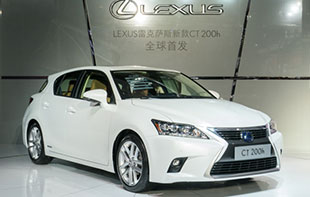 Lexus new hybrid hatch CT200h world premiere in Guangzhou
Copyright 1995 - . All rights reserved. The content (including but not limited to text, photo, multimedia information, etc) published in this site belongs to China Daily Information Co (CDIC). Without written authorization from CDIC, such content shall not be republished or used in any form. Note: Browsers with 1024*768 or higher resolution are suggested for this site.
License for publishing multimedia online 0108263 Registration Number: 20100000002731