Comments
  Print
Print  Mail
Mail  Large Medium Small
BEIJING - An imbalance between supply and demand in the realty market has created rising housing prices and rentals in China's first- and second-tier cities like Beijing, Shanghai, Guangzhou and Shenzhen.
It is agreed at the World Economic Forum "Summer Davos" in Dalian, NE China, earlier this month, China's industrialization and urbanization is still at the inception stage, with huge potential in the consumer market.
Li Tie, director of the China Center for Urban Development under the National Development and Reform Commission, said China's property market will be driven by urbanization.
To promote healthy development of the market, the authorities should consider providing more quality public services in cities to ease the pressure on property prices, he added.
"Investors and homebuyers are returning to the market and pushing up prices because of the limited supply," said Huang Zhijian, chief analyst at Shanghai Uwin Real Estate Information Services Co.
In August, growth rates in the first-tier cities were significantly higher compared to the second- and third-tier cities. New home prices in these cities rose by 18 to 20 percent year on year while those in 35 third-tier cities rose by around 6 percent on average, extending the winning streak to 10 months and pointing to robust housing demand in these top-tier cities.
Zhang Dawei, director of Centaline Property's research center, estimated that housing prices will increase in a year based on the value of prime land. "Based on current levels, these major cities will face huge pressure to realize their goal of curbing house prices this year, even if prices stop increasing right now," he said.
"The market is polarized and it's time to introduce a long-term mechanism to balance it," said Zhang, waning that the market in first- and second-tier cities may explode while third- and fourth-tier cities may build up inventories in future.
As warnings continue to be sounded about the regional difference problem in China's housing market, real estate industry insiders are also worried by another problem, but one that few people are aware of.
This is the over-development of huge urban commercial complexes.
The problem has formed in the market in the second and third-tier cities. Urban complexes are modern developments covering large areas that usually bring together residential blocks, offices, shopping malls and entertainment facilities such as cinemas and clubs.
However, the commercial property market in some second and third-tier cities has already shown signs of overheating. So many urban complexes have sprung up that the market is almost at saturation point.
George Yang, managing director in North China for Colliers International, said, "If bubbles in residential properties burst, people can still sell them if the sticker price is low enough, because people always need a place to live."
"But once the commercial property market crashes, nobody is willing to rent a shop that loses money every day, when there is no customer but accumulating rental and utility fees," Yang added.
One example. In Hohhot, in the Inner Mongolia autonomous region of N China, more than 30 urban complexes are being built for an area whose population is only 3 million.
The problems that those numbers present become clearer when considering a rule of thumb: an urban complex can have a direct influence on about 300,000 residents, which means three or four complexes would be enough for a city with a population of 1 million.
Moreover, the problem is expensive: a single urban complex requires at least several billion yuan, so if it does not succeed, the results can be ruinous for investors.
What makes the matter even more challenging is that some property developers of urban complexes have a common ambition: to attract top international brands such as Chanel and Gucci.
The fact is that these developers are not really concerned about whether China's consumption power can support the expansion of so many luxury brands, experts pointed out.
 Microsoft revamps Surface to challenge Apple
 Highlights of AOPA-China Fly-In air show
 Car Free Day to fight air pollution
 Liaoning carrier completes its furthest sea trial
 798 Art Festival kicks off in Beijing
 Intl comic festival 'Comicopolis' held in Buenos Aires
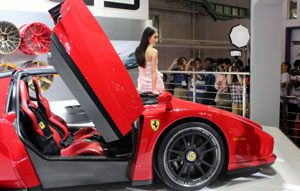 Highlights of CIAPE 2013
 2013 China International Auto Parts Expo kicks off in Beijing

Copyright 1995 - . All rights reserved. The content (including but not limited to text, photo, multimedia information, etc) published in this site belongs to China Daily Information Co (CDIC). Without written authorization from CDIC, such content shall not be republished or used in any form. Note: Browsers with 1024*768 or higher resolution are suggested for this site.
License for publishing multimedia online 0108263 Registration Number: 20100000002731