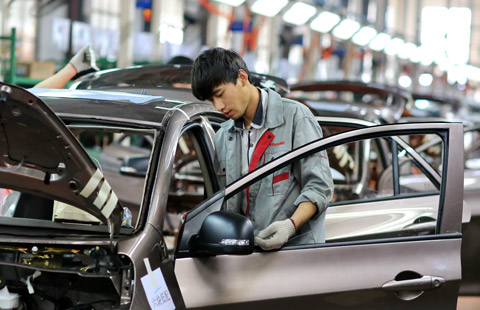
The long road to economic self-reliance


Although China is known as the world's factory, it has found it difficult to maintain that status for several reasons. The biggest challenge has been to find a new growth model that does not rely too much on domestic manufacturing and instead focuses more on overseas expansion.
Africa, with its rich pool of natural resources and with the great strides it is making industrially, appears to be the best destination for Chinese companies to achieve such a transformation. What makes this so fascinating is that China's disadvantages - a lack of natural resources and rising labor costs - are Africa's advantages.
Africa, the raw materials warehouse of the world, has virtually every material crucial to industrialization. It has a rich pool of young people, who form the basis of an abundant labor resource, and it has a strong desire to escape the clutches of poverty and backwardness through industrialization.
Africa has been wracked by poverty and held back by slow development for decades. There are many reasons for this. From an economic perspective, the dominance of a single economic structure has led to lopsided economic development, with most African countries producing things they do not use, and using things they do not produce. This has led to economic development often being controlled by other nations.
African countries have realized the drawbacks of this basic economic structure and, over the past few decades, have explored ways of diversifying economically. Most African countries now regard industrialization as their primary path to a diversified society.
But these efforts have come up short because the industrial structure in many countries has barely changed. At the same time, the foreign trade structure has been largely stagnant and dependent on a few primary and agricultural and mineral products.
One reason for Africa's failure to transform its single economic structure is that its natural resources and labor are so widely spread. For a long time the continent has been seen, either politically or economically, as an entity, and most non-Africans have failed to recognize how diverse it is in languages, culture, religion and politics. These differences have often been the root of conflict but, at the same time, they are huge assets, something that has never been fully realized, let alone exploited.
It is clear, too - with history and current circumstances as the guide - that it is difficult for Africa to achieve its aims of industrialization without unity of purpose among its nations.
Those building the road to industrialization need to consider the continent as a whole, because it is only then that what may seem to be a country's drawbacks will be shown, on a broader canvas, to be its advantages.
Of course, this also requires that all African countries to be involved in planning in a coordinated way, with meticulous division of tasks, an approach that will also reduce the chances of competition and conflict.
It is essential, too, that integration of different regions and different industries be speeded up. Communication, coordination and cooperation between regions should focus on developing markets and on technical exchanges, and ultimately work to find complementarities between different industries.
China's labor-intensive manufacturing, now being transformed, seems to be the best solution for African countries that are in the early stages of industrialization. This is because the Chinese companies are relatively self-sufficient financially, their technical threshold is low and it is relatively easy for them to set up operations in Africa.
Chinese businesses in Africa have focused on investing in labor-intensive manufacturing, which makes the proposition of shifting operations to the continent all the easier.