How the cookie crumbled for Tesco


British retailer can still succeed in China if it becomes a premium, exclusive brand
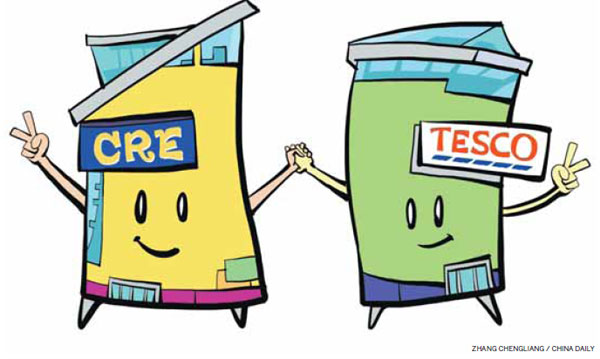
About nine years after the British supermarket chain Tesco PLC launched its gung-ho, go-it-alone expansion across the Chinese mainland, it announced on Aug 9 that it was to merge its unprofitable operation into a State-run company as a minority partner. Tesco's partner, State-owned China Resources Enterprise Ltd, will dominate the tie-up, with Tesco taking just a 20 percent stake.
This marks a humiliating retreat for the British retail giant and, rather than representing part of any coherent strategy, appears to be an attempt to limit losses.
Tesco has also recently announced that it plans to "concentrate on the UK market", yet the British retail market remains sluggish at best with no prospect of growth, unlike international markets such as Asia, and China in particular.
One has to question the credibility of Tesco's overall strategy and, therefore, its senior management. Do they possess the talent to shape the Tesco brand into a truly global outfit?
Problems negotiating with suppliers and regulators, and soaring costs, for rent and labor, are cited as key reasons behind Tesco's failure on the Chinese mainland. In addition, strong competitors such as Carrefour SA and Wal-Mart Stores Inc, combined with a move toward online grocery shopping, have not eased Tesco's plight.
Access to prime urban locations is undoubtedly a contributory factor in Tesco's demise. Local competitors often enjoy a natural advantage here with government connections.
Tesco's go-it-alone entry strategy in 2004 has also been a factor in the demise of the once fabled retailer. History, and recent history at that, is littered with similar tales of foreign companies trying to penetrate Chinese mainland. The British retailers B&Q PLC and Marks and Spencer PLC are prime examples, both having had little success in China and both having initially sought to transplant their British business model.
However, all of the above stand out as symptoms of Tesco's poor performance in China. The root cause can be found in the apparent ethnocentric attitude that no doubt dictates all aspects of Tesco's management thinking and strategy.
This is not unusual for a company so successful in its British home market. Sadly for it, that success has not been replicated in any overseas venture. Embarrassing retreats in the US and Japan have also severely dented Tesco's image.
Tesco has experienced huge success in the British retail market. Since the mid-1980s, when it was the first British retailer to issue a loyalty card, it has risen magnificently above many established competitors such as J Sainsbury PLC with an incredibly well-managed hybrid strategy combining reasonable quality with affordable prices and good service.
Tesco also managed to secure many of the most attractive locations for its supermarkets in Britain.
Its success, particularly under the leadership of Terry Leahy, appeared not to lead to a sense of complacency and strategic drift that so often characterizes such an incredible rise. Leahy's mantra was always "we can do better" despite year after year of impressive financial results and a stronger and stronger grip on British retailing.
This appears to have changed. Tesco's incredible attention to detail and masterful market-orientation have been replaced by an arrogance and a belief that what worked in Britain would work overseas.
It was extremely foolhardy to launch a mainland entry in 2004 without some sort of joint venture with a Chinese partner or partners. The Chinese mainland is a very different market, where relationship building with suppliers, distributors and regulators is key. The Chinese are also very different and changing, and food is inextricably linked to cultural and social factors in China, unlike in Britain.
As part of the initial tie-up though, Tesco should also have laid firm plans and intentions to build the Tesco brand. Even today, about nine years on from Tesco's first foray in China, the corporate brand name is barely known.
Tesco's Chinese name le gou, translates to "happy shopping". A reasonable attempt at positive brand association but which lacks the cultural fit and emotional resonance of Carrefour's jia le fu meaning "happy family". Carrefour has quite deliberately avoided the "shopping" association in favor of the "family" association, so central to Chinese culture.
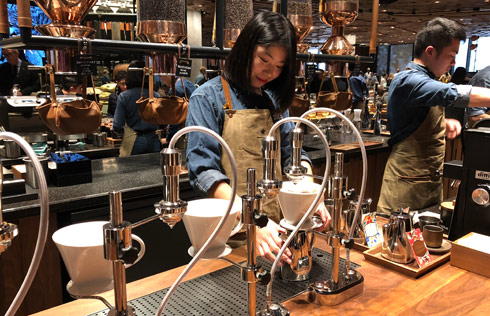
However, on a more strategic level, Tesco appear to have neglected any consideration of brand positioning or repositioning. With established and entrenched competitors such as Walmart and Carrefour, Tesco could never succeed with a similar brand positioning strategy. However, an opportunity still exists for a niche retailer brand with a premium, exclusive brand position in the mainland marketplace. In fact, many foreign brands have repositioned in the same way in China, for example BMW AG, Ikea and Starbucks Corp.
All of these and so many more high quality, but rationally positioned, foreign brands have repositioned in China and offer a far more emotional brand experience. At present this resonates with China's burgeoning urban middle class shopper.
Such repositioning should have guided Tesco's China strategy. Such an emotional offering creates greater brand meaning and loyalty and also reduced dependence on prime location. People are far more likely to seek out more exclusive, emotional offerings.
Indeed Tesco need look no further than its British stronghold, where the niche, premium retailer brand Waitrose occupies just the position that remains unoccupied in China today.
Clearly, what works in Britain will probably not work in China. Far from retreating in China, Tesco should now regroup, reposition and rebrand with "exclusivity", "emotion" and "enterprise" as core brand values.
The author is a visiting professor at the University of International Business and Economics in Beijing and a researcher at Nottingham University's School of Contemporary Chinese Studies. The views do not necessarily reflect those of China Daily.