Financial reform cannot wait


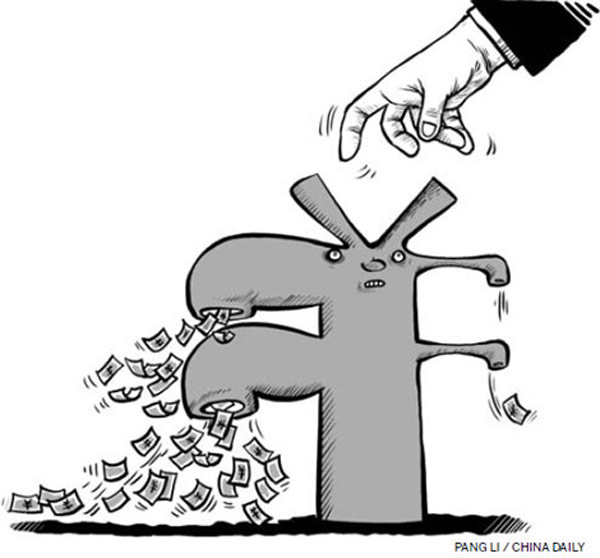
China's financial system is changing fast. Non-bank activities - including those dealing in wealth management products, trust loans and corporate bonds - have mushroomed since the global crisis. In many ways, this is a welcome diversification. However, disorderly growth of the non-bank sector could pose a threat of financial instability and erosion of macroeconomic control in the coming years.
To forestall this risk, China needs to reform its financial system. Without such reform, it will also be difficult to sustain rapid economic growth and rebalance the economy toward consumption. So as China's new leaders embark upon a new era of much-needed reforms, transforming the financial system is appropriately a key item on the agenda.
China's financial sector is flush with liquidity, both because of the high level of savings held domestically by China's capital account restrictions, and large inflows associated with the country's balance of payments surpluses and intervention in the management of the exchange rate. To prevent this liquidity from fueling dangerous lending booms, the People's Bank of China mainly uses direct tools like quantitative limits on bank credit and increases in bank reserve requirements.
In contrast, interest rate hikes are used more sparingly as they conflict with other goals - both loan and deposit rates are kept low to provide cheap credit to certain enterprises, protect bank margins and subsidize the sterilization of foreign exchange intervention.
So why should we worry about the status quo? We should be concerned primarily because quantitative controls on credit are creating enormous incentives for banks to find other ways to lend, including off-balance sheet and through informal means, which is risky and could begin to compromise macroeconomic control over time. Moreover, China's financial system perpetuates its unbalanced growth model by under-pricing capital and depressing interest rates, which suppresses household income and consumption while subsidizing corporate sector investment and savings.
So the rationale for financial reform in China is powerful. However, international experience cautions that many countries that have tried to liberalize their financial sector have lost control over monetary aggregates and that reform must be appropriately sequenced to avoid risks. What might such a road map look like for China?
First, relative prices - including the exchange rate - could be determined more by the market so as to stem the continuous inflow of liquidity. At the same time, the stock of excess liquidity would need to be absorbed by issuing central bank bills and moving to a point where interest rates clear the credit market, not quantity controls. This would facilitate a shift away from quantitative limits on credit toward the use of conventional monetary tools. Significantly, it will also help the central bank to run a more active, independent and counter-cyclical monetary policy.
Second, implicit public guarantees of financial institutions need to be explicitly withdrawn at an early stage. Such blanket backing should be replaced with deposit insurance. It could be complemented by continuously reforming and commercializing the State-owned banks. Ensuring that banks face hard budget constraints is an important prerequisite for a more commercially oriented banking system that adequately prices risk and efficiently allocates credit. This would also help prevent banks from taking undue risks as interest rates are liberalized, restrictions on bank activities eased and new markets opened.