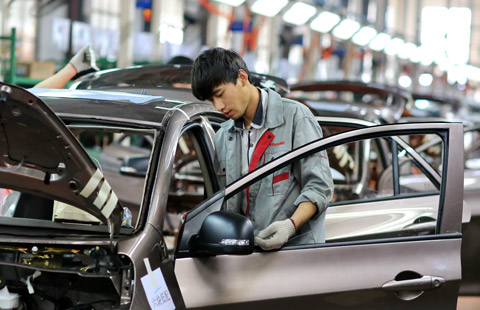
Employers struggle to find talent


Larger social trends are exacerbating matters. Over the past generation, the key to China's remarkable productivity improvement has been the massive movement of people from country to city, from farms to factories. The apparently endless flow of new entrants to the labor force kept wages in check.
This strategy can no longer work. Official statistics show that the pace of migration is beginning to slow; at any rate, the generally low educational level of migrants means that they do not have the skills that companies need. Moreover, due to the one-child policy, the number of people in the workforce will fall in absolute terms, as it did in 2012, by 3.45 million.
In short, just when China needs many more skilled people, its population will be falling. China's fewer workers will therefore need to be better ones, with skills suited to faster-growing sectors, such as high-end manufacturing, wholesale and retail trade, health, and education.
To bridge the skills gap, China has two advantages. One is that this is an area where industry and the private sector have every incentive to step up efforts. The other is that there are good examples of what works, from countries rich and poor, and in just about every industry. These solutions can be readily adapted and scaled up. Here are some ideas that work:
Engage youth early. Where the required skill is rare or new, don't wait for the next generation to grow up and get interested: get to them while they are still in school. A number of industry-led programs, such as South Africa's Go for Gold, expose youths to particular professions during secondary school, then assist them in training and further education. South Africa's construction and engineering industry gets a pipeline of talent, and the young people, many of them from disadvantaged backgrounds, get a foothold in a fast-growing sector.
Run intensive boot camps. These are short programs that focus on delivering particular skills. One example is Dev Bootcamp, a United States-based for-profit computer-programming course that takes students of widely different ages and backgrounds; drills them intensively for nine weeks; and works with employers to understand exactly what they need. At the end of 2012, Dev Bootcamp said it had placed more than 90 percent of its graduates, at an average starting salary of $83,000. China is in a good position to develop boot camps because the for-profit education and training market is developing rapidly. Regardless of job or supplier, it's imperative to involve employers, emphasize learning through practice and simulation, and assess proficiency to ensure that graduates are ready to work.
Create your own talent pipeline. Some of the most powerful solutions are those where leading employers come together to define the skills that they need and then work with local education providers to shape the curriculum. That is the story behind the Automotive Manufacturing Technical Education Collaborative, a joint program of 30 community colleges and major automakers that operate in the US to prepare students for careers in high-end auto-manufacturing skills. Collaboration can also be done on a for-profit basis. China Vocational Training Holdings is a private company that works with automakers to provide training to 100,000 students a year. It provides more than half of the industry's new workers.
China can see the skills gap coming. If it fails to take the steps to close it, that would be a colossal mistake - on the order of $250 billion.
Li-Kai Chen is a partner in McKinsey's Kuala Lumpur office; Mona Mourshed is a director in the Washington DC office, and Andrew Grant is a director in the Singapore office.
- Jobs scarce as record numbers graduate
- Job fair pairs handicraft masters with apprentices
- Record-high Chinese grads struggle to secure jobs
- China vows to help college grads land jobs
- President makes surprise visit to job fair
- Male nurses needed in Chinese job market
- Moving overseas a job remedy for nurses
- Taobao creates new job specifications