Phoenix Arts Group spreads wings globally


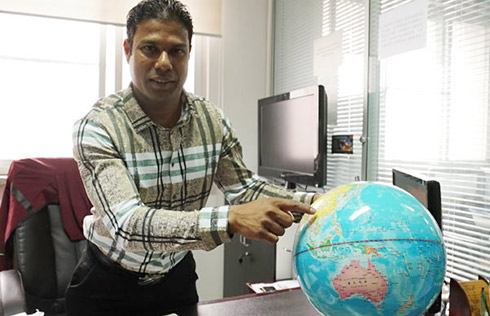
Chen Weihong never became a painter like he wanted to, but at the age of 40 he has managed to build an art materials empire on his own.
The Phoenix Arts Group, in Wuxi, Jiangsu province, is the world's second-largest art materials supplier in terms of production capacity, after the United Kingdom-based Winsor & Newton.
"We plan to open our second overseas factory in Poland to better support the European market in 2014, and the third in Mexico, catering to our customers in the United States," Chen said.
"You need to have a global vision," he stressed, noting that his company's revenue is now more than 500 million yuan ($80.65 million) a year and the profit margin is "several times" higher than those of other textile-industry players.
Chen opened his first overseas plant in Vietnam in 2006 to circumvent US anti-dumping duties and quota restrictions that targeted Chinese companies.
He launched his business in 1995 after learning that there was great demand in Europe for canvases. He then left his job as a salesman and set up a small company.
"I spent almost two years, doing experiments and improving techniques until I produced the first canvas wrap," Chen recalled.
Thanks to the prosperous local textile and chemical industry, Chen was able to access cloth and find skilled workers easily.
Orders then flooded in as his company was filling a market gap.

In 2001, China joined the World Trade Organization and adopted higher export-tax rebates. By seizing the opportunity, Chen increased his company's annual revenue from 10 million yuan to 400 million yuan in the next five years.
Phoenix had an 11 percent market share in the US by 2006, and supplied 80 percent of the canvases that China exported to the country. But then came an anti-dumping investigation in the US.
Chen said that he spent a significant amount of money to hire an experienced US lawyer. However, because Phoenix's products were of higher quality and more expensive than similar Chinese goods, they finally received a much lower duty than the company's Chinese counterparts, which later helped him win additional orders.
"But at the time I made up my mind. I was convinced that I had to search for a manufacturing base outside China," he said.
The company's Vietnam branch now contributes more than $20 million in export value annually. The company also set up a distribution center in Spain to supply the European market.
"We needed to go outside China not only to deal with the trade barriers, but also to cope with the rising costs in China," Chen said.
Cotton-cloth prices have surged by more than 30 percent in the Chinese market in recent years, Chen said, and products sourced from India are about 20 percent cheaper.
The same happened with wood prices, which have gone up in China due to its urbanization drive, while wood in the US and Canada is 20 percent cheaper and of better quality, Chen noted.
More than half of the raw materials that Phoenix uses today are sourced from overseas, including wood from the US and Canada and cotton cloth from India. Meanwhile, more than 90 percent of the raw materials used by the company's Vietnam branch come from the US.
Chen said that his company's fastest-growing period was from 2001 to 2005, and that it now has an annual growth rate of about 15 percent. He added that he is still actively exploring new growth opportunities.
And the Chinese market is full of potential.
"Revenue in the Chinese market now contributes 20 percent of the total, but based on its staggering growth, it will be half of the total sales in three years," Chen said.
He added that emerging Chinese artists have big demand for canvases these days, and more importantly, Chinese parents are generous when it comes to spending on their children's art education.
Chen's company set up the Phoenix Art Palace in 2008 in a bid to diversify its business by introducing art promotion, education and investment activities, which also boost the sales of art materials.
Chen said he has no plans to go public.
"I have a lot of respect for the old private brands in Italy and Germany, because they really focus on making top-quality products, and that's also what I'm pursuing," he said.