Seeking a win-win scenario in trade between China, US


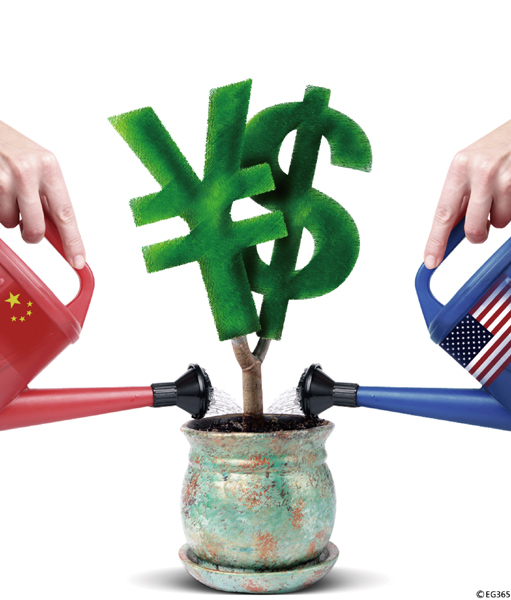
Editor's Note: US exports to China significantly outperformed export growth to the other top 10 US trading partners including Brazil by 180 percent, but US primary interests still lie in securing access to potential Chinese markets. The US-China Business Council looks at China as a $250 billion market for US companies with still greater potential for further growth.

Now China is making great efforts toward improving the two nations' economic cooperation. In this article, to share his views with our readers, Li Zhongzhou, former director-general of MOFCOM and former division director of United Nations Conference on Trade and Development, explains about this development.
The 10 years from 2001 to 2011 witnessed rapid expansion of China-US trade and economic relations. The United States played the key role in negotiating the terms and conditions for China's accession to the World Trade Organization. It extracted the greatest concessions from China in the tariff schedule contained in the China Accession package agreement. The US holds initial negotiating rights for 7,051 tariff numbers of the more than 7,000 tariff numbers package. In other words, the tariff schedule reflects fundamental US trade interests.
In return the US terminated the application of the Jackson Vanick Amendment to grant China unconditional most-favored-nation treatment. China's accession to the WTO significantly contributed to the fast development of China-US trade and economic relations in spite of all the difficulties arising from US partisan politics.
US primary interests lie in securing access to the potential Chinese market. The US-China Business Council looks at China as a $250 billion market for US companies with still greater potential for further growth. According to the council's latest report China and the US Economy: Advancing a Winning Trade Agenda, January 2013, China is the US' third-largest export market next only to the two North American Free Trade Agreement members - Canada and Mexico. US exports of goods to China rose from $19.2 billion in 2001, the year of China's WTO accession, to $103.9 billion in 2011. It represents a 542 percent rise in growth. In that year China bought 60 percent of total US soybean exports and 30 percent of total US cotton exports. In the same year, the US exported $26 billion in services to China and imported $11 billion in services from China, a surplus of $15 billion in favor of the US.
US exports to China significantly outperformed export growth to the other top 10 US trading partners including Brazil by 180 percent, the Netherlands by 95 percent, Mexico by 77 percent, Singapore by 76 percent, Germany by 68 percent, Canada by 59 percent, the Republic of Korea by 56 percent, the United Kingdom by 35 percent and Japan by 1 percent.
According to a US-China Business Council survey, US companies operating in China aim to access the Chinese market. A total of 74 percent of their products made in China sold in the Chinese market: 18 percent were sold to third countries and only 8 percent were sold back to the United States. The products sold back to the US contain a large proportion of US intermediates goods and services.
As the Chinese economy is set to grow at a moderate rate of 7 percent, import/export trade is likely to continue to grow in the next 10 years at a higher rate of at least an average 10 percent. The value of total imports and exports will likely reach some $10 trillion in 10 years.
This huge Chinese market offers the best opportunity for the US to achieve President Barack Obama's ambitious goal of doubling US exports in five years. In terms of US-China trade, this goal is well within reach judging by the successful experience of exponential growth of US exports to China in the past 10 years. For China there is no need to be concerned about fast growth of imports from the US so long as the US does not apply discriminatory trade restrictions against Chinese products.
In an open trading environment and in view of the predominance of the global value chains in production of goods and services, imports will create exports. The Chinese production system is highly integrated with the global value chain.
A preliminary joint Organization for Economic Cooperation and Development-WTO study on trade in value-added characterized the global value chains as a dominant feature of the global economy. Trade policy actions on any products from any sources will have an impact on the global economy including the country taking such actions.
The study singles out the China-US bilateral trade balance to illustrate the complex nature of global value chains. Measured by value-added, China's bilateral trade surplus with the US was more than $40 billion - 25 percent smaller - because that reflects the higher share of US value-added imports in Chinese final demand and also the fact that one-third of China's exports possess foreign contents. This testifies to the high degree of the China-US interdependent and win-win relationship. The presidents of both countries have endorsed a strategic and economic partnership. It is time for actions by the administrations to cement this mutually beneficial partnership.
It is easier said than done. There are a number of hurdles to be removed to allow a truthful partnership to flourish. The foremost one is to avoid misperception or intentional misrepresentation of the inherently beneficiary China-US economic relations as a zero-sum game. The perception that looks at China's economic development per se as a threat to US predominance in world affairs would constitute a major hurdle to productive bilateral cooperation. Joint efforts should be made to facilitate the reinforcement of the two largest economies of the world and contribute to the healthy and sustainable development of the global economy.
Both China and the US are open to foreign direct investment. According to a report by the United Nations Conference on Trade and Development in 2012, China overtook the US to become the top FDI destination country. Paradoxically, the two-way investments from each other are low.
China ranks as the eighth largest destination of US manufacturing investments abroad over the last decade. Chinese companies have a great interest in investing in the US. According to US Government data, Chinese companies invested only $6.5 billion in the US in 2012, in comparison with British investment of $442 billion, German investment of $216 billion and Dutch investment of $240 billion. It is understandable that Chinese companies are just starting to invest from a low level.
What puzzled the Chinese business community is the fact that prospective Chinese direct investments in the United States frequently hit a protectionist wall erected by the administration on untenable arguments such as threats to US national economic security even though China's investment of $6.5 billion accounts for only a tiny, insignificant fraction of total FDIs in the United States. Unless this imbalance is properly addressed, the proposed negotiation on a China-US bilateral investment treaty will lead nowhere.
Lastly, China and the US as the world's top two economies share a common responsibility to support the recovery of the global economy. The pressing issue is to reaffirm commitment to an open economic system and faithfully adhere to the WTO-based multilateral trade rules, learn the lessons of the 1930s and refrain from a beggar-thy-neighbor policy at this time of global economic crisis. We should maintain high vigilance against the danger of protectionist contagion in view of rising concerns about competitive devaluation.
In respect of China's contribution to the global economy, China has made tremendous efforts to maintain GDP growth and structural reform to expand domestic consumption. With continued economic growth, China has been recognized as the engine of global economic growth.
But China is not immune from protectionist contagion. Currently China has become the main target of trade protection actions particularly in anti-dumping and countervailing measures which go far beyond trade remedy and are purely for trade protection inconsistent with WTO rules. For example, there is the parallel levying of antidumping and countervailing duties at a prohibitive level of more than 100 percent. There is growing sentiment within Chinese industry in favor of turning inward in spite of reaffirmation by the central government for further advancing the opening-up policy.
In conclusion, China and the US have identical interests in maintaining an open global economic and trade regime. The China-US strategic and economic dialogue needs a strong push by both sides to achieve substantive progress in win-win cooperation so that it will not degenerate into a mere talking shop. It is time for action.