Comments
  Print
Print  Mail
Mail  Large Medium Small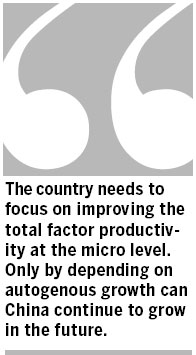
Government needs to push forward with reforms to achieve balanced and sustainable development via restructuring
The government will maintain a proactive fiscal policy and a prudent monetary policy due to the country's slower economic growth. However, the policy space for carrying out short-term macroeconomic measures in China is already quite limited. Therefore, reforms must be promoted to achieve stable economic growth in the course of restructuring.
China's GDP was 7.7 percent in the first quarter of this year, slower than expected. It declined 0.2 percentage points compared with the last quarter of 2012, and was 0.1 percentage points lower than the average growth rate last year. Although it is a slight drop, it was a continuation of the slowdown trend that appeared in 2011. The relatively weak growth is mainly reflected in the low added value in manufacturing, which is rooted in weak investment by manufacturers. Generally, the inventory level is relatively high in China, so the willingness of enterprises to invest is weak.
To be more specific, in the first quarter, the recovery of fixed investments has been largely driven by urbanization and investment in infrastructure and real estate. The investment has been dominated by government projects, investment by private enterprises and in non-governmental projects continued to decline.
The latest data also show that infrastructure investment increased by 25.6 percent in the first quarter this year, which is a substantial year-on-year growth, this rapid increase happened just after the new central leadership took office, and such investment has been the case after previous leadership changes in the past. In fact, manufacturing has continued its declining tendency, and it has dropped 6.1 percentage points compared to last year. The slump in manufacturing and private investment shows that autogenous growth is weak, which reflects the difficulties inherent in China's economic transition and restructuring.
The decrease in the long-term average rate of profit in manufacturing has affected investment confidence, and the corporate debt deleveraging has made the situation worse. Statistics show that the industrial growth of above-scale enterprises rose by 9.5 percent in the first quarter, 2.1 percentage points slower than the growth during the same period last year. Although in the first two months of 2013 above-scale enterprises achieved a profit rate of 5.18 percent, which is a rebound from the last quarter of 2012, investment confidence has been adversely affected by the declining long-term average rate of profit. The large decline in productivity and gross demand has restrained the expansion of manufacturing and resulted in worsening sustainability in enterprises' follow-up capital expenditure.
Generally speaking, the investment capital in manufacturing comes from the self-raised funds of corporations, and data show that the growth in sources of funding for fixed investments has been slowing ever since the beginning of this year, and an obvious decline happened in March when the paid-in investment of fixed investments only increased by 19.6 percent. Moreover, many companies have had to increase their debt to make up their financing gaps and the leverage ratio has increased.
The imbalance between production and demand has resulted in an inventory level that is higher than expected. Currently, there are around 30 to 40 percent of manufacturing enterprises whose rate of capacity utilization is lower than 75 percent. Such severe over-capacity exists not only in traditional industries, like steel, cement and the textile industry, it has also occurred in some emerging industries, like wind power equipment and polycrystalline silicon production.
When the industrial outdated capacity accounts for 15 to 20 percent of the total productivity, even if the manufacturing growth returns to the historical average level, the excess capacity still needs to be digested in the future, and it will be a very difficult task to reduce outdated capacity. Therefore the lack of endogenous power may lead to a weaker recovery, which means the arduous economic resurgence may take much longer than people expect.
The present policy relies on high-leverage fields, like investment in infrastructure, to boost growth, while private investment in manufacturing suffers from restrictions and controls. Therefore, it is inevitable that China has a higher leverage ratio than the GDP growth rate, and we should not expect much stimulus from fiscal and monetary policy this year. As the central government has made economic restructuring the priority over maintaining high growth, it can leave the economy more space for future growth. That's why the central government has highlighted improving the quality and efficiency of economic development and emphasized stabilizing the macro and improving flexibility in the micro.
The weak manufacturing investment growth reflects the difficulties inherent in the country's economy transition, which above all needs to release endogenous economic growth. In the short term, the international financial crisis has reduced consumption in developed countries, and this has hit China's exports. More importantly, the traditional competitive advantages of made-in-China products have gradually weakened, because of rising production and component costs.
Therefore, a short-term stimulus policy cannot balance stable growth with restructuring, and the government should focus on pushing forward transition and deep-seated reform in China. Its macroeconomic policy should pay more attention to structural changes, rather than controlling quantity.
For economic growth, instead of just increasing consumption and investment at the macro level, the country needs to focus on improving the total factor productivity at the micro level. Only by depending on autogenous growth can China continue to grow in the future.
The author is an economics researcher with the State Information Center.
 HK's new cruise terminal receives luxury liner
 Future points to carbon trading
 Seafood businesses flounder amid spending cut
 Equities slump amid slow-growth estimates
 Auto show opens with much fanfare in Xi'an
 Sunnylands summit fuels Chinese tourism interest
 'Palace on wheels' on sale for $3.13m in Dubai
 Fortune smiles on Chengdu as forum concludes
Copyright 1995 - . All rights reserved. The content (including but not limited to text, photo, multimedia information, etc) published in this site belongs to China Daily Information Co (CDIC). Without written authorization from CDIC, such content shall not be republished or used in any form. Note: Browsers with 1024*768 or higher resolution are suggested for this site.
License for publishing multimedia online 0108263 Registration Number: 20100000002731