The country should get used to slow economic growth and transform its growth model for sustainable development
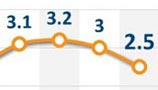
In the context of decelerating real estate investment, feeble external demand and the economic stimulus measures implemented a few years ago running out of steam, China's economic growth rate is expected to be 7.8 percent year-on-year in 2012, down from 9.2 percent in 2011 and 10.4 percent in 2010.
The continuous economic downturn has caused market concerns over a possible "hard landing" of the Chinese economy and even an economic crisis triggered by overproduction.
However, China's economic growth, in my opinion, will be around 8 percent this year, providing the European debt crisis does not deteriorate and no regional military conflict or other major unexpected events occur. The International Monetary Fund has predicted a 8.2 percent growth for China's economy in 2013. Such economic growth, if realized, will mean a soft landing. Such a judgment is based on the steady growth China's consumption, investment and exports are likely to maintain in 2013.
Relatively stable employment for years, a sizeable rise in urban and rural residents' incomes and an improving national social security system will fuel a steady rise in household consumption. The upcoming income distribution program, which will tilt toward low-income groups, will further boost people's consumption power. Residents are expected to spend more on housing, vehicles, education, healthcare and tourism, which will boost domestic demand.
Despite facing continuous de-inventory pressures and being plagued by overcapacity, China's investment is still expected to stabilize this year, although no big progress can be expected. The implementation of the "new 36 articles", which are aimed at promoting the development of non-public sector, will stimulate private investment. Due to supply insufficiency as the result of years of real estate regulations, domestic housing prices are likely to moderately rise, which will result in housing investment rebounding. Past experience indicates there will be investment binges by the government to accompany the widespread power transfers taking place in the country.
Despite the gloomy prospects for exports in the context of the global economic recession, mounting protectionism in developed countries and the ever-growing pressures for the yuan's appreciation, China's exports are also expected to maintain a steady growth. If measures recently taken by the European Central Bank help ease the lingering debt crisis in the eurozone and the US economy can pull out of its "fiscal cliff", the global economy will improve. This will improve the external environment for China's economy. With the unfolding of the free trade area between China and the Association of Southeast Asian Nations, more FTAs are likely to be launched in the surrounding regions. The accelerated efforts by China's enterprises to "go global" are expected to diversify China's export markets and promote its market expansion to other emerging countries. All these, together with a new round of exports-stabilizing measures, such as increased export rebates, will likely help China maintain a 10 percent export growth in nominal terms in 2013.
China's inflation is expected to remain relatively stable in 2013, although it is likely to moderately rebound from the previous year. Due to continuous rises in the cost of domestic factors of production and in the prices of global energy and bulk commodities fueled by the quantitative easing of developed countries, China has been under pressure from imported inflation. Insufficient supplies of pork, an important component of China's consumer price index, is likely to fuel a new round of price rises in the months ahead. Taking into account overproduction and a bumper grain harvest in 2012, China's full-year CPI is expected to run between 3 and 4 percent in 2013.
The relatively wide maneuvering space the Chinese government still enjoys in its fiscal and monetary policies will help China's economy realize a "soft landing" this year.
From a fiscal perspective, the government will continue pushing forward structural tax reductions, including extending the trial of converting business tax to value-added tax and increased tax cuts for small enterprises. Local governments will possibly be allowed to issue local debt and government bonds to ease the fiscal shortage as the result of their declining land revenues in the context of national real estate regulations. To boost consumption and improve people's livelihoods, the government is also expected to earmark more money for the supply of public products, from improving the social security system to constructing subsidized housing for low-income residents.
From a monetary perspective, there is only a slim possibility that the central bank will make further interest rate cuts, as the CPI is expected to rise. Correspondingly, the monetary authorities will likely choose to lower banks' reserve requirements. Reverse-repurchase is expected to replace the issuance of bonds by the central bank, as a way of regulating market liquidity. Capital controls will likely be employed as a short-term means to check the speculative influx and outflow of international capital.
The yuan's strong appreciation since September will not continue into the months ahead, but a 2 percent appreciation can be expected over the year, in the midst of more obvious two-way fluctuations. Now is an appropriate time for China's central bank to improve the yuan's exchange rate formation mechanism and give the market a bigger say. It will be beneficial to China's ongoing economic structural adjustments and enhance the central bank's decision-making independence.
China should get accustomed to a slowed economic growth and step up structural adjustments. It should accelerate its income distribution reform, open services to non-governmental capital and deepen market-oriented pricing reforms for elements of production. An internally driven economy that pursues balanced growth between consumption and investment, between manufacturing and services, and among different regions will help China play a bigger role on the international stage.
The author is a researcher with the Institute of World Economics and Politics under the Chinese Academy of Social Sciences.


Copyright 1995 - . All rights reserved. The content (including but not limited to text, photo, multimedia information, etc) published in this site belongs to China Daily Information Co (CDIC). Without written authorization from CDIC, such content shall not be republished or used in any form. Note: Browsers with 1024*768 or higher resolution are suggested for this site.
License for publishing multimedia online 0108263 Registration Number: 130349