|
 |
|
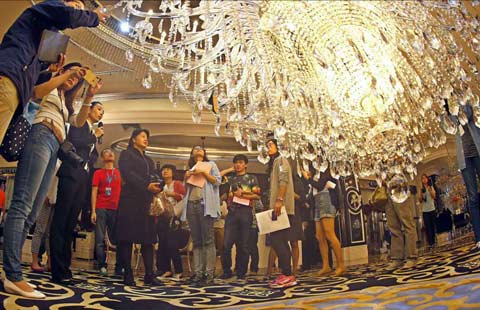
Visitors check out products at the annual Private Label Fair in Shanghai last month. Retailers in China have started to stock their shelves with more private label brands from Chinese manufacturers. Provided to China Daily |
Chinese retailers are increasingly looking to sell private label products to gain an edge
Rene Pieter Bulthuis recently went hunting for razors and blades in Shanghai, despite being freshly shaven and couth. He spent all day in and out of stores, including Wal-Mart, Lotte Mart and Tesco, but couldn't find what he was looking for. Amid the fleet of Gillettes and big name brands, he was searching for something cheaper - that elusive private label.

Bulthuis is the CEO of Feintechnik, a German manufacturer of razors and blades, and like many executives of foreign manufacturers, he sees an opening for his products.
"Although the private label is still a little bit too early for the Chinese market, I have seen the opportunity of expanding my business in this marketplace," he says.
While private label products, which are manufactured or provided by one company for another company's brand and are generally cheaper in price, are popular among consumers in the United States, claims Deloitte, they have been slow to develop in China.
But retailers in China, where only foodstuffs are commonly sold under private labels, are branching into new product territory. They are starting to stock their shelves with more private label brands from Chinese manufacturers, who have begun to shift away from making cheap products for overseas retailers.
From January to September last year, China totaled 14.94 trillion yuan ($2.4 trillion; 1.84 trillion euros) in retail sales of consumer goods, according to the Ministry of Commerce. But total sales of private label brands have been miniscule since the Shanghai Kaikai Department Store introduced its own line of apparel in 1987.
"In China, private labels just account for less than 5 percent of all supermarket sales," says Brian Sharoff, president of the US-based Private Label Manufacturers Association.
In five European countries, including Spain, the United Kingdom and Germany, sales of private label products make up more than 40 percent of total sales at supermarkets. In the US, total sales of private labels in supermarkets came in at $59.9 billion (45.95 billion euros), according to the Nielsen Company, for the 52-week period ending Dec 24, 2011. That is an increase of $2.9 billion on the previous year.
"In Western countries, the economic recession has attracted new customers looking for cheaper prices and good quality. They are not just focusing on international brands," Sharoff says.
In emerging markets, however, consumers are still hunting for top brands and are not fully aware of private labels. That has opened a path for overseas retailers, manufacturers and suppliers.
Metro Cash and Carry, the German self-service wholesale retailer, has opened 50 stores in China since its first store in Shanghai in 1996. Seven years ago, it began offering more private label products in China.
Sharoff says that retailers who are looking to differentiate themselves from competitors and are aiming to build customer loyalty should venture out with private labels.
"We have developed six private label brands in our stores and sales (of private label products) now account for 14 percent of our total turnover, while profits from private label products are over 30 percent," says Yang Weixin, head of a management department at Metro Jinjiang Cash and Carry Co.
Metro Cash and Carry is aiming to ramp up private label offerings by 20 percent in less than five years. When it comes to choosing a supplier, Yang says they tend to work with overseas companies that produce foods, such as milk, that Chinese domestic producers have had a poor history of producing because of numerous food safety scandals.
"The reputation of imported goods is better compared with local manufacturers," Yang says.


Copyright 1995 - . All rights reserved. The content (including but not limited to text, photo, multimedia information, etc) published in this site belongs to China Daily Information Co (CDIC). Without written authorization from CDIC, such content shall not be republished or used in any form. Note: Browsers with 1024*768 or higher resolution are suggested for this site.
License for publishing multimedia online 0108263 Registration Number: 130349