|
 |
|
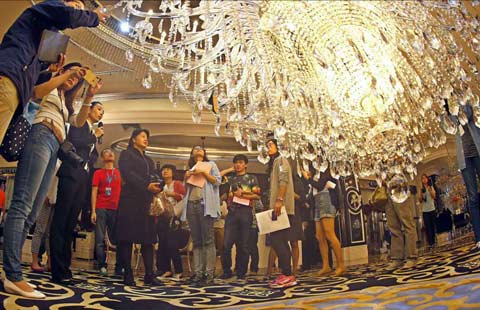
Visitors to the Beijing Marco Polo Cultural and Creative Industrial Park look at a jade carving that is believed by many to bring good luck to those who rotate it. [Photo/China Daily] |
Service sector crucial
By August, the emerging industry had brought more than 1 million job opportunities to Chaoyang district. In 2011, it generated more than 43 billion yuan in added value, around 14 percent of the district's GDP for that year.
The boom in the cultural and creative industries in Chaoyang district is a typical example of the capital's efforts to get the service sector to play a greater role in the city's economic growth.
The cultural and creative industries in Beijing had 900 billion yuan in total revenue in 2011, an amount equal to around 12.1 percent of the capital's GDP.
Beijing's GDP rose by 7.5 percent year-on-year from January to September. At the same time, the quality of Beijing's GDP put the capital at the top of a list of 50 Chinese cities, including Shanghai, Tianjin and Shenzhen, according to a survey published by the Chinese Academy of Sciences on Nov 1.
"Beijing's slow economic growth in recent years results from its restructuring of its model of economic growth, which has made this a difficult time to move out of low-end manufacturing industries and retain high-tech industries," said Chen Ji, head of the industrial research institute at the Capital University of Business and Economics in Beijing.
Shougang Group, Beijing's largest steelmaker and China's fourth-largest one, stopped production and moved its manufacturing base to neighboring Hebei province in 2005.
Zhou Qingjie, a researcher from the School of Economics of Beijing Technology and Business University, said tertiary industries - mainly service industries - are the source of more than 75 percent of Beijing's GDP.
Tertiary industries have been less affected by the slowing of the country's economic growth and this "is an important reason for the capital to reverse its economic growth slowdown ahead of other cities", Zhou said.
"Beijing's economic growth has passed a surging period and entered a phase of steady growth, which is mainly driven by the service sector, while large-scale investment in urban infrastructure keeps being reduced," said Zhao Hong, deputy head of the Beijing Academy of Social Sciences. "The service sector will keep the city's economy growing at a steady pace, although it will not be an obvious driver of economic growth, as manufacturing was."
The city's GDP growth is expected to gain momentum in the fourth quarter, helping the city meet its goal of having 8 percent growth for 2012, according to Yu Xiuqin, spokeswoman for the Beijing Municipal Bureau of Statistics.
China is in the midst of changing its chief sources of economic growth. It is trying to rely less heavily on investment and more on domestic demand. Service industries, including the cultural and creative sectors, will play an important role in the change.
"Low costs in China have led to great economic and social progress in the past few decades," said Zhang Monan, an economics researcher at the State Information Center. "But now that it has reached a certain level of development, it should transform its means of economic growth."
Cheng Shi, a researcher at the ICBC City Finance Research Institute in Beijing, said "the country should further open up its public-service industries, resources, healthcare and education to lay the foundation for the long-term development of the market economy."
Statistics from the Ministry of Commerce show that foreign direct investment into China's services industries, excluding real estate, increased by 2.1 percent year-on-year in the first 10 months of 2012. Total FDI to China in the same period dropped by 3.45 percent year-on-year, suggesting that global investors are optimistic about the service sector's prospects.
Contact the writer at lijiabao@chinadaily.com.cn


Copyright 1995 - . All rights reserved. The content (including but not limited to text, photo, multimedia information, etc) published in this site belongs to China Daily Information Co (CDIC). Without written authorization from CDIC, such content shall not be republished or used in any form. Note: Browsers with 1024*768 or higher resolution are suggested for this site.
License for publishing multimedia online 0108263 Registration Number: 130349