Shipbuilding industry faces severe test amid sluggish global market
Shanghai Shipping Exchange launched the mainland's first dry bulk and oil import indices on Wednesday, to track bulk carrier and tanker trades with the world's largest consumer of commodities.
Officials said the China dry bulk import index and the China oil import index will provide better insight into shipping prices, and cater for the growing demands of businesses who need to have quick access to the latest shipping prices in China's domestic market.
|
 |
|
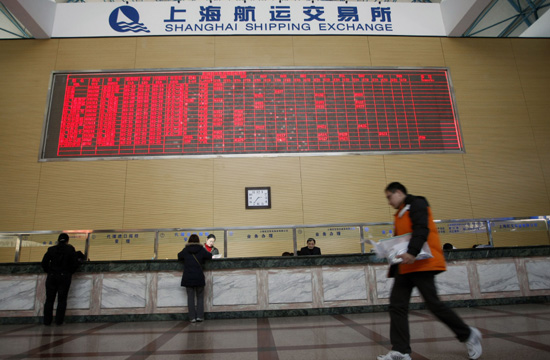
Customers complete transactions at the Shanghai Shipping Exchange. The exchange has launched new indices on dry-bulk and oil imports to provide a better insight into shipping prices. [Photo/China Daily] |
The new indices will also give China more say in the under-pressure global shipping market, the exchange added, especially as Shanghai continues its quest to become one of the leading international shipping centers.
Xu Guang, chief engineer with the Ministry of Transport, said that Shanghai plans to become an international shipping center equipped with the best global shipping resources by the end of 2020, and the launch of the indices marked a milestone on its way to that.
The global shipping industry has been facing difficult times in recent years, and as demand remains sluggish, a key to recovery will be to explore opportunities to strive for innovation and enhance service quality, said Xu.
Zhang Ye, president of the exchange, said the two indices differ from the Baltic Dry Index or BDI - a number issued daily by the London-based Baltic Exchange which represents the cost of hauling dry freight over the world's oceans - in various ways, and will not aim to compete with it.
"Demand from China has a significant impact on the global shipping market. However, without our own indices, we can only rely on the BDI as a reference of quotes," said Zhang.
In 2011, iron ore imported to China accounted for 63 percent of world iron ore shipments, and some 75 percent of that in Asia.
Shipments of soybeans into China accounted for about 60 percent of the world market, according to figures from the exchange.
The indices launched on Wednesday will target users in China, and are compiled with quotes from three parties - carriers, freight brokers and cargo owners - to provide accurate market trends, said Zhang.
The exchange launched China's containers freight index in 1998.
The introduction of the two new indices means the exchange can provide detailed information on shipping prices of all major routes into China, including monitoring the movement of the country's four key commodities of coal, ore, grain and oil.
China's shipping industry faces a severe test in today's sluggish global market, none more so than its shipbuilders, with many of the country's shipyards closing, according to Chen Qiang, chairman and chief executive officer of China Rongsheng Heavy Industries Group Holdings Ltd.
Production at Chinese yards declined steeply during the first quarter of the year, and the mounting costs of materials and labor have added huge pressure on builders, he said.
Chen added the rising price of crude oil and shrinking demand for ocean shipping, have also made shipowners reluctant to order new vessels.
According to the latest data from the Ministry of Industry and Information Technology, completed ship capacity by builders dropped by 18.5 percent to 41.58 million deadweight tons in the first three quarters of 2012 compared to last year, and new orders decreased by 46.9 percent year-on-year to 15.41 million deadweight tons.
Chinese yards' order books stood at 121 million deadweight tons at the end of September, down 19.4 percent from the amount at the end of 2011.
During the 12 months to June 2012, several shipbuilders in the Yangtze River Delta, one of the country's traditional shipping hubs, went bankrupt, said Xinhua News Agency.
Chen said shipbuilders must find ways of enhancing production efficiency and developing markets around the world, including introducing new vessels aimed particularly at the demands of high-end market.
Zhang, meanwhile, added that the exchange will also research and develop financial products aimed at the industry, based on the two new indices.
"We have been developing derivatives based on the indices, and will introduce them as conditions mature," he said.
wuyiyao@chinadaily.com.cn


Copyright 1995 - . All rights reserved. The content (including but not limited to text, photo, multimedia information, etc) published in this site belongs to China Daily Information Co (CDIC). Without written authorization from CDIC, such content shall not be republished or used in any form. Note: Browsers with 1024*768 or higher resolution are suggested for this site.
License for publishing multimedia online 0108263 Registration Number: 130349