Discovery of deposit aids national supply amid nuclear power drive
Despite Sunday's announcement that China has found a large uranium ore deposit in the Inner Mongolia autonomous region, energy experts are saying the discovery won't lead to the country's importing less of the radioactive material.
That's especially true, they said, as the country works to resume previously stalled nuclear energy projects.
"In the coming years, China's demand for the radioactive ore will surge with the booming development of nuclear power," said Lin Zong, a researcher at the Development and Research Center of the China Geological Survey.
"The deposit won't reduce the country's imports of uranium."
He said uranium is a substance of strategic importance to China. The more of it the country has, the better, he added.
The Ministry of Land and Resources said on Sunday that a large leaching sandstone-type uranium deposit had been discovered in Inner Mongolia.
The deposit, the largest found so far in China to contain that type of uranium, is in the Daying areas of central Inner Mongolia, the ministry said.
The discovery will help increase the country's supply of uranium and ensure energy sources for nuclear power exist, the ministry said, without elaborating.
The site was discovered along with a "super-size" coal deposit estimated to contain 51 billion tons of coal, the ministry said.
The discovery gives evidence of the country's efforts to encourage the practice of exploring for coal and uranium simultaneously as a way to save costs, it said.
A team consisting of 500 technicians and builders from nuclear power companies and related government departments was sent to conduct the 10-month exploration after the site was tested during the drilling to detect radioactivity.
According to a 2012 white paper on the country's energy policy, which was released in October, the country is expected to have 40 million kilowatts of installed nuclear capacity by 2015, leading it to consume at least 7,500 tons a year of natural uranium.
China now produces about 1,000 tons of uranium a year, said Kevin Jianjun Tu, a senior associate at the Washington-based Carnegie Endowment for International Peace, where he directs Carnegie's work on China's energy and climate policies, in a previous report.
The World Nuclear Association estimates China will be using 20,000 tons of uranium a year by 2020, about a third of the global output in 2009.
The newly discovered uranium deposit comes as a sign that China can increase its domestic uranium supplies and secure the fuel needed to develop its nuclear programs, according to the Ministry of Land and Resources.
Yan Weidong, deputy director of the management and development division of the Ministry of Land and Resources' information center, said plans haven't been made to recover resources from the deposit, but the discovery will definitely influence the price of uranium and decrease the country's dependence on imports.
In general, the price of uranium fluctuates from tens of dollars per half a kilogram to $130 per half kilogram.
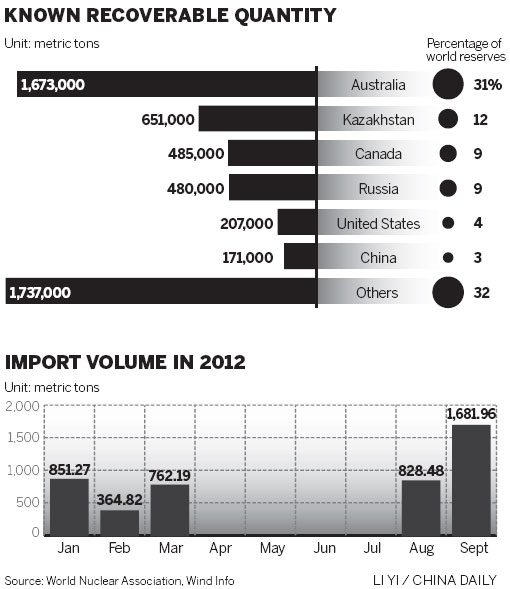
China imported 16,126 tons of uranium in 2011, 6 percent fewer than the 17,135 tons it imported in 2010, according to data from the General Administration of Customs.
The country buys 95 percent of its uranium from Kazakhstan, Namibia, Australia and Uzbekistan.
Besides purchasing foreign uranium, China's nuclear companies have been seeking opportunities to mine uranium abroad.
In March, China Guangdong Nuclear Power Group and the China-Africa Development Fund agreed to buy the Australian mining company Extract Resources Ltd for $2.3 billion in order to gain access to the world's fourth-largest deposits of uranium, which are in Namibia.
Xinhua contributed to this story.
Contact the writers at wangqian@chinadaily.com.cn and dujuan@chinadaily.com.cn?


Copyright 1995 - . All rights reserved. The content (including but not limited to text, photo, multimedia information, etc) published in this site belongs to China Daily Information Co (CDIC). Without written authorization from CDIC, such content shall not be republished or used in any form. Note: Browsers with 1024*768 or higher resolution are suggested for this site.
License for publishing multimedia online 0108263 Registration Number: 130349