Comments()
  Print
Print  Mail
Mail  Large Medium Small
Finding a recipe for confidence in what we eat on a regular basis
It seems there is at least one media story about food safety incidents every month in China.
Last year, several scandals were exposed, including restaurants serving food cooked with "gutter oil" - cooking oil recycled from kitchen waste, decomposed animal fat and organs from slaughterhouses - as well as melamine-tainted baby formula milk and pork contaminated with the weight-loss drug clenbuterol.
|
 |
|
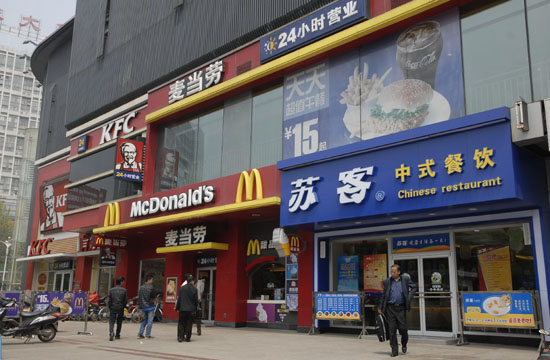
Fast food companies compete in Zhenjiang, Jiangsu province. Food safety has become the top concern when Chinese people choose eateries. [Photo/China Daily] |
As a consequence, food safety has become a controversial issue in China, both for consumers and food makers. Food companies in China and abroad have stepped up their efforts to guarantee quality, especially with regard to identifying its source.
Mengniu, the country's largest dairy producer, invested 2.4 billion yuan ($380 million) and opened two operations in Hebei province in August. One of the two plants includes a dairy farm - the first in the country where milk products are produced alongside the cows that produce the milk.
"The new plant is in line with the strategy of China Oil & Foodstuffs Corporation, Mengniu's largest shareholder, which aims to complete the whole industry chain," said Gong Bo, an industry analyst with Beijing United Innovation Capital Ltd. "The move will benefit Mengniu's market competitiveness and profit margin. At the same time, Mengniu will have direct management of the farm, which helps to provide safe and good quality milk."
In a similar move, McDonald's Corp, the world's largest fast food restaurant chain, is closely cooperating with long-term suppliers.
It has long invested in its supply chain. In China, the company cooperates with Beijing Fuxi Food Co Ltd, which provides beef and chicken for hundreds of McDonald's outlets in northern China. In the United Kingdom, OSI Food Solutions Ltd is the exclusive supplier of beef patties to McDonald's. It has been the US fast food giant's supplier for more than 40 years.
According to OSI, all McDonald's burgers are made from 100 percent whole cuts of beef and all the meat is checked for bone and gristle to ensure that none finds its way into patties.
It says the meat is then minced, shaped and frozen to make beef patties. Nothing is added to the meat - no binders, fillers or preservatives.
"We can trace our beef back to the farms where it was produced so we know exactly how the animal was reared. Traceability is essential to ensure our customers have confidence in the safety and origin of the food we serve. From countryside to counter, we keep traceability going every step of the way," said Peter Mitchell, purchasing manager of OSI.
A recent report conducted by Ipsos, an international market research company, shows that more than 60 percent of customers choose foreign rather than Chinese brands. In the opinion of experts this shows the Chinese have little confidence in domestic food companies and that they have done too little in publishing and sharing food safety information.
"Domestic food brands still have plenty of opportunities if they concentrate on quality. Once the quality is guaranteed, the price and psychological advantage can help them," said Kevin Zhou, vice-president of Ipsos China.
"At the same time, domestic food makers should communicate with consumers more than ever, release more information about the manufacturing process to the public and should try to build customers' trust in them," Zhou added.
Industry experts said China's food-safety problems also highlight the failure of government regulation and supervision as it seeks to expand the market economy.
In June, the Ministry of Health joined hands with 13 other government departments, including the Ministry of Agriculture, to release a five-year plan to upgrade food safety regulations.
According to the plan, the government will prioritize safety standards for dairy products, infant food, meat, alcohol, vegetable oil, seasonings, health products and food additives to specify limits for dangerous ingredients. Moreover, the government will make a special effort to set standards for testing various contaminants, food additives, microorganisms, pesticides and animal drug residue in food production by 2015.
In July, The State Council released a statement on its website that said the government will establish a better regulation mechanism, legal and standards systems, as well as technical support systems, to improve overall food safety management in about five years.
liwoke@chinadaily.com.cn

 Domestic auto lineup looks overseas
 Electric car industry in the slow lane
 Brighter days for solar power
 Market flat, Japan-brand sales plummet
Copyright 1995 - 2010 . All rights reserved. The content (including but not limited to text, photo, multimedia information, etc) published in this site belongs to China Daily Information Co (CDIC). Without written authorization from CDIC, such content shall not be republished or used in any form. Note: Browsers with 1024*768 or higher resolution are suggested for this site.
License for publishing multimedia online 0108263 Registration Number: 20100000002731